


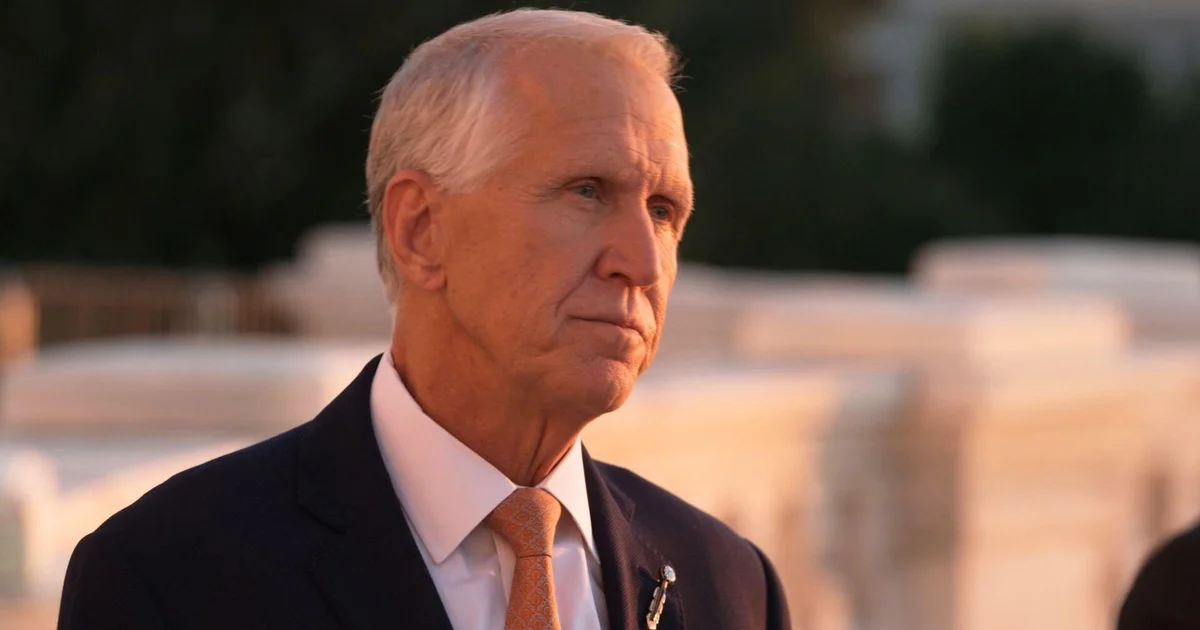
Republican senator Thom Tillis has warned that the United States could end up with “a sort of dictator king” unless Congress reasserts its authority over the executive branch, as he prepares to leave the Senate.
The North Carolina senator, who has served during the presidencies of Barack Obama, Joe Biden and Donald Trump, has also criticised what he describes as the “sycophants” surrounding Mr Trump.
In his new book, How to Lose Friends and Antagonize Presidents, Mr Tillis details what he calls the “WTF moments” of Mr Trump’s second administration and argues that America’s system of checks and balances is under growing strain.
Thom Tillis warns of authoritarianism
Mr Tillis said presidents from both parties had increasingly relied on executive orders while failing to treat Congress as an equal branch of government.
“We always make the mistake when our guy’s in office of conveying power to the White House,” he said. “And I’ve had a real problem with that because it almost always comes back to bite you.”
He said there had been a “constant escalation” across four administrations in presidents ignoring Congress, warning that the public could underestimate how quickly democratic safeguards could be lost.
“I want checks and balances. I want all three branches to have their individual role and continue to check power as they have for 250 years,” Mr Tillis said.
First elected in the 2014 midterm elections, Mr Tillis said his conservative views had not changed. He described himself as pro-Second Amendment, pro-life and supportive of limited government and fiscal restraint.
“The only difference between me and a lotta people that call themselves true conservatives is I got a long list of things that were ratified and they don’t,” he said.
His departure from Washington follows a public clash with the White House over Mr Trump’s One Big Beautiful Bill Act. Mr Tillis said in June 2025 that he would vote against the legislation because he believed it would push too many low-income people in North Carolina off Medicaid.
Mr Trump responded by calling him “a talker and complainer, not a doer” and threatened to support a primary challenger. Mr Tillis subsequently decided to retire rather than fight to retain his seat.
Criticism of Trump administration advisers
Although Mr Tillis voted to confirm all of Mr Trump’s Cabinet nominees, including Defence Secretary Pete Hegseth, he now describes that vote as his “biggest regret”. He has since called for Mr Hegseth to be dismissed.
Mr Tillis said he supported Mr Trump’s decision to act against Iran but believed Mr Hegseth may have failed to heed military advice after the first strike.
He has also attacked former Homeland Security adviser Kristi Noem, Health Secretary Robert F Kennedy Jr, Commerce Secretary Howard Lutnick and White House deputy chief of staff Stephen Miller, accusing them of failing to “look around corners” for the president.
Mr Tillis said Ms Noem and Mr Hegseth were “poster children for men and women who should never have the authority they’ve been granted”. He had previously criticised Ms Noem over her handling of the deaths of Renee Good and Alex Pretti in Minneapolis; two days later, Mr Trump fired her.
His position on the administration has been complicated by his continued support for Mr Trump in some areas. Mr Tillis has said he wants the president to succeed, while blaming advisers and senior officials for decisions he opposes.
He has also described the 6 January 2021 attack on the Capitol and the threat to the peaceful transfer of power as “despicable”. However, he did not vote to convict Mr Trump during the former president’s second impeachment trial, saying the process had been rushed and politicised.
“Cheapening the impeachment process to prevent somebody from running in the future, I just don’t buy it,” he said.
Warning over the midterm elections
Mr Tillis said he feared a Jan. 6-style reaction if candidates backed by Mr Trump lost their elections in the midterms.
“I think there’s a risk. I really do,” he said, calling such an outcome “another unforced error”. He predicted Republicans faced an “electoral bloodbath”, with affordability issues likely to concern voters.
According to Mr Tillis’s book, at least 30 Republican senators have privately expressed reservations about Mr Trump’s actions but remain reluctant to challenge him publicly because they fear being targeted in primary contests.
“They don’t want to bear the weight of the president,” Mr Tillis said. “You’re up for reelection? He’ll target you in a primary.”
