


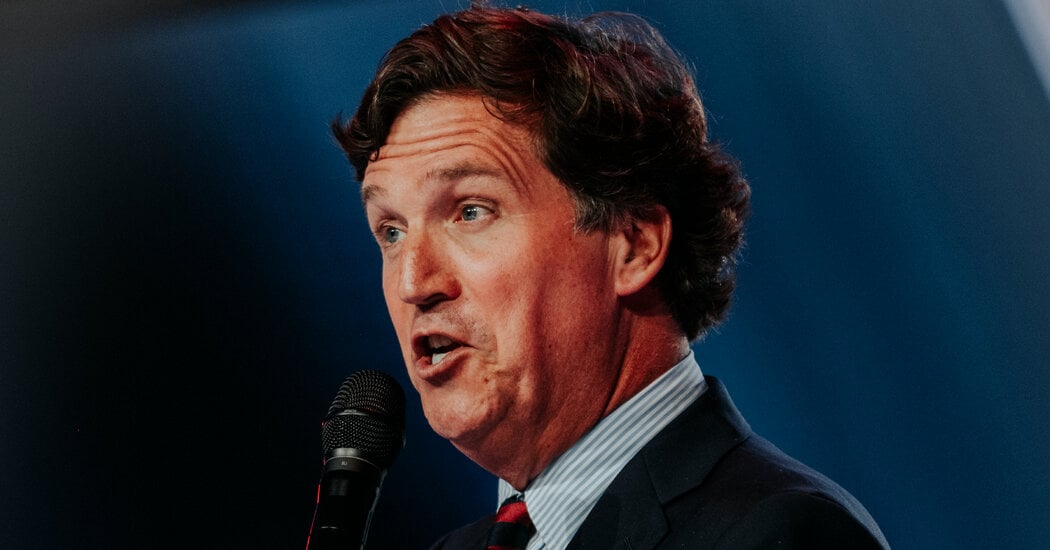
Tucker Carlson has emerged as an unlikely defender of Abdul El-Sayed, the Democratic Senate candidate in Michigan, while launching a sustained attack on his Republican opponent, Mike Rogers.
Mr Carlson, a prominent far-right podcaster who has spent much of his career defending the Republican Party, has praised Dr El-Sayed’s criticism of US military intervention and Israel. He has simultaneously described Mr Rogers as a symbol of what he calls the “cruelty and stupidity of the national security state”.
The intervention has prompted speculation that Mr Carlson is effectively backing Dr El-Sayed, a progressive candidate campaigning for universal healthcare and the abolition of Immigration and Customs Enforcement. Mr Carlson rejected that interpretation, saying: “I’m a podcaster. I don’t make endorsements.”
His support followed criticism from Mr Rogers over comments Dr El-Sayed made in 2021, when he said US military actions after the September 11 attacks had “scarred millions” around the world.
Mr Carlson defended the Democrat in a newsletter, writing: “El-Sayed did not celebrate airplane hijackings or cheerlead Al Qaeda, he simply said that the U.S. conducting terrorism of its own in response to 9/11 was not exactly an appropriate reaction. He is obviously right.”
He has also attacked Mr Rogers over his support for Israel and his earlier backing for the war with Iran. “I wouldn’t vote for Mike Rogers at gunpoint,” Mr Carlson said on his podcast, adding: “There’s no one who should be farther from a position of power than Mike Rogers.”
Mr Carlson later called Mr Rogers “a toady to Israel and an enemy of civil liberties” and said he could “hardly believe Republicans nominated him”. Mr Rogers’s campaign did not respond to requests for comment.
The two men remain sharply divided on many issues. Dr El-Sayed is the son of Egyptian immigrants and has made opposition to US aid to Israel a central part of his campaign, while Mr Carlson is known for nativist rhetoric and has promoted conspiracy theories. He has also faced accusations of antisemitism, which he has denied.
Aryeh Tuchman, director of the Nexus Center for Antisemitism Research and a former director of the Anti-Defamation League’s Center on Extremism, said Dr El-Sayed’s criticism of Israel could make some Jewish people feel “unsafe”. But he said Mr Carlson’s opposition to Israel was linked to “classic antisemitic ideas”.
Political observers have described the relationship between Mr Carlson and Dr El-Sayed as an example of a possible “horseshoe alliance”, in which opposing ends of the political spectrum converge on particular issues. Josh Pasek, a professor of political science and communication at the University of Michigan, said the apparent alignment was more likely a “marriage of convenience” than evidence that the two sides shared the same beliefs.
Their common ground centres on opposition to interventionist foreign policy and criticism of the Israeli government. Mr Carlson left the Republican Party this year over his opposition to the war with Iran and has said he is “tormented” by his role in helping Donald Trump return to the White House.
Mr Carlson’s position has changed since the 2024 election, when he was frequently alongside Mr Trump and lobbied for JD Vance, then a senator from Ohio, to become his running mate. He has since discussed helping to create a new political party that would support ending all immigration.
Democratic strategists believe Mr Carlson’s attacks could help Dr El-Sayed reach conservative voters disillusioned with Mr Rogers. Joe DiSano, a Michigan Democratic strategist who does not intend to vote for Dr El-Sayed because of his views on Israel, said the intervention offered the Democrat a “clear advantage”.
Adrian Hemond, another Democratic strategist, said it was difficult to assess the impact of Mr Carlson’s commentary. Dr El-Sayed’s campaign had sought to alter the make-up of the electorate and had done so to some extent in the primary, he said, but repeating that result in November would be more difficult.
Dr El-Sayed has nevertheless ruled out bringing Mr Carlson on to the campaign trail. Asked about the possibility on the “Pod Save America” podcast, he replied: “Unlikely — by unlikely, I mean no.”
He said Mr Carlson was drawing attention to the “corruption inside MAGA”, while acknowledging that they disagreed on “a lot of things”. But he said they shared the view that Mr Rogers “never saw a war he didn’t like” and never saw a “corporate contribution he didn’t like”.
