


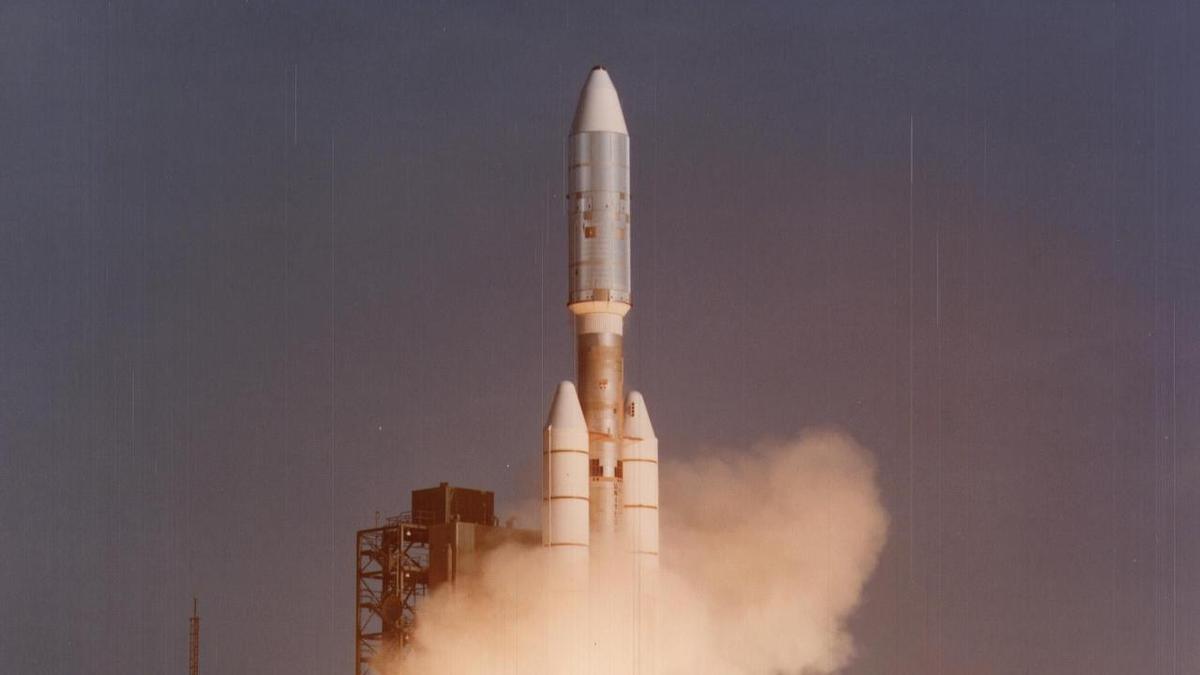
Voyager 1 is set to become the first human-made object to travel one light-day from Earth, marking another milestone for the spacecraft as it continues its journey through interstellar space.
The probe, launched 49 years ago, will reach the distance on Wednesday. At more than 26 billion kilometres from Earth, its radio signals will take 24 hours to arrive, travelling at the speed of light.
NASA project manager Suzanne Dodd described Voyager 1 as an ambassador from Earth travelling between the stars. “It’s a national treasure,” she said. “Really extraordinary.”
NASA has invited people to mark the occasion on Tuesday evening by using a phone or torch to create a wave of golden light after sunset. Participants are being encouraged to use Morse code to spell out “V-G-R”, Voyager 1’s call sign, in the night sky.
Voyager 1 continues sending data from interstellar space
Despite occasional problems associated with its age, Voyager 1 and its twin, Voyager 2, are still transmitting science and engineering data while travelling at about 61,000 kilometres per hour towards different regions of space.
Voyager 1 passed Jupiter and Saturn in 1979 and 1980 before reaching what NASA defines as interstellar space in 2012. Voyager 2 visited those planets as well as Uranus and Neptune, returning images before entering interstellar space in 2018.
Although Voyager 2 was launched two weeks after its twin, it is not expected to reach one light-day from Earth until 2035. NASA estimates Voyager 1 will need another 18,000 years to travel one light-year, and more than twice that time before coming close to another star.
