


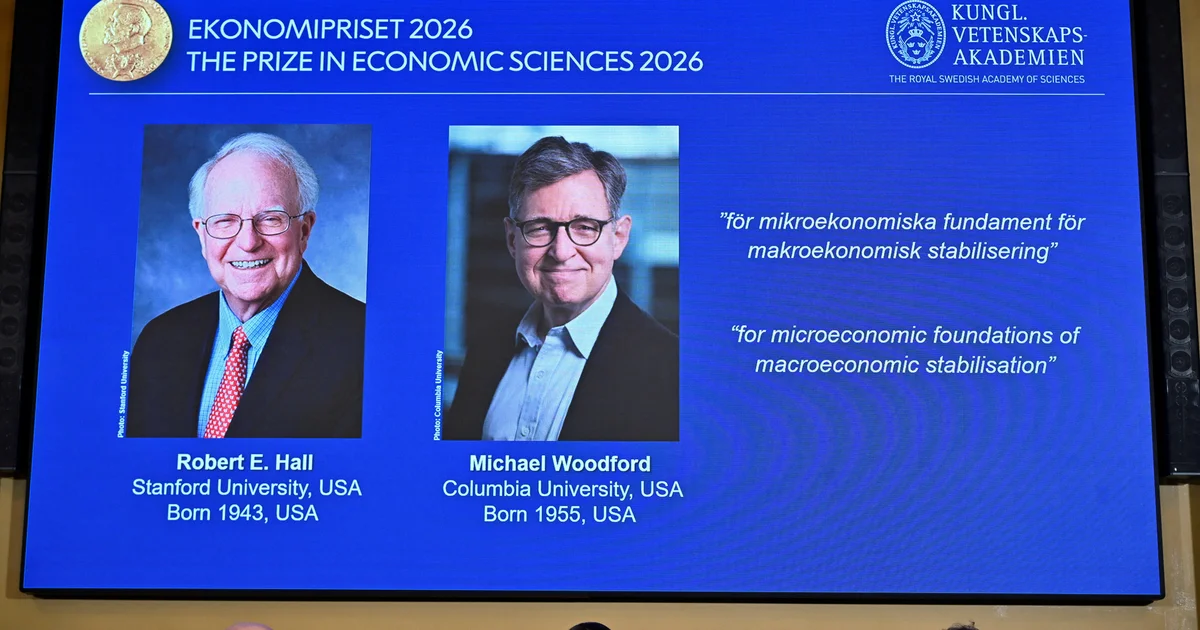
Robert E. Hall and Michael Woodford have won the 2026 Nobel economics prize for work that has helped governments and central banks respond to economic shocks.
The Royal Swedish Academy of Sciences said the American-born economists were being honoured for their “microeconomic foundations of macroeconomic stabilisation”, providing a stronger basis for policies designed to soften economic peaks and troughs.
Hall, 83, is affiliated with Stanford University in California, while Woodford, who was born in 1955, is affiliated with Columbia University in New York.
Speaking by telephone to the prize committee from New York, Woodford said: “It’s a tremendous honor, it’s a surprise.”
John Hassler, chair of the Committee for the Prize in Economic Sciences, said the pair had provided “a stable theoretical foundation” for models used by central banks and governments around the world.
“With them, we are better equipped to deal with shocks in the economy, such as energy crises or sudden changes in how much households consume,” he said.
The economists behind modern stabilisation policy
For decades, policymakers responding to economic shocks drew on the ideas of British economist John Maynard Keynes, including cutting taxes and increasing public spending to encourage consumption and investment.
But the economic turmoil of the 1970s exposed the limits of straightforward assumptions about the relationship between inflation and unemployment. The period of “stagflation”, in which both were high, showed that the traditional approach was too simplistic.
Hall and Woodford developed models that took greater account of how households and businesses make decisions about spending, saving and investment. Their contributions helped establish a new foundation for economic stabilisation policy.
“The laureates have helped us smooth out the economy’s peaks and troughs,” the academy said.
The economics award is formally known as the Bank of Sweden Prize in Economic Sciences in Memory of Alfred Nobel. It was established by Sweden’s central bank in 1968 as a memorial to Alfred Nobel, the 19th-century businessman and chemist who founded the five original Nobel Prizes.
The prize carries 12 million Swedish kronor, worth about $1.2 million, whether awarded to an individual, a small group of laureates or an organisation.
Last year, three researchers studying business innovation won the award for explaining how new products and inventions promote economic growth and human welfare, even as older companies are displaced.
