


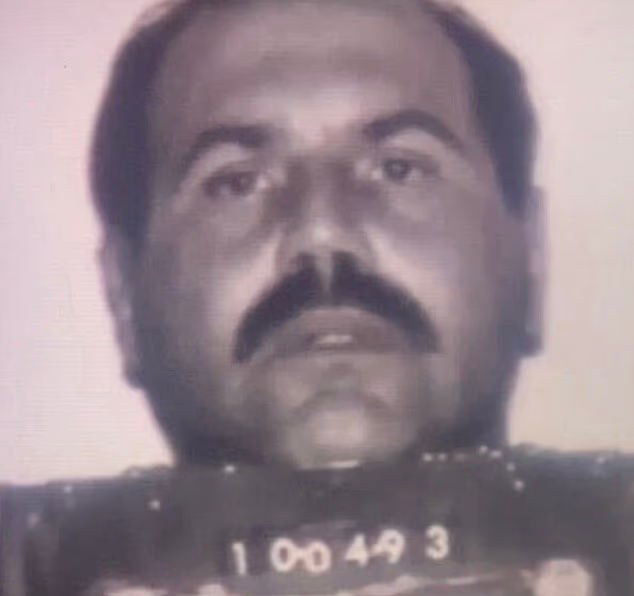
A newly unsealed federal court letter says an informant described as “extremely reliable” gave investigators information about the disposal of the knife allegedly used to kill Nicole Brown Simpson and Ronald Goldman in 1994.
The document also refers to claims about OJ Simpson’s alleged domestic violence and the former couple’s purported narcotics use. It does not disclose whether Joseph “Joey” Ippolito implicated himself or anyone else in the killings, or provide specific details about the weapon.
Simpson was acquitted of the murders in 1995, although he was later found liable for the wrongful deaths in a civil case. He continued to deny involvement until his death from cancer in 2024, aged 76.
The letter was written in support of a more lenient sentence for Ippolito, a convicted drug trafficker and prison escapee who had become a federal informant. An assistant US attorney told a judge that Ippolito was “privy to many facts” connected to the murders.
Those facts allegedly included “Mr Simpson’s alleged domestic violence, the Simpsons’ narcotics usage, Mr Simpson’s attempted flight from justice, and his disposal of the murder weapon”.
The letter said Ippolito was arrested and began co-operating as Simpson’s criminal trial was drawing to a close. It added that conversations with Los Angeles authorities indicated his information had been “at the very least, very helpful to their case”, although he was never called as a witness.
Ippolito, who owned a restaurant in Santa Monica, died in 2006. His brother Sam has given differing accounts of the night Brown and Goldman were killed in the Brentwood area of Los Angeles.
One account attributed to Sam said the brothers were staying in West Hollywood when Joey left to help a friend, returning with what appeared to be blood on his hands and a bag containing a heavy object. Sam later denied making that statement, saying Joey was hiding at the time and had not been out after 10pm.
The murders are believed to have happened after 10pm on June 12, 1994. Sam has also denied asking for money in connection with his account.
Ippolito was closely associated with Al Cowlings, Simpson’s friend and former team-mate. Cowlings was driving the white Ford Bronco in which Simpson was a passenger during the widely watched low-speed police pursuit on June 17, five days after the killings.
According to the unsealed material, Ippolito later received credit for time served after the government agreed not to prosecute him over drug distribution in California during the five years before his arrest. He was released in 1998.
Fresh claims over a possible accomplice
The disclosure has revived questions about whether Simpson acted alone. Tom Lange, the lead investigator, recalled seeing Ippolito’s name but said he had never regarded him as a serious suspect. Lange continues to believe Simpson committed the double murder alone.
The killings remain unsolved and the investigation is still open with the Los Angeles Police Department. The knife has never been recovered, helping to fuel speculation that another person may have been involved.
Jim Clemente, a former New York state prosecutor and FBI profiler, has backed the accomplice theory. Speaking on a podcast with media personality Tom Zenner and Kato Kaelin, a former Simpson tenant and witness at his trial, Clemente pointed to the defensive wounds on Goldman’s legs.
He said the cuts to Goldman’s clothing suggested his legs were raised as he fought back, while his arms were being restrained. “The only way that we behaviorally could figure out how that could happen is if somebody has him in a bear hug from behind and he’s being stabbed by somebody in the front,” Clemente said.
Clemente argued that Brown was the intended target and that Goldman may have arrived unexpectedly while returning glasses Brown had left at a restaurant. He described the attack as planned rather than a spontaneous crime, but stopped short of naming the alleged accomplice, saying only that he had a “pretty good idea” who it was.
Simpson’s defence lawyer, Johnnie Cochran, previously suggested that drug dealers might have been looking for Brown’s friend Faye Resnick, who was battling cocaine addiction, and could have been responsible for the killings.
However, at least one member of Brown’s family remains unconvinced by the theory. Her sister said she had heard the claims for years and regarded the idea of a conspiracy as “a bunch of BS”.
