


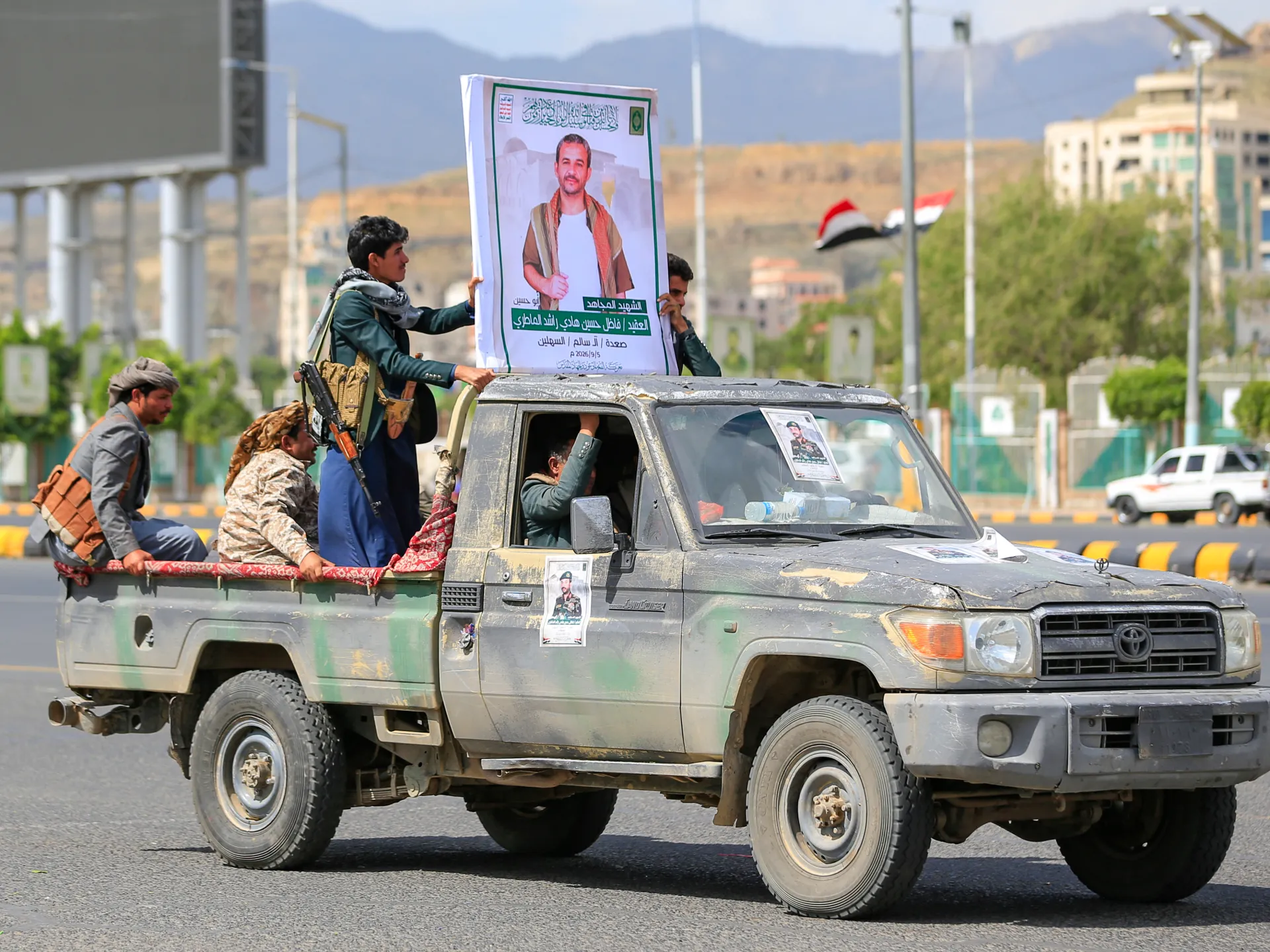
US-Houthi talks have taken place in Muscat after the Iran-aligned movement seized thousands of square kilometres in south-western Yemen, strengthening its control over islands, Red Sea coastline and the strategically vital Bab al-Mandeb Strait.
US officials met Houthi representatives at the American embassy in the Omani capital over the weekend. The group said it had no plans to attack US shipping in the Red Sea, although it warned that restrictions would apply to vessels linked to Saudi Arabia.
The assurance has done little to ease concern over disruption to two of the world’s most important shipping routes. Traffic through the Strait of Hormuz has already been restricted for six months, and any further interference could push oil and consumer prices higher.
Washington’s apparent willingness to accept the Houthi position, at least for now, reflects its reluctance to open another military front in Yemen while it remains engaged in an unresolved war with Iran.
Pressure on Washington to intervene
Saudi Arabia has urged the United States to take action against the Houthis. Crown Prince Mohammed bin Salman reportedly called Donald Trump twice last week to press for US strikes, but the president refused.
Admiral Brad Cooper, the commander of US Central Command, later travelled to Riyadh for urgent discussions with the crown prince. The visit indicated that Washington was seeking to strengthen support for Saudi Arabia without committing to direct military intervention.
Mr Trump described the crown prince as a “good friend” and said “everything will work out very well”, but the White House made no specific military commitment or explicit guarantee to protect Saudi energy infrastructure and shipping routes.
Military chiefs from Israel, Saudi Arabia, the United Arab Emirates, Bahrain, Kuwait, Qatar, Jordan and Egypt also attended a private meeting convened by the US, according to a report.
Israel has reportedly offered to intervene in Yemen on Saudi Arabia’s behalf, although Simon Mabon, a professor of international relations at Lancaster University, said any Israeli role would probably be limited.
“With elections coming up [in Israel], there comes a point when there is overreach,” Professor Mabon said. “In light of Gaza, Lebanon, Syria and the West Bank – as well as the question marks over Iran – Yemen could be a bridge too far.”
Saudi Arabia may also be wary of relying publicly on Israeli military support during the war in Gaza, as it could damage Riyadh’s standing across the Arab and Muslim worlds.
Professor Mabon said the US response risked deepening Saudi doubts about its long-standing security relationship with Washington. “This is another instance of the United States failing to fulfil its role as a security guarantor,” he said.
Saudi Arabia has been seeking alternative security partnerships since attacks on its oil infrastructure in 2018 and 2019 exposed the limits of US guarantees. It signed a mutual defence agreement with Pakistan last September, followed last month by the Mecca Joint Defence Agreement with Pakistan and Turkiye.
Those agreements state that an attack on one member would be treated as an attack on all three. Professor Mabon said the latest crisis was unlikely to cause a complete break with Washington, but could accelerate Riyadh’s efforts to diversify its security relationships.
Why the US is holding back on Yemen
The United States is already facing the financial and military demands of its war with Iran, which the Trump administration initially expected to end within days. More than six months later, the conflict remains unresolved and oil prices have risen.
Opening a new campaign in Yemen could create political difficulties for Republicans before November’s midterm elections, particularly after Mr Trump campaigned on ending US involvement in “forever wars”. A Reuters/Ipsos poll published last month found that 31 per cent of Americans supported military action against Iran, while 83 per cent expected the conflict to continue for an extended period.
There are also questions about the availability of US weapons. Reports in July said stocks of some critical munitions, including long-range missiles and Patriot interceptors, were running low.
A Pentagon watchdog report said the first four months of the war had cost $33 billion, including $22 billion in expended munitions. It said dozens of aircraft had been lost or damaged and that Iranian attacks had caused an estimated $184 million in damage to US diplomatic facilities.
The administration has denied that America is running short of weapons, insisting it retains “massive amounts” of military equipment. Around 50 military officers and civilian officials working with the Joint Staff were ordered to take lie-detector tests as officials sought to identify the source of leaks about readiness and weapons stocks.
“We know there are hugely depleted weapons stockpiles, which have prompted some US officials to urge a pause in the war on Iran,” Professor Mabon said. “When you put that together, it is probably the main reason Trump said no to MBS.”
Some analysts have suggested that disruption around Bab al-Mandeb could harm China more than the United States because the route is particularly important for trade to Asia. But attacks on Saudi infrastructure and shipping would also damage a close US ally, while higher transport and energy costs would eventually affect American consumers.
Professor Mabon rejected the idea that Mr Trump was deliberately tolerating disruption to weaken China or benefit US energy companies. “The potential closure of Bab al-Mandeb and strikes on the Saudi pipeline will hit major US allies harder than China,” he said.
With the United States already stretched by the conflict with Iran, its response to the Houthi advance suggests that the military, economic and electoral risks of another Middle Eastern war are weighing heavily on the administration.
