


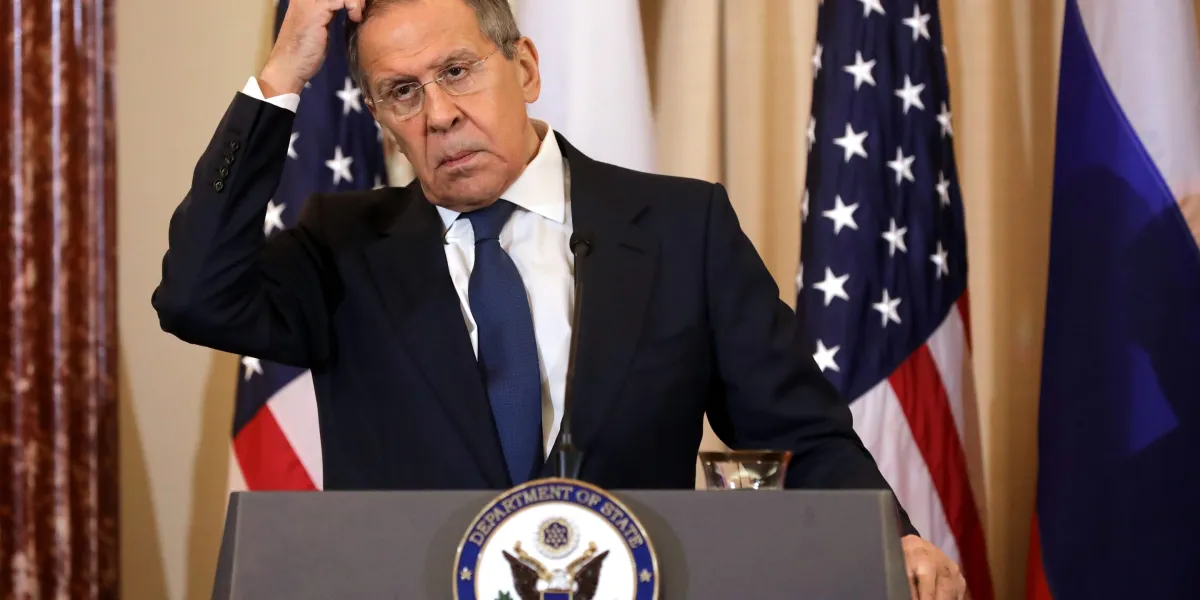
Plans for a traditional G20 group photo have been cancelled after European diplomats objected to being pictured alongside Russia’s Foreign Minister Sergey Lavrov at talks in Atlanta.
US Secretary of State Marco Rubio decided to abandon the photo session after concluding that the dispute would distract from the meeting, according to two US officials. The wider discussions will proceed as planned and are intended to prepare for a G20 leaders’ summit hosted by Donald Trump at his Miami golf club in December.
The cancellation of the G20 group photo has highlighted the divisions within the organisation over the war in Ukraine, the conflict involving the US and Israel and Iran, American tariffs and tensions in the South China Sea.
Opening the talks, Mr Rubio said he hoped they would be productive, describing the moment as one of choosing for the US and the wider world.
“We are facing a series of interconnected economic and geopolitical crises,” he said, adding that many posed “severe threats to essential foundations of the global economic order”.
Lavrov’s attendance causes tension among Western allies
Several G20 members had already raised concerns about Russia’s invitation, amid intensified attacks on Ukraine and Mr Trump’s efforts to improve relations with Vladimir Putin. Those efforts have included waiving fresh sanctions on Moscow and temporarily restricting logistical and intelligence assistance to Ukraine.
Poland’s deputy prime minister and foreign minister, Radosław Sikorski, said cancelling the photograph was “the right decision”. He told reporters in Atlanta: “I am not the only one who does not want to be photographed with Lavrov.”
Germany’s foreign minister, Johann Wadephul, said: “There is no normality with Russia,” but added that the disagreements had to be addressed at the negotiating table. “We also must not send falsely optimistic signals,” he said.
Russia’s Foreign Ministry said there had been difficulties securing visas for its delegation, which were resolved only at the last minute. Ministry spokeswoman Maria Zakharova said the problems had created the impression that “not everyone in Washington is happy” about Mr Lavrov’s attendance.
She said the Russian foreign minister would use the meeting to press for the “swift reform of global economic institutions”.
Ian Kelly, a former US ambassador to Georgia, said inviting Mr Lavrov appeared politically unwise and could make it harder for the G20’s Western members to present a united position on Ukraine.
“It seems politically boneheaded to invite him,” said Mr Kelly, who now teaches international relations and diplomacy at Northwestern University.
He said Republican lawmakers, who are concerned about losing their congressional majorities, were “cranky” with Mr Trump’s conciliatory approach to the Russian president.
South Africa excluded from meeting
Ukraine, which is not a G20 member, has attended previous meetings but was not invited this year after US officials chose to include only formal members of the group.
South Africa, a founding member and the organisation’s only African country, was also absent from the invitation list. The country has been involved in several disputes with the Trump administration, while senior US officials, including Mr Trump and Mr Rubio, stayed away when South Africa held the G20 presidency last year.
Phindile Kunene, a spokeswoman for South Africa’s foreign minister Ronald Lamola, said: “We have consistently maintained that our nonparticipation is not voluntary.”
She said South Africa welcomed support from other G20 members that had objected to its exclusion and was ready to participate “on an equal footing with other members” when Britain takes over the presidency next year.
The meeting is also expected to address freedom of navigation in the Strait of Hormuz, the Red Sea, the Black Sea and the South China Sea, with discussions covering Iran, Russia’s war against Ukraine and China’s relations with smaller neighbours.
However, the prospect of renewed US military action against Iran is casting a further shadow over the talks and has put countries in the region, including G20 member Saudi Arabia, on edge.
Elaine Dezenski, of the Foundation for Defense of Democracies, said the gathering would be a test of whether the US could build co-operation when consensus among all members appeared unattainable.
It remains unclear whether Mr Putin will accept Mr Trump’s invitation to attend the December summit in Florida.
