


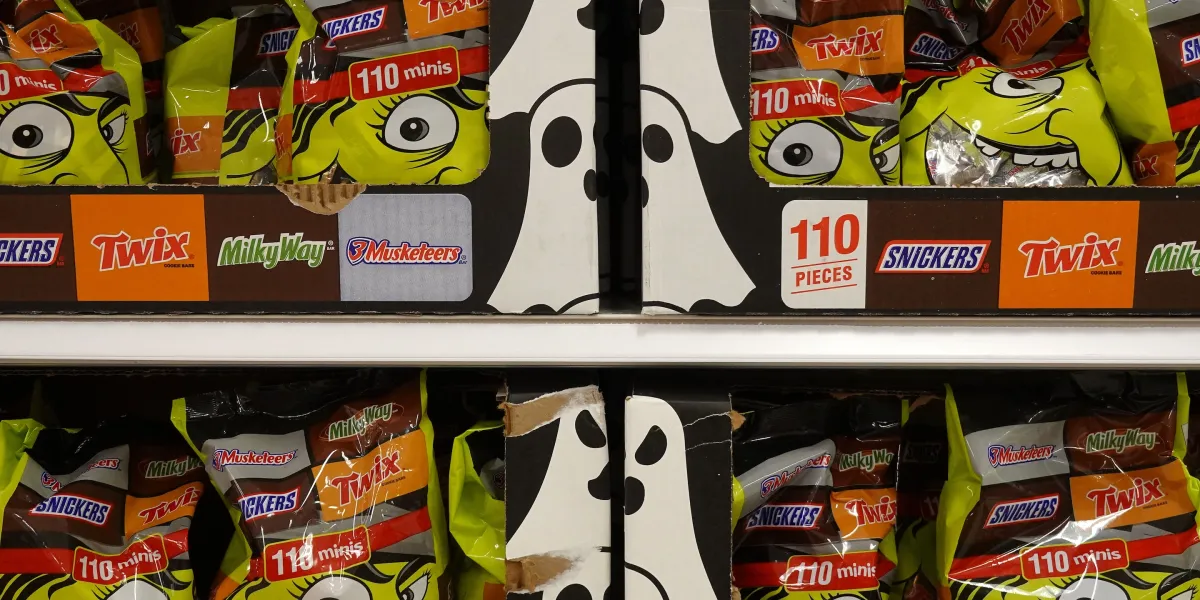
Halloween candy sales in the US have weakened as high petrol prices and persistent inflation lead shoppers to cut back, Hershey executives have said. Sales across the confectionery category at convenience stores fell 5% in September, with the decline continuing into October.
Hershey’s chief financial officer, Dave Hulays, said consumers were becoming “more cautious on inflation”, with fuel costs and interest rates adding to pressure on household budgets.
“They are making more deliberate choices across channels,” he said, pointing to a shift towards mass retailers, online shopping and warehouse clubs.
The weakness appears to be concentrated in where and how often people shop, rather than in demand for confectionery as a whole. Outside convenience stores, the category grew 3.7% in the third quarter, Hulays said.
Halloween candy sales fall as prices remain elevated
Hershey’s latest results showed the impact of shoppers paying more for less. Third-quarter net sales increased 3% to about $3.28 billion, but the rise was driven by roughly 11 percentage points of price increases while volumes fell by about 10 points.
The company has narrowed its full-year organic net sales growth forecast to about 3%, at the lower end of its previous range of 3% to 3.5%.
NielsenIQ data showed Halloween candy sales fell 6.7% in the month to 17 October compared with the same period last year. Small bags were the only size to record growth, while the average price of regular petrol had risen to $4.29 a gallon, nearly 40% higher than a year earlier.
Consumers are not abandoning Halloween altogether. The National Retail Federation expects total spending on the holiday to reach a record $13.5 billion, up from $13.1 billion last year, including $4.1 billion on sweets. It said 96% of those celebrating planned to buy candy, while also noting that affordability was influencing decisions.
Cocoa prices, which contributed to years of higher chocolate costs, have fallen substantially from their record high of about $10,710 per metric tonne in January 2025. They dropped to $3,241 by March before rising again this spring amid disruption to fertiliser supplies in Africa and warnings about El Niño.
Hulays said the industry was emerging from a historical surplus of 500,000 to 600,000 metric tonnes, with inventories in better health and production increasing in newer growing regions such as Ecuador.
“We don’t expect cocoa to remain at current levels long term,” he said. However, shoppers have yet to see much relief. A 100-piece bag of Halloween candy now costs an average of $16.96, up 71% from $9.91 in 2021, while government data showed candy and gum prices had risen 44% over five years through September.
Freight, packaging and other costs unrelated to cocoa have helped keep prices high, even as the main ingredient has become cheaper.
Hershey is also facing a shorter selling period this year, with Halloween falling on a Saturday after a late Labor Day. Chief executive Kirk Tanner said about 35% of seasonal sales take place during the final week.
“The biggest selling days are still ahead of us,” Tanner said, adding that Hershey had shipped more seasonal product than last year and that its displays were in shops. Consumer surveys, he said, indicated that intended participation was broadly in line with last year.
“Now we need consumers to show up,” Tanner said. “The last few days are really critical.”
Looking to 2027, Tanner said Hershey would rely on new products and more affordable pack sizes and price points to attract shoppers who were increasingly conscious of costs.
