


France’s finance minister has warned that the French economy could be heading for recession unless the government swiftly passes a budget to reduce the deficit, as nationwide protests over the cost of living threaten further disruption.
Roland Lescure issued the warning after official figures showed that the economy contracted by 0.1 per cent between July and September, following a 0.2 per cent fall in the first quarter and stagnation in the second.
“If we fail to achieve the turnaround outlined in the budget, we are headed straight for a wall,” Mr Lescure told France Info radio.
“For three quarters now, there has been no growth,” he said, adding: “The conclusion to be drawn from all this is that, as of 2026, the French economy is at a standstill.”
The figures, published by national statistics office Insee, came as annual inflation accelerated to 3.4 per cent in October from 3.1 per cent the previous month. It was the fastest rate recorded since January 2024.
Analysts said the performance would make it difficult for the government to meet its growth forecast of 0.5 per cent for the year, or even the 0.4 per cent estimate issued by Insee and the Bank of France.
Slower growth is also expected to complicate efforts to reduce France’s budget deficit to 5 per cent of gross domestic product next year. The deficit is projected to remain at 5.4 per cent in 2026, according to Allianz Trade economist Maxime Darmet.
“We will begin 2027 from a very weak starting point in terms of growth,” Mr Darmet said, warning that this “raises questions about the credibility of deficit reduction efforts”.
Protests add to pressure on French government
Concerns over France’s debt and deficit have pushed up the cost of government borrowing, with interest rates on French debt reaching their highest level in more than two decades.
Mr Darmet warned of a possible “vicious cycle” in which weak growth leads investors to demand a higher risk premium, further increasing borrowing costs and placing additional pressure on the economy.
Sylvain Bersinger, of consultancy Bersingeco, said the outlook was “rather bleak”. He warned that an unclear political direction after forthcoming elections could lead to “a prolonged political and budgetary crisis” and a worsening public debt crisis.
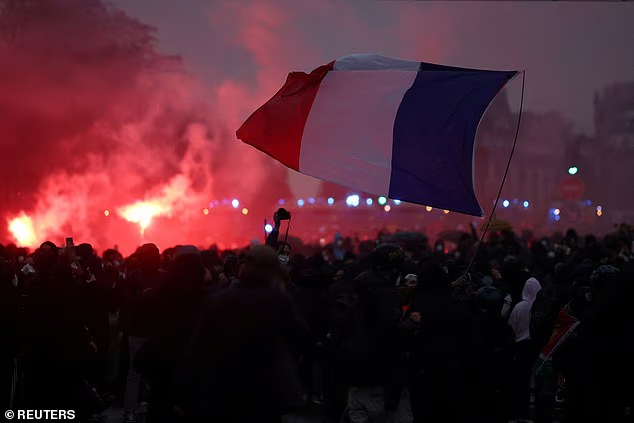
The economic strain has coincided with growing anger over wages, living costs, inequality and public services. Authorities have warned of a “very high risk of public disorder” during protests planned for Saturday, after demonstrations earlier this month descended into some of France’s worst rioting in years.
Interior Minister Laurent Nunez said 70,000 security personnel would be deployed again. He said radical groups had used social media to call for violent gatherings, particularly after mainstream demonstrations end in the evening.
“October 31 is a day that poses a very high risk to public order,” Mr Nunez said, promising that the response from security forces would be “extremely firm”.
The Interior Ministry said 410,000 people took part in marches last Saturday, when the deployment of 70,000 police helped prevent a repeat of the looting and vandalism reported on October 17.
Labour leaders and students have called for further demonstrations and a nationwide strike on November 5. The unrest has caused an estimated $2 billion in damage and lost revenue, with about 2,400 shops targeted.
France’s Chamber of Commerce said losses for retailers alone exceeded €1 billion. Morningstar DBRS estimated that the total cost, including uninsured damage and lost revenue, could approach $2 billion and rise further if protests escalate.
Consumer confidence has fallen to a 13-year low, raising concerns about the crucial November and December trading period, which typically accounts for 40 per cent of annual retail turnover.
Alain Di Crescenzo, president of the French Chamber of Commerce, said commercial activity in city centres had been “brought to a standstill”. More than a quarter of outlets damaged during the protests remain closed, while other businesses have shut temporarily as a precaution.
Stores affected have included luxury brands such as Hermes, Louis Vuitton and Burberry, as well as Carrefour supermarkets and smaller independent shops. Burberry’s store on Paris’s Rue Saint-Honoré reopened on Tuesday after being closed for ten days.
Pandora said three of its shops remained shut after being vandalised and looted, while H&M closed some outlets and reduced opening hours after four of its stores were affected. Adidas also reported some closures and falling visitor numbers in cities affected by the protests.
