


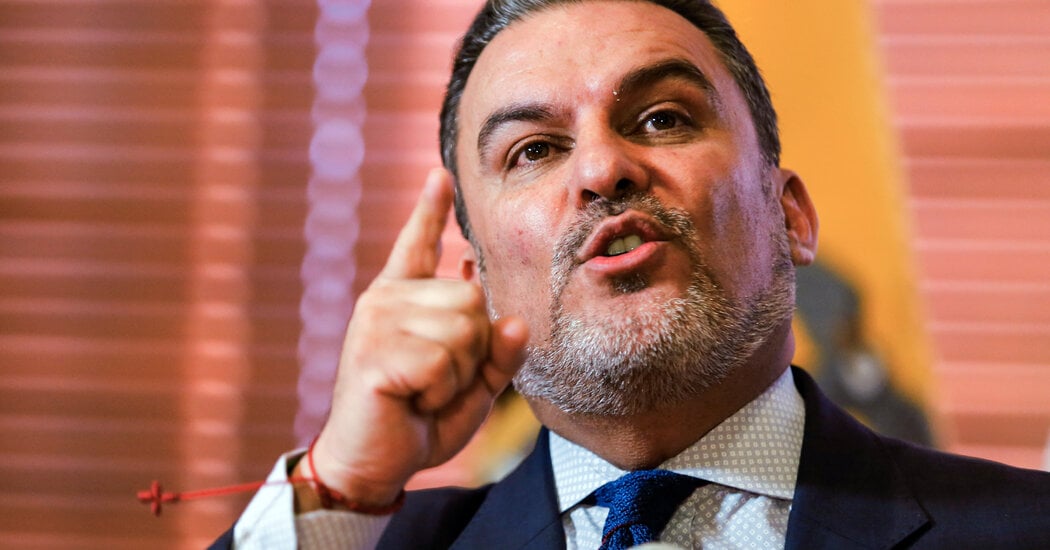
The fast-tracked deportation of former Ecuadorian interior minister José Serrano has raised questions about the Trump administration’s control of the US immigration courts, after an appeals panel overturned a ruling that he could face torture if returned home.
Mr Serrano was sent from the United States to Ecuador within hours of the decision by three immigration appeals judges. He is now being held in a maximum-security prison, where his lawyers say he was filmed naked and told that the footage would be shown to President Daniel Noboa.
Ecuadorian officials have denied that Mr Serrano was mistreated. His legal team has asked a US federal appeals court to order his return, arguing that the deportation happened too quickly for them to challenge the ruling.
Immigration appeal decided in a day
Mr Serrano had been detained in the US for months while challenging his removal. An immigration judge in Miami ruled in May that he could not be deported to Ecuador because there was a likelihood he would be tortured there.
The judge found that Mr Serrano was not eligible for asylum because he had admitted accepting about 575,000 dollars in bribes from government contractors. She did not determine whether he had played a role in the 2023 assassination of presidential candidate Fernando Villavicencio, saying that question should be decided by the Ecuadorian courts.
However, she concluded that Mr Serrano could face serious harm in Ecuador. Her ruling cited the deaths of people arrested in the Villavicencio case and the alleged mistreatment of Jorge Glas, a senior former government figure imprisoned in Ecuador.
The US Department of Homeland Security submitted its appeal at 4.06pm on August 27. At 3.12pm the following day, the appeals panel unanimously overturned the decision, saying it had not been shown that Mr Serrano was likely to be tortured.
Within five hours, he was on a plane bound for Ecuador. Former immigration appeals judges said that a complex case of this kind would normally take weeks to decide, rather than a single day.
“I can’t recall a case ever moving that quickly,” said Charles Adkins-Blanch, a former vice chairman of the immigration appeals board. “It’s highly unusual.”
The panel said injuries suffered by Mr Glas did not meet the legal definition of torture because it had not been established that they were deliberately inflicted with the specific intention of causing severe pain or suffering. It also said there was no proof that the Ecuadorian government had been responsible for the deaths of other suspects in the assassination case.
Claims of political pressure
Mr Serrano served in several senior roles under Rafael Correa, Ecuador’s left-wing former president and a political rival of Mr Noboa. He later became a prominent critic of Mr Noboa while living in the United States, where he had applied for asylum.
US Immigration and Customs Enforcement arrested him in Florida in 2025, shortly after Mr Noboa had met Kristi Noem, then the homeland security secretary, in Ecuador. Ms Noem is now a special envoy for Western Hemisphere security at the State Department.
Mr Noboa had publicly demanded Mr Serrano’s return after Ecuador charged him with orchestrating the killing of Mr Villavicencio. Mr Serrano denies involvement and has described the accusation as politically motivated.
The Ecuadorian president appeared to claim credit for the deportation shortly after it took place. “We said it, we did it,” he wrote on social media, alongside a photograph showing Mr Serrano shackled between two ICE agents. He later warned Mr Correa: “You’re next.”
Chandler Rebel, a spokesman for the Department of Homeland Security, said it was “categorically false” that Mr Serrano had been detained for political reasons.
“The Department of Homeland Security does not conduct immigration enforcement on behalf of foreign political interests, nor does it target individuals for protected political speech,” he said. “What makes someone a target of ICE is being in the country illegally.”
The Justice Department said it could not comment on individual cases but that the administration was “restoring integrity to the immigration adjudication system”. Neither Mr Noboa’s office nor the State Department responded to requests for comment.
Alleged abuse in Ecuadorian prison
Catherine Walker, one of Mr Serrano’s lawyers, said an Ecuadorian member of his legal team had spoken to him by video for the first time since his deportation last week. She said three unidentified masked guards monitored the call.
Ms Walker said Mr Serrano told the lawyer that guards had taken photographs and videos of him while he was naked and threatened to send the material to Mr Noboa. Ecuadorian officials have rejected claims that he has been mistreated.
Mr Serrano is being held at El Encuentro, a prison modelled on El Salvador’s CECOT detention centre, according to Mr Noboa. His lawyers say they are seeking an order from a US federal appeals court requiring him to be brought back to the United States.
The case comes as the Trump administration reshapes the Board of Immigration Appeals, which reviews decisions by lower immigration judges. The board has been reduced from 28 members to 15, with Biden-era appointees removed and replacements installed who are viewed as ideologically aligned with the president.
All three judges who decided Mr Serrano’s case had previously worked for the Department of Homeland Security. The judge who wrote the ruling, Keith Hunsucker, had also served for several months as acting chief judge of the US immigration court system.
Immigration judges are employed by the Justice Department rather than the independent judicial branch. They are required by law to use their “independent judgment and discretion”, although administration officials have the power to hire and dismiss them.
