


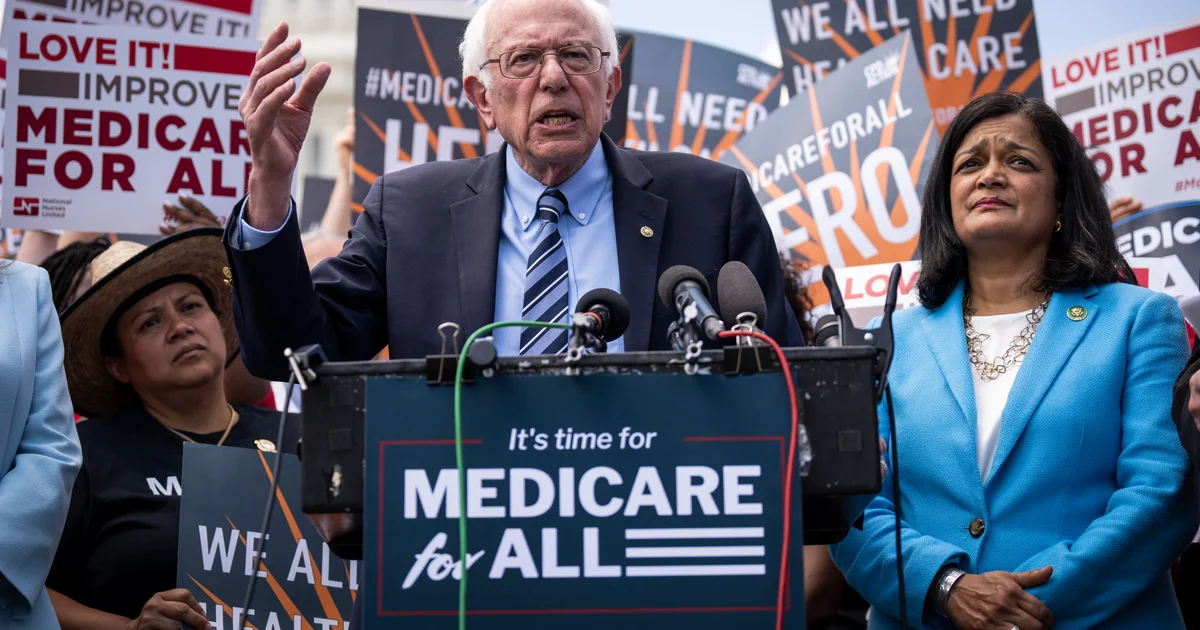
Medicare for All has emerged as a more powerful issue for Democrats after progressive candidates successfully campaigned on universal healthcare in states including Michigan, Texas, Iowa and Maine, but the midterm results have also exposed the political obstacles facing the policy.
Abdul El-Sayed, who made the proposal a defining issue of his congressional campaign and is now a senator-elect, was backed by Kim Bogan, an emergency-room nurse in Lansing who says America’s healthcare system needs to be dismantled and rebuilt.
After 15 years at Sparrow Hospital, Ms Bogan said patients were arriving for treatment sicker, struggling to afford prescriptions and sometimes dying while staff cared for several other people at the same time.
She spent the past year campaigning between 12-hour shifts for Mr El-Sayed. Yet she accepts that victories for candidates supporting some form of Medicare for All do not mean the plan will be easy to pass.
“Nobody expected that,” she said.
Medicare for All faces opposition from moderates
Medicare for All generally refers to a government-run healthcare programme that would provide universal cover while replacing most or all private insurance. Supporters argue that the cost-of-living crisis has created an opportunity for fundamental reform, as Americans face mounting premiums and medical bills.
Jonathan Oberlander, a healthcare reform expert at the University of North Carolina-Chapel Hill, said the election had been driven by anger over issues including inflation, corruption and the war in Iran, rather than a clear demand for government control of health insurance.
“Whatever else people voted for in this midterm election — anger about inflation, anger about corruption, anger about the Iran war — they by and large didn’t vote to have the government take over health insurance,” he said.
Mr Oberlander said the affordability crisis had nevertheless “dominated this election”, adding that Medicare for All supporters expected the issue to gain momentum before the 2028 Democratic presidential primaries.
More moderate Democrats are likely to regard the policy as a threat to seats won in Republican-leaning states such as Iowa, Kansas and South Carolina. Mr Oberlander said that while Democrats might hold a majority in Congress, “it’s not a majority for Medicare for All”.
Previous proposals would have required millions of Americans to give up their existing insurance, according to Michael Cannon, a healthcare economist at the libertarian Cato Institute and an opponent of the plan.
“If Medicare for All actually had the price levels that Bernie Sanders and Abdul El-Sayed envision, the industry would tear it to shreds,” he said.
Recent polling has shown support for Medicare for All at its strongest level in nearly a decade, but backing falls when voters are presented with arguments that it could mean higher taxes or delays in treatment.
Healthcare costs fuel demand for change
For some voters, the pressure of rising costs has outweighed long-held doubts about government involvement. Jaime Bardenhagen, a former nurse from rural northern Michigan who has Parkinson’s and sialidosis, said she felt guilty about qualifying for disability benefits despite having worked for as long as her health allowed.
Her family’s monthly insurance premiums rose from 700 dollars to 1,300 dollars after enhanced Affordable Care Act subsidies expired. The policy also carried a 7,500-dollar deductible, forcing her and her husband to postpone medical tests recommended by her doctor.
Ms Bardenhagen said her husband voted for Donald Trump in 2016 but stayed home this time, while she considered not voting because she no longer trusted either party. Even so, she supports Medicare for All after becoming disillusioned with insurers’ influence over prescriptions and treatment.
“So, absolutely, the government should take it over,” she said.
Michael Cannon argued that expanding federal control would leave patients dependent on government spending that was not sustainable. He also rejected the idea that replacing private plans with a public system would necessarily force down drug and healthcare prices.
Healthcare reform is likely to remain under pressure as Affordable Care Act premiums are expected to rise by double digits again next year, employers pass more insurance costs to workers and projected Medicaid cuts threaten to leave 7.5 million more people uninsured by 2034.
Sara Collins, a senior scholar at the Commonwealth Fund, said both parties would face demands for solutions to the affordability crisis. Possible measures could include restoring enhanced Affordable Care Act subsidies and restricting insurers’ use of prior authorisation, which requires approval before some covered treatments can proceed.
Democrats may ultimately pursue a public option or a version of Medicare for All that leaves employer and union insurance schemes in place while providing a guaranteed government-backed baseline.
Mr El-Sayed said during his campaign: “If you like your insurance from your employer or from your union, that can still be there for you.”
For Ms Bardenhagen, the election delivered a straightforward message to Democrats: “Do something.”
