


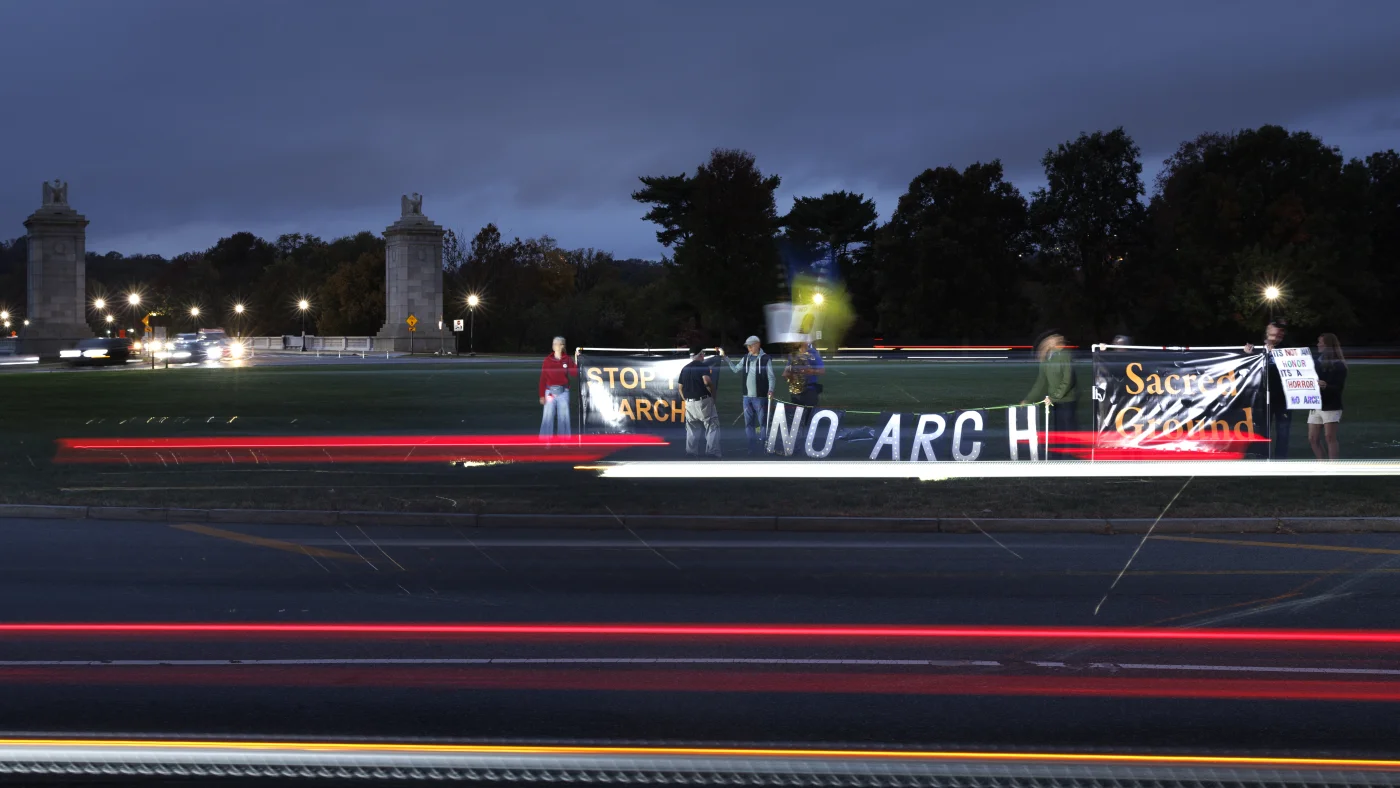
Donald Trump’s proposed 250-foot arch in Washington has been approved by the National Capital Planning Commission, despite hours of opposition from veterans, lawmakers, residents and preservation experts.
The commission voted 8-4 to approve the structure at Memorial Circle, the traffic island linking the Lincoln Memorial with Arlington National Cemetery. The administration said excavation could begin immediately, although Congress has not authorised the project and legal challenges remain unresolved.
The decision came after a meeting lasting almost nine hours, during which 131 people had registered to speak. The hearing was held virtually because of the volume of testimony, while an early failure of the livestream delayed proceedings by about an hour.
Opponents argued that the arch would obstruct a significant view, disrespect service members buried at Arlington and create additional risks in Washington’s complex airspace. They also questioned the project’s legality and cost.
A group of Vietnam War veterans and an architectural historian sued the government earlier this year, claiming congressional approval was required. The District of Columbia and Virginia brought a similar legal challenge last weekend.
Judge Tanya Chutkin, of the US District Court for the District of Columbia, consolidated the cases and instructed the government to notify the court within an hour of the commission’s decision. That has raised the possibility of an emergency preliminary injunction preventing construction.
The legal dispute intensified after white lines appeared on the grass at Memorial Circle before the meeting. Government lawyers told the court that the markings had been made on Saturday by the designated construction company, apparently without authorisation from the National Park Service.
Opposition to Trump’s proposed arch
Many speakers said the monument represented an attempt by Mr Trump to commemorate himself in the US capital. Some also linked their opposition to the Democrats’ performance in the midterm elections, describing it as a rejection of what they called the president’s unilateral building projects.
“Leaving aside all of the legitimate concerns and challenges about the required approvals, funding, land use, single-source bidding, and peer review, the American people spoke this past Tuesday at the ballot box,” said former Washington resident Emi Yamauchi.
Only a small number of speakers supported the arch, including Republican representatives Andrew Clyde of Georgia and Brian Mast of Florida, both of whom are veterans. Several opponents told commissioners that relatives were buried at Arlington or that they intended to be buried there themselves.
Critics also questioned whether the outcome had been decided in advance. Trump-appointed chair Mark Paoletta and other commissioners had voiced support for the project at the beginning of the meeting, although the commissioners were not shown on screen during much of the public testimony.
When deliberations began shortly before 10pm, administration allies backed moving ahead. They rejected arguments that the arch would breach Washington’s height restrictions or federal environmental and historic preservation laws.
Supporters said Congress had authorised the project in 1925 by approving two 166-foot columns for Memorial Circle, although those columns were never built. They also cited claims by Mr Trump and Defence Secretary Pete Hegseth that the monument would strengthen national security.
Interior Department official Greg Wischer told the meeting that details relating to national defence had been filed under seal in court, but said the National Park Service had not seen any preparations connected to such functions.
Phil Mendelson, the Democratic chair of the District of Columbia Council and a member of the commission, sought to delay the decision until complete site and building plans were available. His motion was defeated by eight votes to four.
“We cannot approve final site and building plans until we have the final site and building plan,” Mr Mendelson said.
Vice-chair Stuart Levenbach, a Trump appointee, warned against postponement because the project’s backers were facing a time constraint and wanted a decision that day. The commission approved the arch minutes later, and the administration notified the court within half an hour.
The National Trust for Historic Preservation described the vote as a “sham”, saying the process undermined democracy, breached federal law and insulted veterans. The National Parks Conservation Association said it would take the issue to Congress in an effort to stop construction.
Democratic lawmakers have also pledged to block and investigate the project if they regain a congressional majority in January. Virginia representative Don Beyer has introduced legislation to prohibit and defund the arch, while representative Jared Huffman warned that companies and officials involved could face legal risks if the project had not been authorised by Congress.
