


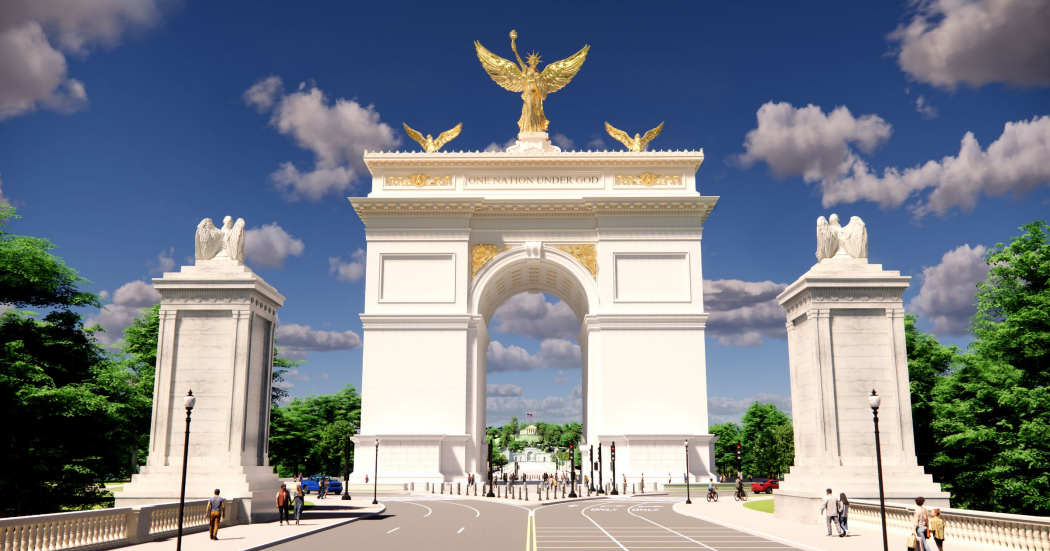
Plans for a 250-foot triumphal arch between the Lincoln Memorial and Arlington National Cemetery have been approved by the National Capital Planning Commission, despite opposition from veterans, lawmakers and local authorities.
The commission voted 8-4 to approve the monument after almost nine hours of public comments. The body, which acts as the federal government’s planning agency for the Washington region, includes several allies of President Donald Trump.
The decision gives the project planning approval, but construction could still be delayed by a legal challenge in Washington. A federal judge is considering whether to temporarily block the work.
The arch is intended to mark 250 years of American independence and would stand at the centre of Memorial Circle, across the Potomac from the Lincoln Memorial. Construction is expected to take three years, although the project’s cost and who would pay for it remain unclear.
Mark Paoletta, the commission’s executive director and the top lawyer at the Office of Management and Budget, recommended that the plans be accepted. He described Mr Trump’s proposal as a “historic vision” and said it would be the “grandest arch ever built by mankind”.
Opponents argued that the structure would damage the setting linking the Lincoln Memorial with Arlington National Cemetery. California congressman Jared Huffman, the senior Democrat on the House Natural Resources Committee, called the arch “illegal” and said Congress should debate the proposed monument.
“This arch would dishonor America, our ideals, and our laws,” Mr Huffman told the commission.
Jimi Shaughnessy, a Marine veteran who spoke against the plans, said a “dominating arch with a carnival-like atmosphere of tourists, food trucks and buses is abhorrent and insulting to those who gave all and to their families”.
The commission said it had received more than 1,300 public comments, most of them opposing the scheme.
The main structure will be 166 feet tall and topped by three gilded figures: a gold, winged female figure flanked by a gold eagle on either side. An observation deck is also planned, with the administration estimating that the site could attract between 2,000 and 22,400 visitors a day.
The monument will be close to Ronald Reagan Washington National Airport. The Federal Aviation Administration has determined that it poses no hazard to air navigation, subject to safety lighting including a non-standard eternal flame and continuous floodlighting.
Mr Trump said in September that his “Triumphal Arch” would be a “top grade Military Complex” containing drones and sniper ammunition. However, the documents submitted to the planning commission do not include those military uses, while Justice Department lawyers declined to provide further details about national security features at a hearing in October.
The Virginia veterans Michael Lemmon and Shaun Byrnes are among those challenging the project in court. They have argued that the arch would affect their experience when visiting graves at Arlington National Cemetery and that they would be harmed by its size and purpose.
Virginia and Washington DC have filed a separate lawsuit, arguing that the administration lacks congressional authorisation and has not followed the required procedures. Their lawyers said construction could cause traffic disruption, pollution and stormwater runoff in the Potomac, interfere with emergency services and create other difficulties.
US District Judge Tanya Chutkan has ordered the government to notify her within one hour of any planning commission vote and to give 30 minutes’ notice before any preparations for construction. The Justice Department has said work could begin as soon as the day of the commission’s decision, although the administration said a construction company might only be arranging off-site preparations in anticipation of permit approval.
Judge Chutkan said the central issue in the veterans’ case was whether they had the legal right to sue. The Justice Department has urged her to follow a recent Supreme Court ruling involving a challenge to a planned White House ballroom, while lawyers for the veterans argue that their case is different.
