


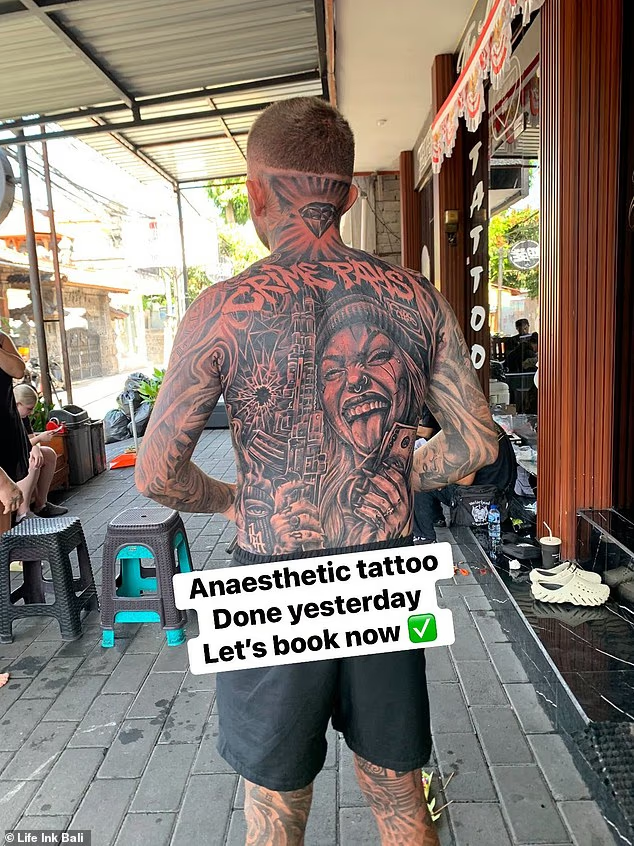
Australian tattoo artists and medical professionals have warned against a growing Bali trend in which tourists undergo full-body tattoo sessions while under general anaesthetic, saying the practice carries unnecessary and potentially life-threatening risks.
Customers are reportedly paying between $9,000 and $16,000 for the procedures, carried out in licensed hospital operating rooms with as many as nine tattoo artists working simultaneously.
The sessions can last between 10 and 20 hours, condensing work that would ordinarily take months or years into one or two appointments. Hospital and procedure fees are included in the price.
Thousands of tourists, predominantly Australians, have travelled to Bali this year for large or full-body tattoos, with videos and photographs of the procedures spreading on social media. Foreign visitors account for at least 80 per cent of clients at tattoo shops on the island.
Artists question the purpose and quality of Bali tattoo sessions
Kian Forreal, owner and master artist at Authentink Studio in Sydney’s Surry Hills, said the use of a general anaesthetic removed what he regarded as a central part of the tattooing experience.
Mr Forreal, who has 33 years of experience and specialises in traditional Japanese Irezumi and large-scale bodysuits, also questioned the quality of some of the designs produced in the sessions.
“You don’t end up with a nice tattoo. You end up with usually a bunch of AI slop or Pinterest slop that’s sort of mashed together,” he said.
He compared the procedure to claiming to have climbed Mount Everest after being taken to the summit by helicopter, arguing that enduring the process was part of the transformation involved in receiving a tattoo.
“When done properly, you have something that you’ve earned,” he said. “Going to Bali under general anaesthetic is like wearing the badge ‘I climbed Everest’ but taking a helicopter. Like did you though? No.”
Sydney artist Ray Vom, who runs Markd Tattoo Studio in Redfern, said customers might not fully appreciate the dangers of being placed under general anaesthetic for a procedure that was not medically necessary.
“It’s such a big risk. I don’t think they really stress that enough because some people don’t wake up,” Mr Vom told 9News.
Gold Coast artist Kristen Sorrenson, of Nine Muses, said she “wouldn’t take those odds” to have a tattoo.
Doctors warn of risks from general anaesthetic
Kyle Hoath, president of the Australian Medical Association WA, described the practice as dangerous, unnecessary and unsafe.
He said general anaesthesia required a trained medical professional to keep a patient breathing and alive while unconscious, and carried risks including death. Doctors generally avoided using it for procedures that could be completed without it, he said.
“Tattooing can be done safely and can be done in safe sterile environments, but there is no need to go through a general anaesthetic, which adds considerable risk to the procedure, just for convenience’s sake,” Mr Hoath told 9News Perth.
“That’s not convenient, that’s dangerous and that’s unsafe, and something that should be avoided.”
Despite the warnings, Brisbane man Anthony Waud said he had travelled to Bali in September and spent nine hours under general anaesthetic while having his front and back tattooed.
The 46-year-old said he paid $9,000 and had experienced no problems during his recovery. He said medical staff had asked about his drug use, alcohol consumption and smoking before carrying out blood tests, heart checks and blood pressure checks.
“I had no concerns. Everything was done professionally. The medical side was good. They were very helpful and caring,” Mr Waud said.
