


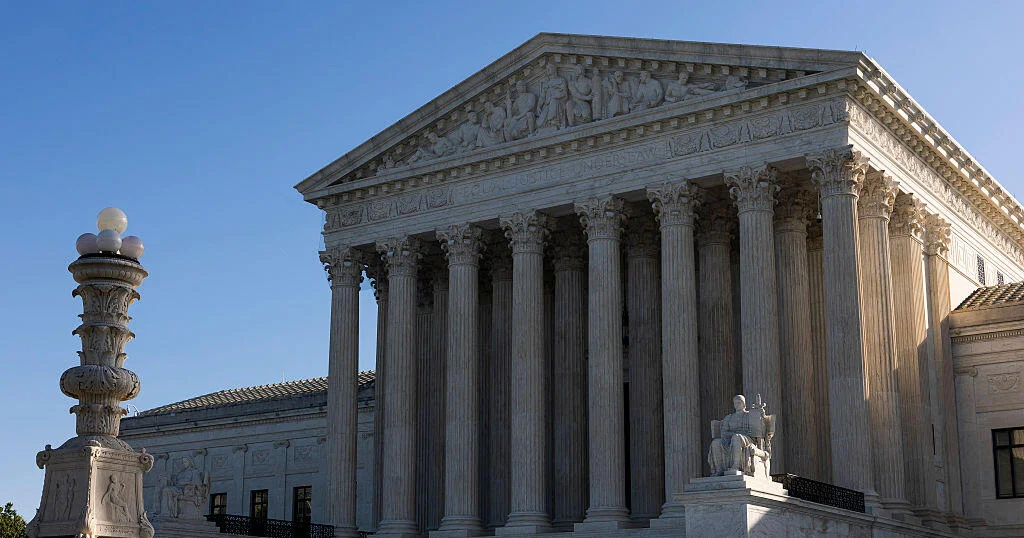
Democrats are preparing to revive efforts to reform the US Supreme Court after winning control of both chambers of Congress in the midterm elections, although the measures face significant obstacles before they could become law.
The party is expected to hold at least 54 seats in the Senate and at least 250 in the House, allowing it to advance legislation that had little prospect under Republican control. Most Senate legislation, however, requires 60 votes to proceed, leaving Democrats short of the threshold needed to overcome a filibuster.
It is also unclear whether President Donald Trump would sign any court-reform package approved by Congress.
Hakeem Jeffries, the Democratic leader in the House who is expected to become speaker in January, has already signalled that the Supreme Court will be among his priorities.
“We must root out corrupt price gouging, clean up the mess at the Supreme Court and ban Members of Congress from trading stocks,” he wrote in a letter to Democratic colleagues announcing his candidacy for the speakership. “Accountability begins at home.”
Mr Jeffries said in August that “dramatic” reform of the Supreme Court was needed. He indicated that Jamie Raskin, who is expected to lead the House Judiciary Committee in the next Congress, would take charge of the issue.
Democratic calls for action have intensified since the party last controlled Congress. The court’s conservative majority has overturned longstanding precedents and expanded executive authority, while its decisions on abortion, voting rights and presidential power have fuelled demands for changes to its structure and oversight.
Ethics proposals likely to return
One of the most immediate areas for action is judicial ethics. During the first two years of Joe Biden’s administration, the House approved legislation that would have required Supreme Court justices to follow ethics rules, but the proposal stalled in the Senate.
Efforts gained fresh momentum in 2023 after reports about trips taken by Justice Clarence Thomas with a wealthy Republican donor that were not included in his financial disclosures. A proposal by Democratic Senator Sheldon Whitehouse requiring the court to adopt an ethics code and establish a process for handling misconduct complaints was advanced by the Senate Judiciary Committee, but did not reach the full Senate.
Mr Whitehouse later reintroduced the measure, while Democratic Representative Hank Johnson brought forward companion legislation in the House. The plans would require the disclosure of gifts, income and reimbursements, including gifts received from parties to cases or people submitting friend-of-the-court briefs.
Other Democratic proposals would create an Office of Ethics Counsel and an Office of Investigative Counsel within the Supreme Court. The investigative office would examine ethics complaints against justices.
A separate measure from Mr Raskin and Representative Alexandria Ocasio-Cortez would prevent federal judges and Supreme Court justices from accepting gifts worth more than 50 dollars.
The Supreme Court adopted its own code of conduct in November 2023, but the absence of an enforcement mechanism has prompted continued calls for Congress to intervene.
Gabe Roth, executive director of the judicial reform organisation Fix the Court, said a Democratic-led Congress could also examine alleged misconduct in the lower federal courts.
Some judges have been accused of mistreating their clerks, while others have faced misconduct investigations. A Georgia district judge received a private reprimand after an investigation found she had sex with a police officer in her chambers, and a Republican congressman from the state has filed articles of impeachment against her.
A Texas district judge is facing judicial conduct proceedings after allegations that she made racial insults towards a lawyer, judges and court staff. She has also been accused of recusing herself from dozens of cases without explanation or for unusual reasons.
“There’s 2,400 federal judges, so there’s going to be a few bad apples, but if we’re going to talk about cleaning up the government, we can’t leave out the third branch,” Mr Roth said.
Democrats could also revisit measures extending workplace discrimination and harassment protections to the judiciary, as well as proposals banning judges and justices from trading stocks or taking part in prediction markets.
Term limits and a larger Supreme Court
Another longstanding Democratic proposal is to impose term limits on Supreme Court justices. The Constitution says federal judges hold office “during good behavior”, a provision that has been interpreted as granting them life tenure.
Several House bills would establish 18-year terms for Supreme Court justices and create regular appointment periods during a president’s term. One proposed constitutional amendment would require justices who had served more than 18 years to retire. Chief Justice John Roberts and Justices Samuel Alito and Clarence Thomas have all served longer than that.
A separate constitutional amendment introduced by Republican Representative Tom Barrett would impose 20-year limits on members of the Supreme Court and lower federal courts. Mr Barrett lost his seat in the midterm elections.
Constitutional amendments require the support of two-thirds of both the House and Senate before being ratified by three-quarters of the states, meaning term-limit proposals face a considerably higher barrier than ordinary legislation.
Democrats could also consider expanding the Supreme Court. The Constitution does not specify how many justices should sit on the court, and its size has changed six times in US history. There have been nine justices since 1869.
A bill introduced by Democratic Representative Al Green would increase the number of seats from nine to 13. Earlier Democratic proposals have also called for four additional justices, particularly in response to contentious rulings on abortion, regulatory authority and presidential power.
Joe Biden previously established a commission to examine possible Supreme Court reforms. The panel did not recommend structural changes, instead setting out arguments for and against the various proposals.
With Democrats now able to move legislation through the House, those plans are likely to return to the political agenda. Their prospects in the Senate, and ultimately at the White House, remain uncertain.
