


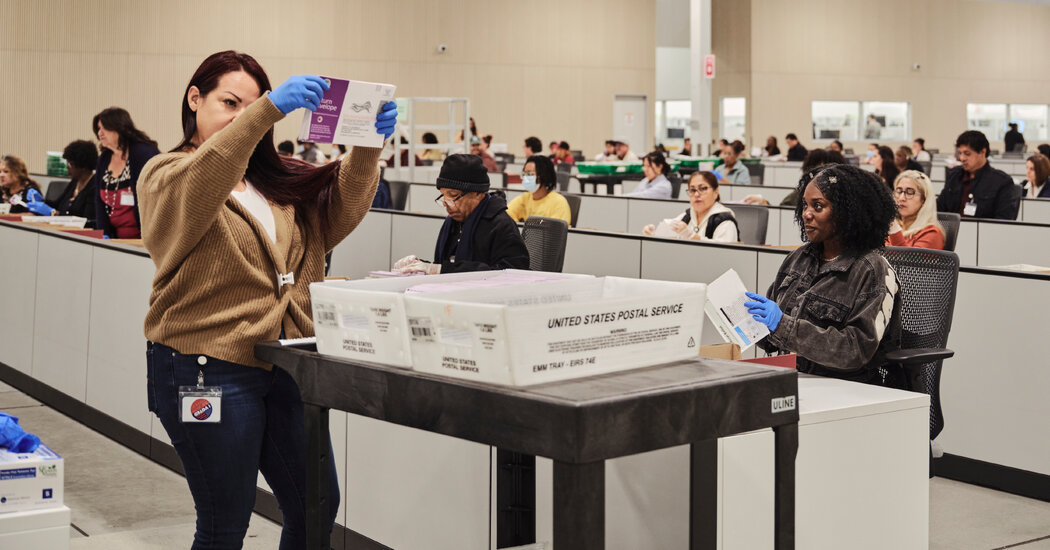
The US Postal Service is pressing ahead with a new system to screen mail-in ballots for the November midterm elections, despite court orders blocking key parts of President Donald Trump’s plan to restrict voting by post.
The Federal Ballot Mail Portal would require states to submit lists of voters due to receive postal ballots, together with addresses and unique barcodes. Postal workers would then scan ballot envelopes before delivery and reject mail that did not match the information held in the system.
The project has raised concerns among election officials and lawmakers, who warn that a rushed rollout could delay or prevent voters from receiving their ballots. The first states are due to begin sending ballots on Friday, September 4, with 20 states expected to be mailing them by September 19.
North Carolina county election boards are scheduled to be among the first to send absentee ballots. Jason Tyson, a spokesman for the state board of elections, said North Carolina had no current plans to use the Postal Service portal.
Under the system described in Postal Service documents and court filings, election offices would have to use approved envelopes bearing scannable barcodes. Once a batch of ballots was handed over for delivery, the Postal Service would compare the codes with the voter details uploaded by the relevant state.
A single apparent error could result in an entire batch being returned. A Postal Service fact sheet says batches of up to 10,000 ballots could be rejected if even one envelope failed to match the data in the portal.
Election officials have warned that the arrangement could create serious delays, particularly if a mistake affected a large mailing. In Wisconsin, where ballots are due to be sent on September 17, a senior official said it would be “virtually impossible” for the state to meet the proposed requirements, according to a federal court filing.
The state said rural election offices lacked the staff and time to add the necessary codes to every envelope. Any rejected batch would have to be corrected and sent again, raising the prospect that some voters might not receive their ballots in time.
Whistleblower raises concerns over ballot portal
A federal whistleblower has alleged that the portal was developed in a rushed and disorganised manner, without the normal safeguards expected for a system handling sensitive election information.
The disclosure, released with the support of Whistleblower Aid and referred to Congress, claims that work began around June 15, just months before the election, and that developers were given a September 1 target. The project’s requirements were said to have changed repeatedly, with no clear written specification and inadequate testing.
The whistleblower also alleged that the system had not undergone the usual stages of internal testing and user acceptance testing. A failure to identify scanning or database errors before launch, the disclosure warned, could prevent large numbers of legitimate ballots from being delivered.
Senator Richard Blumenthal, a Democrat from Connecticut, has demanded documents and answers from the Postal Service, including details of testing, contractors and safeguards against false rejections. Representatives Robert Garcia of California and Joseph Morelle of New York have separately asked the agency’s inspector general to investigate.
The Postal Service has disputed the description of the project as chaotic, saying the portal has been in development for months and is intended to offer election officials a “simple, secure, and efficient way” to share ballot information.
The agency has also argued that it is legally entitled to continue developing the system while states are not being compelled to use it. A federal judge’s temporary restraining order issued on August 27 halted implementation of the new requirements for 14 days, but allowed non-binding guidance and voluntary work on the portal to continue.
The legal dispute centres on an executive order signed by Mr Trump on March 31. It directs the federal government to create state-by-state lists linked to voting eligibility and seeks to require states to provide information to the Postal Service before mail ballots can be delivered.
More than two dozen Democratic state attorneys general and voting rights groups have challenged the order, arguing that the Constitution gives states responsibility for running elections. They say the federal government and the Postal Service have no authority to decide which ballots state election officials may send.
The Supreme Court temporarily allowed parts of the administration’s approach to proceed on procedural grounds in August, without ruling on whether the order itself was lawful. A Boston judge later blocked implementation again before the midterm elections, and the administration has appealed.
Postal workers’ representatives say staff have not been properly trained. Jonathan Smith, president of the American Postal Workers Union, said no clerk had been instructed on how election mail would be accepted, checked or rejected under the proposed rules.
“At this time, to our knowledge, no postal clerk, either in a business mail entry unit or at a post office retail location, has been trained on how they will be expected to accept, validate or reject any election mail consistent with the executive order,” Mr Smith said.
Officials in Oklahoma have also sought instructions from the Postal Service on how to comply with the new requirements but had not received a response, according to the state’s election board.
With the November 3 election approaching, state officials face the prospect of preparing for a system whose legal status remains unsettled and whose practical operation is still being developed.
