


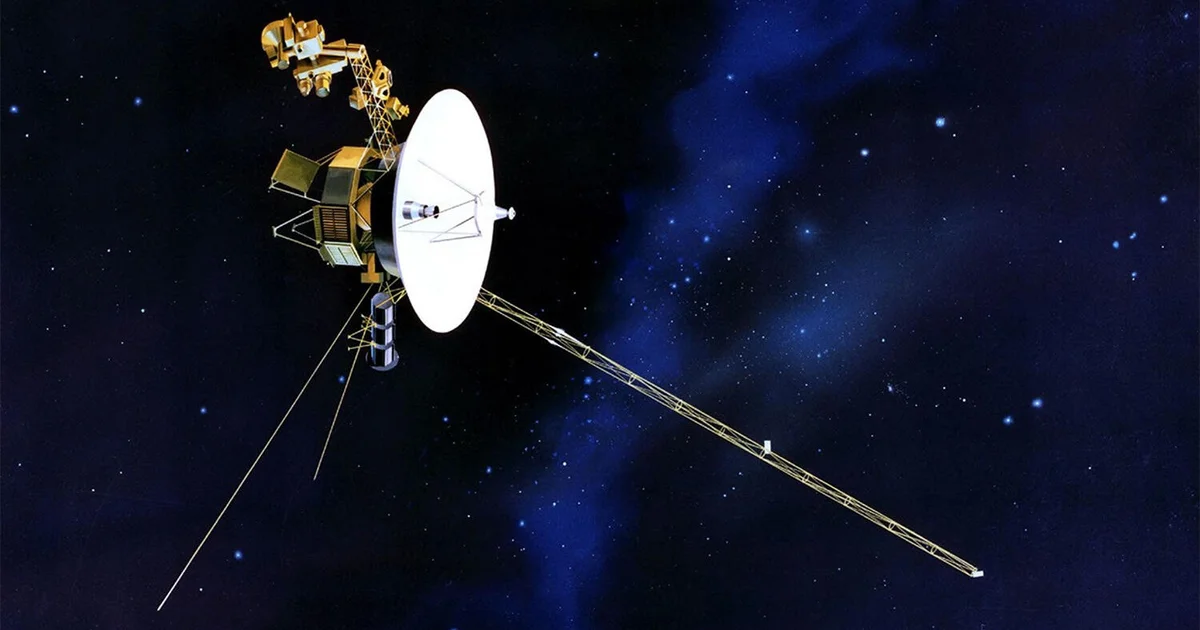
NASA’s Voyager 1 probe has reached a distance of one light day from Earth – more than 16 billion miles – becoming the farthest human-made object ever to travel from the planet.
Launched in 1977, the spacecraft was designed to provide close-up views of Jupiter, Saturn and their moons. Its journey has since carried it beyond the solar system and into interstellar space, where it continues to send scientific data back to Earth.
Voyager 1 is travelling at almost 38,000mph. Radio signals moving at the speed of light now take 24 hours to make the journey between the spacecraft and flight controllers at NASA’s Jet Propulsion Laboratory in California.
The 13-member team responsible for the probe had to wait until Thursday for the first signal sent after the milestone to confirm that it had been reached.
“It’s difficult to describe, difficult to put into words,” said Kareem Badaruddin, the Voyager Interstellar Mission manager and one of only three full-time team members keeping the ageing spacecraft operational.
“I feel like this mission is one of the great things that people have ever done, that humans have ever done,” he said. “All of us, every person, whether they’ve worked on this mission or not, can take some pride in it and can feel like this is a part of what our civilisation has accomplished.”
Voyager probes continue to send data
Voyager 1 and its sister spacecraft, Voyager 2, are still transmitting information about magnetic fields, charged particles and plasma waves in the space between the stars, although their signals are growing weaker.
Voyager 2 was launched first, in August 1977, and later flew past Uranus and Neptune after completing its encounters with Jupiter and Saturn. It followed Voyager 1 into interstellar space in 2018, six years after its counterpart.
The probes are powered by electricity generated as plutonium-238 decays inside compact nuclear generators. Voyager 1 began its mission with about 470 watts of power but now has slightly more than 210 watts, enough to operate two of its 10 instruments while keeping the spacecraft pointed towards Earth.
Voyager 2 has a little more than 230 watts available and is operating three instruments. Engineers are carefully managing the remaining power and heat needed to prevent fuel lines from freezing and to keep the spacecraft’s antenna aimed at Earth.
By the time Voyager 1’s signal arrives, its strength is less than a tiny fraction of a trillionth of a watt. NASA’s giant Deep Space Network antennas are required to detect the faint transmission, while commands sent to the spacecraft take a full day to arrive and another day to produce a response.
“If you want to say ‘hello’ to Voyager, you send your message and then you go home and you wait two days before you finally get a response,” Suzanne Dodd, the Voyager project manager at JPL, said.
A message carried across the stars
It is not known how many more years the spacecraft will function. Engineers hope that careful management will allow the data stream to continue for several more years before the plutonium-powered systems finally stop.
Even then, Voyager 1 and Voyager 2 are expected to remain largely intact as they travel through space for a billion years or more. Each carries a golden phonograph record containing greetings in 55 languages, photographs, natural sounds, artwork and music from several cultures.
The recordings include music by Johann Sebastian Bach, Navajo chants and Chuck Berry singing “Johnny B. Goode”. They were intended as a message in a bottle in case the spacecraft were ever found by beings from another civilisation.
Voyager 1 reached Jupiter in 1979, sending back detailed images of the Great Red Spot, the planet’s major moons and Io’s volcanic surface. It then flew past Saturn, recording new views of the planet’s rings, atmosphere and moon Titan.
Its cameras were used for the final time on Valentine’s Day in 1990, when it photographed the planets of the solar system from 3.7 billion miles away. Earth appeared as a tiny blue point in the image later known as the “pale blue dot”.
In 2012, Voyager 1 crossed the outer edge of the bubble formed by the solar wind and the Sun’s magnetic field, entering interstellar space. Its onward journey will continue long after its instruments fall silent, carrying a record of the planet from which it came.
