


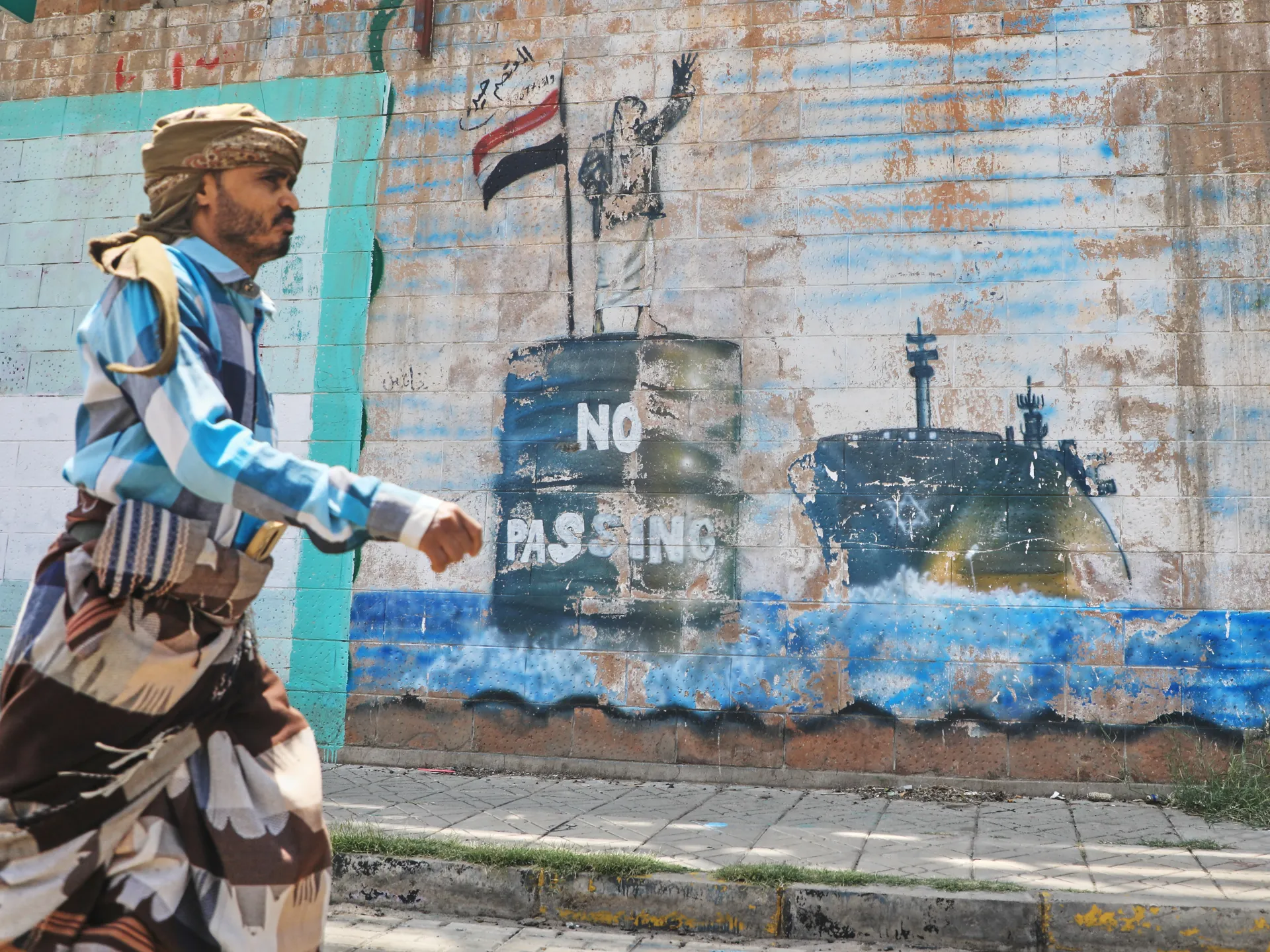
Houthi territorial gains along Yemen’s Red Sea coast are increasing the group’s military leverage, but may not deliver a comparable expansion of its finances, analysts say. The group already controls major stretches of the coast, including the port city of Hodeidah, and remains constrained by international sanctions and its status as an unrecognised governing authority.
The latest advance has extended Houthi control towards the Mocha coast and the Bab al-Mandab Strait, at the southern entrance to the Red Sea. But Ahmed al-Shalafi, a Yemeni affairs editor, described the development as a “geographical and military gain” rather than an economic one.
Sanctions severely restrict the Houthis’ ability to commercially exploit newly captured territory through formal international channels. Any attempt to impose new charges or secure revenues from shipping and trade around Bab al-Mandab could instead trigger further confrontation, Mr al-Shalafi said.
The Houthis’ parallel economy
The group has built an extensive revenue-raising system since seizing the capital, Sana’a, in September 2014. Its centralised structure collects taxes, customs duties, zakat, or religious alms, and other levies across the most populous parts of north-western Yemen.
A report by the Mokha Center for Strategic Studies estimated that the system generated direct and indirect financial resources and costs worth about 2.5 billion dollars a year.
Of that figure, approximately 800 million dollars came from taxes and customs, while a further 600 million dollars was raised through additional fees and levies. The report also estimated 300 million dollars in cash and in-kind contributions to the war effort, 100 million dollars connected to mobilisation events and 700 million dollars in indirect costs carried by businesses through higher transport, service and fee-related expenses.
Houthi authorities have also revoked the licences of 4,225 established commercial agencies, which act as local representatives for foreign companies. The Sana’a Center for Strategic Studies said the move could allow businesses linked to the group to replace them.
The Houthis have defended the decision, saying the agencies had failed to renew their registrations for three years. Houssam al-Saeedi, an economic researcher and head of the Economic Studies Programme at the Yemen and Gulf Center for Studies, argued that the restructuring was deliberate.
“It seizes companies belonging to existing merchants and manages them in favour of the [Houthis],” Mr al-Saeedi said. “What is happening is a network aimed primarily at bringing about a change or replacement of capital; so that even in the event of reaching a political settlement or a military victory, this group retains financial sources in the future.”
The Houthis reject the description of their economic policies as an attempt simply to tighten control over private enterprise. They say recent measures are intended to promote domestic production, investment and small businesses, while making commercial regulation simpler.
Oil and alleged smuggling networks
Trade and commercial activity in Houthi-controlled territory has increasingly focused on sectors where the group can collect revenue and exercise control. Of nearly 68,000 commercial records examined by the Mokha Center, 26 per cent related to general trade and imports, followed by food commodities at 18 per cent.
Mr al-Saeedi said the group had created “a completely separate system” alongside Yemen’s existing economy, using state institutions to collect official taxes while imposing additional, non-state charges.
“There are various, long, and large collection operations under the name of ‘supporting the war effort’ and others, and these are not taken through government mechanisms,” he said.
Beyond domestic revenues, the US Government has alleged that illicit oil trading is one of the Houthis’ main sources of external finance. The US Treasury said in January that the group generated more than two billion dollars annually through illegal oil sales and alleged that Iran supplied it with oil, including free monthly shipments, through Iranian-owned or affiliated companies based in Dubai.
Mr al-Saeedi said the energy sector had long been a priority for the Houthis, alleging that companies involved in the trade acted as fronts for money laundering and that smuggled oil could generate income through domestic sales and monopoly pricing.
He also said weapons, oil and money were moved through smuggling and laundering networks. Iranian oil sold to third parties was allegedly followed by transfers to the Houthis through complex financial channels, including cryptocurrency transactions and local exchange houses.
The group operates under extensive international sanctions. The United States designates the Houthis as both a Foreign Terrorist Organisation and a Specially Designated Global Terrorist group, while the United Nations Security Council lists them under its Yemen sanctions regime and applies a targeted arms embargo.
The Houthis have previously denied using Iranian fuel to finance their operations.
Revenue raising amid economic crisis
The group’s financial system operates alongside a severe economic and humanitarian crisis. The United Nations estimated in March that 22.3 million people in Yemen required humanitarian assistance and protection.
In areas controlled by the Houthis, public-sector employees have gone years without receiving salaries. Rising economic hardship has fuelled criticism of the authorities, although dissent is not tolerated by the group.
Mr al-Shalafi said the Houthis had tied regional military activity to the domestic crisis, using confrontation and mobilisation to justify continued levies and military spending while delaying payments owed to residents.
“They transformed these economic crises into a combat priority, turning them into war, confrontation, and mobilisation,” he said. “The war, of course, gives them the justification to continue imposing levies, for military spending, and to postpone the entitlements of the people inside.”
The Houthis blame the salary crisis on the transfer of the Central Bank of Yemen’s headquarters to government-controlled Aden and their loss of access to oil and gas revenues. They also accuse Saudi Arabia, which backs the Yemeni Government, of imposing a blockade.
Whether the latest gains will significantly strengthen the Houthi economy remains uncertain. Control of more coastline, ports and territory around Bab al-Mandab may increase the group’s military bargaining power, but is unlikely to guarantee new commercial income.
“[Houthi] control over the Mocha coast and Bab al-Mandab will not be met by a world standing idly by or paying royalties and levies to the Houthis; there will be a confrontation or conflict of some kind to settle this issue,” Mr al-Shalafi said.
Yemen is already divided between two increasingly separate economic systems, one in Houthi-held territory and the other in areas controlled by the internationally recognised government. Mr al-Saeedi said resolving the division would require either a decisive military outcome or a comprehensive political settlement.
