


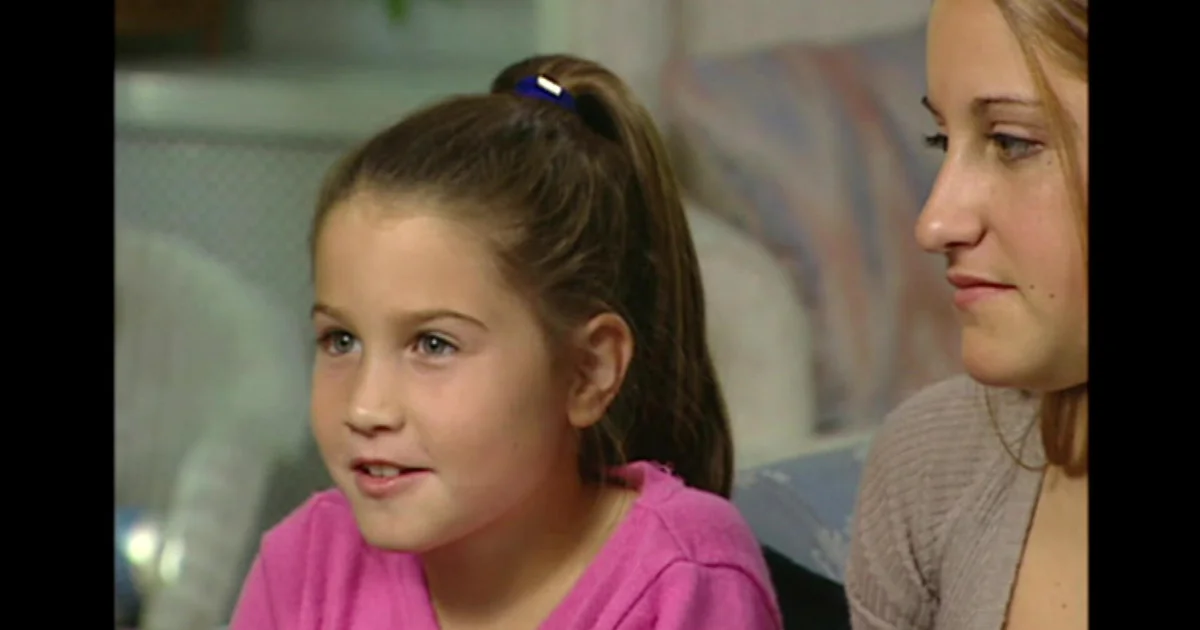
Children who lost parents in the September 11 attacks were left to confront grief, confusion and sudden responsibility, as newly revisited archive footage records the pain of families across America.
The report, first broadcast by CBS in October 2001, follows children whose mothers and fathers left for work on September 11 and never returned. Their accounts capture the weeks after the attacks, when families were still waiting for news and struggling to understand the scale of what had happened.
Among those featured was eight-year-old Danielle Spinelli, whose father, Frank, died at the World Trade Centre. She said she wished she could travel back in time to tell him not to go to work and to remind him that she loved him.
Frank Spinelli had kissed his children goodbye that morning, as he did every day. Later, he telephoned his wife from inside the burning building.
“Hi honey, it’s me, plane hit the building. Um. I’m OK. The building’s on fire. We’re trying to get out. I love you. I’ll see you later,” he said in a message recorded in the aftermath.
He was found in the wreckage two weeks before his 45th birthday. His family still baked a cake for him, keeping alive a ritual that had suddenly become impossible to fulfil.
For his teenage son, Chris, the consequences were visible at night. He described his mother waking in the early hours and being unable to return to sleep, saying it was difficult to see her coping with the loss.
At the Pentagon, Major Dwayne Williams also failed to come home. His children, Kelsie and Tyler, had moved with their parents to the Washington area only three months earlier, after their father took up a new job.
Kelsie, 13, wrote that she could still imagine touching her father’s face and dreaming that he would walk through the door and tell the family he was all right. Tyler, 17, wrote that he had been forced to face a life he had never imagined and to support his mother in his father’s absence.
Other children described taking on duties once carried out by the parent they had lost. Mike Shaw, 16, returned from school each day to check that his mother and younger sister were safe, saying he was doing the things his father would have done.
His father, Jeff, was an electrician at the World Trade Centre. After the first plane struck, Jeff told his wife that the building was filled with smoke and that he could barely hear. During a later call, he was out of breath and said goodbye.
More than a month after the attacks, Mike was still telephoning his father’s mobile phone. Hearing the recorded voice and leaving a message had become his way of maintaining a daily conversation with a parent who was gone.
The archive report also follows Brendan Regan, whose father, New York firefighter Lieutenant Bobby Regan, had coached his Little League team shortly before the attacks. Brendan had delivered the decisive hit in the team’s championship victory days earlier.
His sister Caitlin said she had always been grateful that their father made time for his children, even though she had not known how significant those ordinary moments would become.
Decades later, the recollections remain a record of the youngest people caught in the aftermath of 9/11: children forced to navigate bereavement while the wider world was still trying to comprehend the attacks.
