


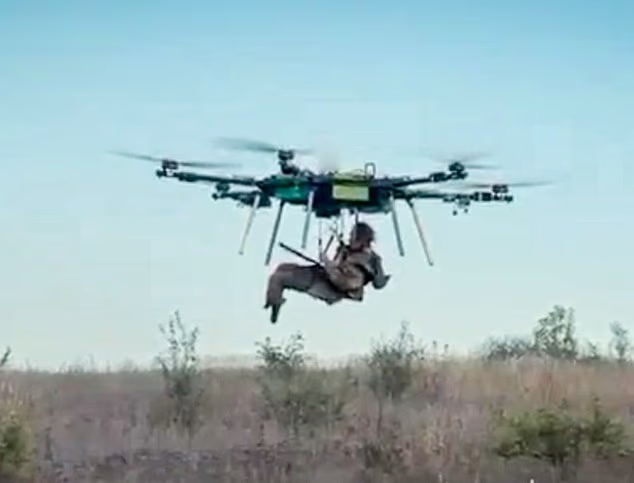
A Ukrainian infantryman who spent 491 days trapped on the frontline has been rescued by an aerial drone after losing both legs and surviving alone inside a cast-iron furnace in an abandoned school.
Kostiantyn Vlasenko, 49, was evacuated from Petropavlivka in the Kharkiv region by Ukraine’s 92nd Separate Assault Brigade on October 4. The operation is described as the first unmanned aerial evacuation of a wounded serviceman.
Vlasenko was strapped beneath a heavily modified bomber drone, which carried him about 11 miles to safety at an altitude of roughly 400ft. Three Vampire drones accompanied the aircraft to protect it from Russian forces, with one reportedly shot down during the mission.
Now recovering in hospital, Vlasenko said he had initially expected a ground vehicle or quadbike to reach him. Instead, a drone delivered a sealed bag containing a nylon seat, rope, carabiners and a phone loaded with video instructions.
“I realised it was going to be an aerial drone,” he told Ukrainian journalist Yuriy Butusov. “It was going to land and turn off its motors so I could crawl underneath.”
Footage of the rescue shows Vlasenko securing himself to the drone’s underside before giving a thumbs-up to its camera as it lifted off.
Ukrainian soldier endured months in hiding
Vlasenko had spent the previous 231 days alone in the ruins of the school after his comrade, known by the callsign Baski, was killed by a Russian drone.
The men had first sheltered for eight months in a cramped underground concrete drainage pipe. They were forced to leave after it flooded during a hard frost, reaching the abandoned school while carrying injuries and weakened by the cold.
Russian aircraft later detected food deliveries being dropped by Ukrainian drones. Vlasenko was wounded in one attack, while his already frostbitten left foot was badly damaged. He then twisted his right leg while trying to collect supplies.
Baski was killed while going outside to retrieve food. Vlasenko said he could hear his friend groaning through the night but was unable to see or treat his injuries in the darkness. Baski died on his 50th birthday.
After covering his comrade’s body, Vlasenko tried to leave the position but was warned by Russian forces to surrender. A loudspeaker promised captivity, an exchange and a return home.
Instead, Vlasenko answered with the defiant phrase associated with the defenders of Snake Island: “Russian warship, go f*** yourself!”
He then took shelter inside a cast-iron furnace as Russian bombardment continued. Two large munitions struck nearby, leaving him buried under collapsing debris, but he survived and continued reporting enemy movements by radio.
His condition deteriorated during the months that followed. His frostbitten left foot developed necrosis and eventually fell off. His right leg later became numb, developed gangrene and began to hang from the ankle.
“I realised I had to cut it off,” he said. “I knew it couldn’t be saved any more.”
Using a blunt knife and a brick, Vlasenko amputated the leg himself. “Tears were flowing, but I had to cut. So I cut,” he said.
Despite his isolation, fellow soldiers continued to send food and medicine by drone. They also sent chocolates, sweets, tea and cigarettes, while his wife posted him a Stephen King book, The Outsider.
Vlasenko said he survived by thinking about his daughter, Khrystyna, while radio messages from other Ukrainian positions helped him feel less alone.
When he was finally told that a rescue was being organised, he said the news left him bewildered. During the flight to safety, he feared he might be dropped into a river because he cannot swim.
“I have no words… A wonder. It is a miracle,” Vlasenko said of the operation. Despite becoming the first soldier evacuated by aerial drone, he added: “I don’t like being first. I prefer being second.”
