


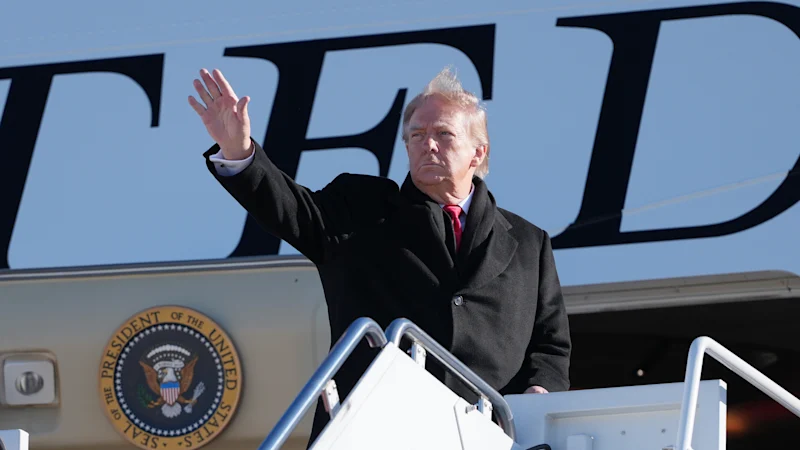
Donald Trump has arrived in the Philippines for a diplomatic push across Asia, with Anthony Albanese given less than an hour to press Australia’s priorities before the US president moves on to a historic meeting with Chinese President Xi Jinping and Russian President Vladimir Putin.
Trump and the Australian prime minister will join Indian Prime Minister Narendra Modi and Japanese Prime Minister Sanae Takaichi on Tuesday evening for the first in-person leaders’ meeting of the Quad security partnership attended by the US president.
The meeting, held on the sidelines of the ASEAN summit in Manila, is the first gathering of Quad leaders in two years. However, only 55 minutes have been allocated to the talks, limiting expectations of a detailed programme of new initiatives.
The Quad meeting is intended to send a signal to China
The grouping of Australia, the United States, India and Japan has been presented as a means of co-ordinating responses to shared security challenges in the Indo-Pacific. Its revival in Manila is also intended to demonstrate that political differences have not broken the partnership.
In a speech to the East Asia summit, Mr Albanese said the Quad enabled countries to work together “to respond to common threats better”. He condemned aggressive actions in Myanmar, North Korea and Russia, saying the countries needed to co-operate on “the urgent challenges that confront each of our sovereign nations”.
Analysts Raji Rajagopalan and Justin Bassi, of the Australian Strategic Policy Institute, said the most important outcome would be the political message sent to Beijing by the four leaders appearing together.
“Whether the summit produces a substantive new outcome is less of an issue than the political signal they send to the region and above all China by coming together,” they wrote.
The Quad was elevated to leaders’ level by former US president Joe Biden in 2021 as a democratic counterweight to China in the Indo-Pacific. But the partnership has faced questions over its purpose, while tensions between Washington and New Delhi over trade have tested its unity.
A planned meeting in Sydney in 2023 was abandoned after Mr Biden was unable to travel because of debt ceiling negotiations. Plans for India to host the following year were also dropped because of scheduling difficulties, with meetings instead taking place in Japan and the United States.
Mr Trump has not attended a Quad meeting since returning to office in 2025. His decision to impose sweeping tariffs on India also damaged what had been a close relationship with Mr Modi.
After Quad foreign ministers met in Atlanta this month, they voiced “grave concerns” about economic coercion involving export restrictions and non-market policies, in an apparent criticism of China. They also pledged greater co-operation on critical minerals, artificial intelligence, maritime security and energy security.
The ministers agreed to work together on a new port in Fiji, where competition with China has been intense.
Mr Albanese is also expected to use his meetings with Mr Trump at the ASEAN and APEC conferences to argue for a de-escalation of the conflict in the Middle East.
“I have a good relationship with President Trump. He’s aware of Australia’s very strong views that we want to see a de-escalation, because it’s having an impact on the region… where the conflict is occurring,” Mr Albanese said on Sunday.
He added that the conflict was affecting “supermarket shelves in the United States, in Australia, in the Philippines, right around the world”.
Mr Trump is due to spend less than 24 hours in the Philippines before travelling to the APEC summit in Shenzhen, China, on Wednesday. The following day he is scheduled to meet Mr Xi and Mr Putin in a trilateral meeting involving the leaders of the world’s three major powers.
The Quad gathering will give Mr Albanese and the other leaders an opportunity to present a co-ordinated position on Indo-Pacific security before that meeting takes place.
