


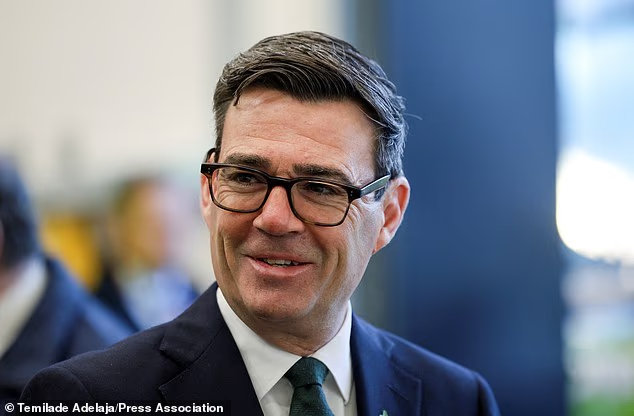
Andy Burnham has reached his first 100 days as Prime Minister with Labour’s poll ratings showing signs of recovery, but questions remain over the substance of his policies and the progress made by his Government.
Mr Burnham entered Downing Street after winning the Makerfield by-election on June 18 and taking his seat in the Commons four days later. His arrival marked a sharp change in style from Sir Keir Starmer, with the Manchester mayor presenting himself as a more relaxed and accessible figure.
His early weeks in office included a nationwide listening tour, a summer recess and a foreign holiday. The tour produced photographs of the Prime Minister shopping in Sheffield with a bag bearing the words ‘Feeling Jammy’, but the initiative soon faded from public view.
Mr Burnham also announced the creation of ‘No10 North’, a new Whitehall presence in Manchester intended to bring government closer to the regions. The office was launched with considerable attention, although it has since attracted little public discussion and has generated costs including rail travel for London-based officials.
The Prime Minister’s policy announcements have been broad. In his first speech outside Downing Street, he pledged to end rough sleeping, while also promising to lower living costs, build more homes and oversee the re-industrialisation of Britain.
However, prices have continued to rise since June, the housing market has weakened and delays to the electricity grid have contributed to the cancellation of a planned artificial intelligence data centre in Loughton, Essex.
Mr Burnham has also faced questions over the lack of detail behind his proposals. His aides have offered a series of commitments, but costed plans for tackling rough sleeping, speeding up planning decisions, supporting manufacturers and reducing household bills remain unclear.
The Government may provide greater clarity in the Budget. Yet there is limited enthusiasm among Labour MPs for reducing welfare spending, despite warnings from former Burnham economics adviser Andy Haldane that failing to act could lead to a repeat of the Liz Truss mini-Budget.
Questions over the Prime Minister’s priorities
Care reform has so far been framed as a “big conversation about national care”, while the Prime Minister has said the pension triple lock will be broken from April 2030 at the earliest.
Mr Burnham has also reopened the question of Britain’s relationship with the European Union after campaigning in the Makerfield by-election on a promise not to revisit Brexit disputes. He has called for “an honest conversation” about a possible return to free movement.
The Government’s approach to energy and the environment has created further uncertainty. Ed Miliband was appointed Foreign Secretary, while Miatta Fahnbulleh took responsibility for energy policy and has been described as holding similarly strong environmental views.
Foreign policy has been another difficult area during the Prime Minister’s first 100 days. Britain has faced tensions involving Russia, Ukraine, Israel, Iran and Argentina, including renewed Argentine claims over the Falkland Islands after the Netanyahu government supported Buenos Aires.
There has also been criticism of the Government’s limited response to unrest across parts of Europe and to Russia’s activity involving undersea cables. A meeting between Mr Burnham and Donald Trump at the United Nations in September was viewed as an uncomfortable encounter for the British leader.
At home, Mr Burnham’s public profile has been built partly through social media and popular culture. He has appeared in TikTok videos, met teenage influencers, featured on Gogglebox and discussed food, football and buses.
He has also recorded podcasts with Gary Lineker and Alastair Campbell, while more conventional and challenging interviews have been less prominent. His conference slogan, “hope again”, was intended to signal a break with the gloom associated with the previous Labour leadership.
The approach appears to have coincided with a rise of several points in Labour’s poll ratings. But the improvement has prompted comparisons with the volatility of previous polling leads, including Theresa May’s collapse before the 2017 general election.
In Parliament, the Prime Minister has yet to establish a commanding presence. He has been criticised for relying on broad language about conversations and problem-solving rather than setting out detailed answers on employment, energy prices and welfare.
With Parliament sitting again, Mr Burnham is facing more sustained scrutiny from the Opposition. When challenged by Kemi Badenoch, he has responded by arguing for “problem-solving not point-scoring”.
After 100 days, the central question is whether his political accessibility can be converted into a programme capable of delivering on his promises. For now, the Government’s improved polling position has outpaced the evidence of concrete progress.
