


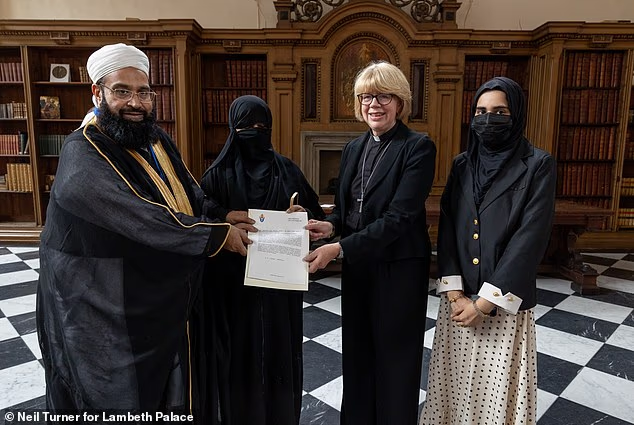
The Church of England has withdrawn an award given to Pakistani cleric Hafiz Tahir Ashrafi after scrutiny of past remarks in which he praised Osama bin Laden and appeared to justify Hamas’s October 7 attacks.
Ashrafi, 68, had been presented with the Hubert Walter Award for Reconciliation and Interfaith Co-operation by Sarah Mullally, the Archbishop of Canterbury, at a ceremony at Lambeth Palace.
The honour was intended to recognise his work promoting “harmonious relationships between different religious groups”. It was withdrawn later the same day after Lambeth Palace said it was “urgently reviewing this matter”.
The controversy was raised after Conservative MP Nick Timothy highlighted comments Ashrafi had made about bin Laden. The cleric has previously told the BBC that he met the al-Qaeda leader “many times”.
In 2007, following the decision to give Salman Rushdie a knighthood, Ashrafi awarded bin Laden the title “Saifullah, or Sword of God”. He told AFP: “We are pleased to award the title of Saifullah to Osama bin Laden after the British government’s decision to bestow the title of ‘Sir’ on blasphemer Rushdie. This is the highest title for a Muslim warrior.”
In a separate interview with Reuters, he said: “If a blasphemer can be given the title ‘Sir’ by the West… then a mujahid who has been fighting for Islam against the Russians, Americans and British must be given the lofty title of Islam, Saifullah.”
Ashrafi’s award was presented in the Great Hall at Lambeth Palace, where he was photographed alongside Archbishop Mullally and two women, one of whom was described as his wife.
The ceremony took place on the 25th anniversary of the September 11 attacks. The award was among a series of annual Lambeth honours selected by the Archbishop of Canterbury.
Past remarks under scrutiny
Further statements attributed to Ashrafi have also come under examination. On the day of the October 7 attacks, in which Hamas killed about 1,200 people in Israel, he told Pakistani television channel BOL: “Hamas’s response is an answer to Israel’s atrocities. Israel has been continuously desecrating Al-Aqsa Mosque.”
In a second interview, he said: “Allah crushed the pride of Israel through the Palestinian freedom fighters.”
Earlier this year, Ashrafi was reported to have claimed at a conference that US and Israeli strikes on Iran formed part of a plan to take control of Pakistan. “Under the cover of Iran, the target of the Jews and Christians is nuclear-armed Pakistan,” he said, while praising Iran’s “mujahideen” as standing “like a wall of lead against Jews and Christians”.
He was also reported to have described Ayatollah Khamenei as a “martyr”.
Ashrafi has chaired Pakistan’s Ulema Council of Muslim scholars for decades. The body issues views on whether customs and government policies comply with Islamic law, and his position has given him a regular platform on Pakistani television and radio.
His public comments have included support for Pakistan’s blasphemy laws, which carry the death penalty for critics of Islam. In 2023, he said he hoped the European Union would introduce legislation internationally on blasphemy.
In 2015, following the murders of staff at the French satirical magazine Charlie Hebdo, Ashrafi chaired a meeting in Lahore which described the publication of cartoons depicting the Prophet Mohammed as terrorism and called for international rules linking freedom of expression with respect for religion.
He has also faced criticism over comments concerning women. In 2021, he endorsed remarks by Pakistan’s then-prime minister that women wearing few clothes encouraged men to rape them, saying: “If a woman is wearing very few clothes it will have an impact on men unless they are robots.” He described the original comment as “legal and in accordance with Holy Quran”, according to the material reported at the time.
In 2022, he supported the closure of a breast milk bank in Karachi, calling it “un-Islamic”. He has also backed a man’s right to marry more than once without the consent of his first wife.
“Islam permits the husband to marry four times and he does not need permission for it,” Ashrafi told reporters in 2014. “Islam clearly says that a man can marry more than once if he treats all his wives fairly.”
In 2013, he reportedly suggested in a television interview that suicide attacks in Afghanistan were lawful because Nato troops were invaders. After the comments prompted international condemnation, he said they had been taken out of context and that he considered suicide bombing to be un-Islamic.
Ashrafi has also taken positions described as more progressive in Pakistan, including opposition to forced marriage, child marriage, forced conversion and honour killings. In a 2022 speech, he said women did not need to be confined “within the four walls of the house”.
The Church of England has not commented on the reasons Ashrafi was selected for the award or on the arrangements surrounding his attendance at the ceremony. The honour was withdrawn after the questions about his past statements were raised.
