


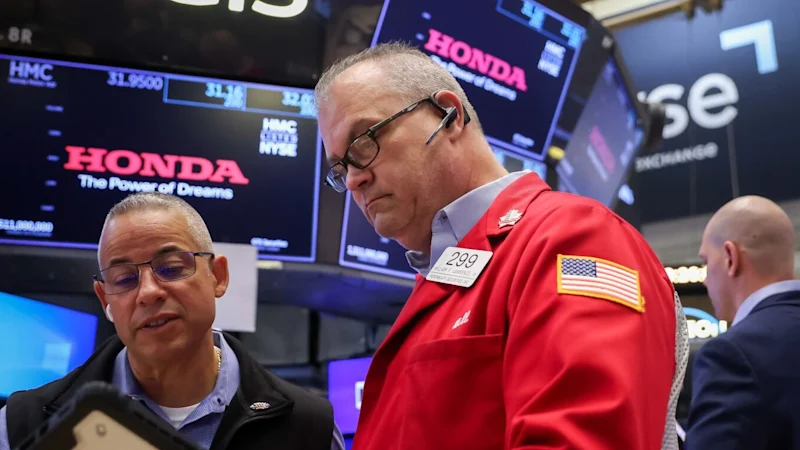
Australian shares are set to open lower after a fresh sell-off in artificial-intelligence stocks dragged Wall Street down, with Nvidia again leading the decline.
Futures indicated the ASX 200 would fall by 39 points, or 0.4 per cent, at the open after the index lost 0.4 per cent on Monday. The Australian dollar was also weaker at US67.42¢.
On Wall Street, the S&P 500 fell 1.2 per cent and was on course for a third consecutive decline. The technology-heavy Nasdaq Composite dropped 1.7 per cent, while the Dow Jones Industrial Average was down 395 points, or 0.8 per cent, in midday trading.
Nvidia fell 2.3 per cent, adding to pressure on the wider AI industry. The chipmaker has become one of the most influential companies in the sector, supplying processors used in AI technology and providing cash that has helped other businesses expand.
Investors are also weighing the consequences of chief executive Jensen Huang’s resignation last week. His departure has added to uncertainty surrounding Nvidia and the broader industry, which was already facing concerns that share prices had risen too far and that the sector could be caught in a bubble.
“The market was already worried about this risk before what happened at Nvidia,” Zhiwei Zhang, president and chief economist at Pinpoint Asset Management, said in a commentary. “Now the risk has become even more serious.”
Other chipmakers fell sharply. Broadcom lost 3.1 per cent, while Advanced Micro Devices declined 4.6 per cent. CoreWeave, which buys Nvidia chips and rents access to them through the cloud, fell 5.2 per cent, and GE Vernova, which is helping power AI data centres, dropped 3.2 per cent.
The next major test for Nvidia will come after the US market closes on Tuesday, when the company is due to publish its latest quarterly results. Interim chief executive Colette Kress is also expected to address investors.
Nvidia has repeatedly exceeded analysts’ forecasts and issued stronger-than-expected revenue guidance, leaving investors focused on whether its latest figures can maintain that record.
Concerns about possible restrictions on further AI data-centre construction have also grown after Democrats secured sweeping victories in this month’s US midterm elections.
The technology sell-off overshadowed an otherwise strong US earnings season. Companies in the S&P 500 are on course to report earnings per share for the summer that are almost 32 per cent higher than a year earlier, according to FactSet.
Elsewhere, L3Harris Technologies fell 2.6 per cent after officials in President Donald Trump’s administration suggested the contractor for the Federal Aviation Administration might be responsible for Friday’s nationwide ground stop. L3Harris said it was supporting the FAA’s investigation.
Summit Therapeutics dropped 14.6 per cent after saying the US Food and Drug Administration had indicated it could not approve the company’s application for a lung-cancer therapy. Tyson Foods provided some support to the market, rising 6.4 per cent after reporting stronger-than-expected quarterly profit, despite weaker revenue following lower beef sales.
US Treasury yields eased after last week’s rise prompted by higher-than-expected inflation. The yield on the 10-year Treasury fell to 5.14 per cent from 5.15 per cent, while Brent crude dropped 2.6 per cent to 93.35 US dollars a barrel.
Markets in Asia were also weaker, with South Korea’s Kospi falling 3.6 per cent and Japan’s Nikkei 225 down 2.4 per cent. Japan’s economy contracted in the latest quarter, while technology and AI-related shares came under pressure.
