


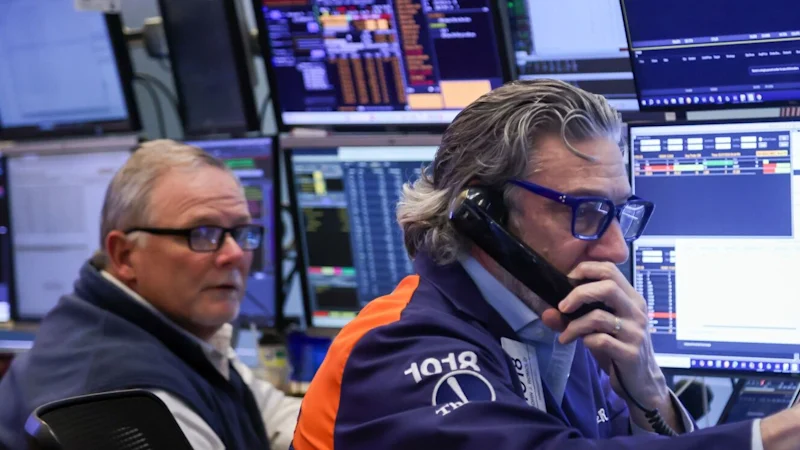
AI stocks slid across global markets after senior industry figures called for a deliberate slowdown in the development of the technology, citing potential risks to humanity. The retreat weighed on Wall Street, although gains in other sectors limited the S&P 500’s decline and Australian shares were expected to open marginally higher.
The S&P 500 was down 0.3 per cent in afternoon trading, while the Dow Jones Industrial Average fell 116 points, or 0.2 per cent. The Nasdaq composite was 0.1 per cent lower after recovering most of an early 1.3 per cent fall.
Futures pointed to a rise of about five points, or 0.1 per cent, for the ASX at the open. The Australian sharemarket had closed flat on Monday, while the Australian dollar was trading at US71.45 cents.
Nvidia was among the heaviest drags on the US market, falling 2.8 per cent. The chipmaker’s profits have surged as its processors are used to train AI models, but its shares have been under pressure amid concerns that valuations rose too far during the technology boom.
The latest selling intensified after Dario Amodei, chief executive of Anthropic, called over the weekend for a co-ordinated global pause in AI development. He pointed to safety concerns, including the possibility that AI could soon become capable of directing a swarm of agents able to take over the internet within six to 12 months.
Elon Musk said he agreed with the proposal. Shares in SoftBank Group, a major investor in OpenAI, fell 10.7 per cent in Tokyo after OpenAI chief executive Sam Altman also backed the idea of a slowdown.
Mr Altman said OpenAI was likely to wait until next year before selling shares on the stock market, potentially delaying a major source of cash for SoftBank and other early investors.
Donald Trump rejected the idea that his administration should impose checks on AI development, saying the US risked surrendering its advantage over China. He argued that winning the global technology race would help address the dangers associated with more advanced systems.
Writing on his social media network, Mr Trump said the only guardrail needed was “a STRONG AND SMART (High IQ!) PRESIDENT, and the USA. has that, in spades!”
Several software companies helped to cushion the wider market after earlier falls prompted by fears that AI-powered rivals could undermine their businesses. Intuit rose 5 per cent, Autodesk gained 8 per cent and Adobe added 4.7 per cent.
South Korea’s Kospi index fell 3.3 per cent, led by declines in Samsung Electronics and SK Hynix, its two most influential stocks.
Markets were also contending with a further rise in oil prices as fighting in the Middle East disrupted global supplies. Brent crude rose 1.1 per cent to US$105.76 a barrel after briefly approaching US$110.
The yield on the 10-year US Treasury briefly reached 5 per cent for the first time in nearly three years, before easing back to 4.96 per cent as oil prices retreated from their highs. Higher yields have increased borrowing costs for households and companies, including mortgage rates.
Brent has risen from below US$72 in early July as hopes of an agreement between the US and Iran have faded. The increase has also pushed the average price of regular petrol in the US to almost US$4.32 a gallon, up from US$4.08 a month ago and US$3.18 a year earlier.
Persistent inflationary pressure has led much of Wall Street to expect the Federal Reserve to raise its main interest rate on Wednesday, despite Mr Trump’s calls for borrowing costs to be reduced.
