


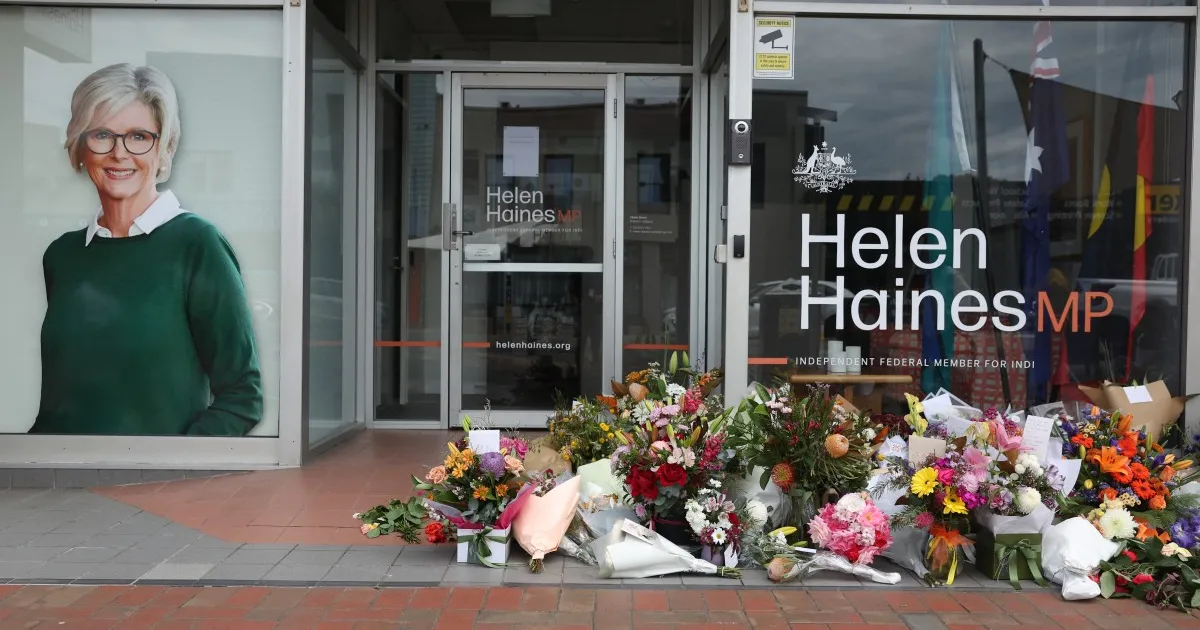
Australian independent MP Helen Haines has had both legs amputated after being struck by a car outside her office in Wangaratta, Victoria, in what Prime Minister Anthony Albanese described as a “deliberate attack”.
The 65-year-old politician’s right leg was amputated on Wednesday, two days after surgeons removed her left leg. She was flown to a Melbourne hospital following the incident and remains in a stable condition.
Her husband, Phil Haines, told reporters outside the hospital: “The good news in all this is that Helen is alive and she’s stable. That is the most important thing for our family.”
He added: “We are grateful and thankful that, at this stage, both her heart and her mind are in good shape.”
What happened to Helen Haines?
Police allege that Haines was retrieving something from the boot of her car in Wangaratta on Monday afternoon when a Toyota Land Cruiser drove past her. The driver is accused of turning around, veering towards her and pinning her against the vehicle.
Home Affairs Minister Tony Burke said the driver then reversed before allegedly ramming her again.
Brendan Nugent, 43, appeared in court on Wednesday but did not apply for bail or enter a plea. He faces charges of dangerous driving causing serious injury, intentionally causing serious injury and causing harm to a public official.
He has also been charged with cannabis cultivation and possession. Nugent will remain in custody until his next court appearance in February.
Victoria Police Chief Mike Bush said officers had found no direct previous contact between Haines and the accused. He said establishing the motive was “very much a centrepiece of the investigation”.
Police said they were examining all possible leads, including whether Nugent held radical anti-government views. His lawyer told the court that he had a rare neurological condition called idiopathic transverse myelitis.
Australian Federal Police Commissioner Krissy Barrett said there had been no specific intelligence warning of an imminent attack. Antiterrorism officers are involved in the investigation, although police believe the incident was isolated and have said there was no intelligence indicating a threat to Haines.
Threats against Australian lawmakers
The attack has renewed concern about the safety of Australian politicians, as police warn of growing online extremism and increasing abuse, threats and intimidation directed at lawmakers.
Threats against Australian MPs and electorate offices doubled between 2021 and 2025, with 1,067 incidents reported to police last year. Police charged 41 people with offences related to threats against parliamentarians during the same period.
Threats against candidates also rose by 17 per cent during the 2025 election campaign. Earlier this month, police charged three men over separate threats to politicians and government officials, while three others received court sentences.
Mr Albanese said the incident was a reminder that “the world is a more dangerous and divided place than it was a generation ago”. He said Australians should be able to expect politicians to carry out ordinary activities safely, “for goodness sake”.
Opposition politician James Paterson called for a review of personal security arrangements. He said Australian MPs were “by global standards uniquely accessible to the public”, but warned that attacks could fundamentally change democracy if serving in parliament became a serious risk to life.
Australian Security Intelligence Organisation director-general Mike Burgess warned last year that politically motivated violence was among the agency’s fastest-growing security concerns, driven by “grievance narratives, conspiracies and online echo chambers”.
Who is Helen Haines?
Haines entered parliament in 2019 after working as a nurse and midwife. She retained the rural seat of Indi in 2022 and 2025 and became known for campaigning on stronger climate action, political transparency and anti-corruption measures.
She introduced a bill for a federal integrity commission in 2021, which was defeated. The National Anti-Corruption Commission Act was passed the following year, and Haines later served as deputy chair of the parliamentary committee overseeing the commission.
Wangaratta Mayor Irene Grant said the attack had left the town, a regional centre about 250 kilometres north-east of Melbourne, in a sombre mood.
“What has happened to Helen has caused the community to step back in utter disbelief. We can’t believe it; people are horrified by what has happened,” she said.
