


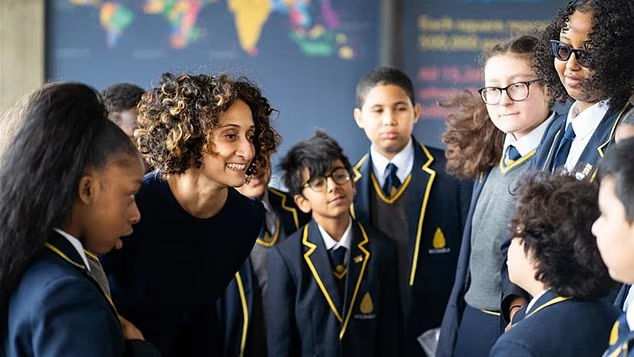
Katharine Birbalsingh has called for schools to replace multicultural displays centred on pupils’ ancestral flags with a shared sense of British identity, arguing that “multicultural patriotism” is the best way to unite children from different backgrounds.
Writing ahead of the publication of her new book, the headmistress said activities in which pupils are asked to bring flags representing their heritage risk reinforcing divisions rather than easing alienation.
She described seeing children carrying Jamaican, Palestinian, Turkish, Romanian and Pakistani flags on their way to school. The pupils had been asked to bring them in as part of a celebration of their cultures.
Almost all of those children, she argued, would have been born in Britain, with some having visited the countries represented by the flags only a few times. She said schools should instead emphasise what pupils share as residents of the same country.
At Michaela Community School in Wembley, north-west London, which she co-founded in 2014, the Union Jack is displayed and pupils sing the National Anthem. Birbalsingh said the school’s diverse intake was united by living in Britain, rather than divided by ethnicity or religion.
“The thing that unites the children at my very diverse and multicultural school is that they all live in Britain,” she writes. “What unites us is what we should celebrate.”
Birbalsingh argues for ‘multicultural patriotism’
Birbalsingh, who has been described as Britain’s strictest headmistress, said her proposed approach would allow children to retain their connections to other countries while developing a stronger understanding of Britain’s history, customs and values.
She argues that integration requires effort and that people arriving in a country need to learn its “origin story”, traditions and expectations. In her view, schools have a central role in creating that shared understanding.
“Multicultural patriotism” is presented as a national identity broad enough to include pupils with different backgrounds, but strong enough to place the country ahead of separate tribal, cultural or political loyalties.
Birbalsingh said her experience of teaching mainly ethnic-minority children in inner-city London had led her to question the effects of current approaches to diversity. She claimed that pupils often formed friendship groups along Bengali, Pakistani, African, Christian or Muslim lines.
She argued that some children were being encouraged to see themselves primarily as members of marginalised groups, with a shared belief that Britain was hostile to ethnic minorities becoming the basis of their identity.
Her criticism extends to what she describes as the “decolonisation” of school curriculums. She said lessons could present an overly narrow picture in which white people were portrayed as oppressors and non-white people as victims, while literature and history were routinely examined through the themes of racism, patriarchy and class.
Birbalsingh said this approach fostered “white guilt” among some pupils and a sense of victimhood among others. She argued that children should instead be taught values including duty, gratitude, hard work, sacrifice and personal responsibility.
She acknowledged that racism existed in Britain and that the country had a history of racial injustice. However, she said opposition to racism had shifted from a demand that everybody be treated with dignity and respect towards a broader ideology that interpreted society primarily through race and power.
In her view, this could produce unintended consequences. She cited the case of the Rotherham grooming scandal, saying staff had been nervous about identifying the ethnic backgrounds of alleged perpetrators for fear of being accused of racism. She also referred to concerns raised about Axel Rudakubana, saying a headteacher had faced accusations of racial profiling after raising concerns about him.
Birbalsingh stressed that she was not arguing racism was rare or insignificant. Rather, she said the emphasis on racial identity and “white guilt” could make it harder to judge people as individuals and could discourage institutions from acting on concerns.
She also criticised diversity initiatives in the arts, advertising and professional appointments, arguing that some ethnic-minority people wanted to be recognised for their ability rather than selected to satisfy a target.
Birbalsingh said she had rejected invitations to boards where she believed an ethnic-minority member was wanted primarily to improve the organisation’s appearance. She argued that such practices risked creating doubts about whether people had been appointed on merit.
The headmistress said Michaela’s ethos was deliberately built around common rules and expectations. Pupils greet teachers, thank them for lessons and are expected to accept responsibility for improving their own lives rather than making excuses.
She said one of her proudest moments came when about 400 pupils gathered to watch England play in the World Cup, waving St George’s flags and cheering for the same team.
Birbalsingh added that she had once been able to share such scenes without fearing a backlash, but now expected abuse from people who believed children from minority backgrounds had no right to identify with England. She said patriotism had been attacked both by some on the Left and by an increasingly ethnonationalist Right.
Her book argues that both extremes should be rejected. She said progressive politics could encourage guilt and grievance, while Right-wing identity politics could turn anger about national change into hostility towards neighbours.
She called for a shared future based on forgiveness, without denying the injustices of the past or excusing wrongdoing. Different identities, she said, could exist within a wider national identity, but multiculturalism would only work if people were prepared to place the country and the common good above their own group interests.
Birbalsingh’s book, Diversity Is Not Our Strength, is due to be published on November 12.
