


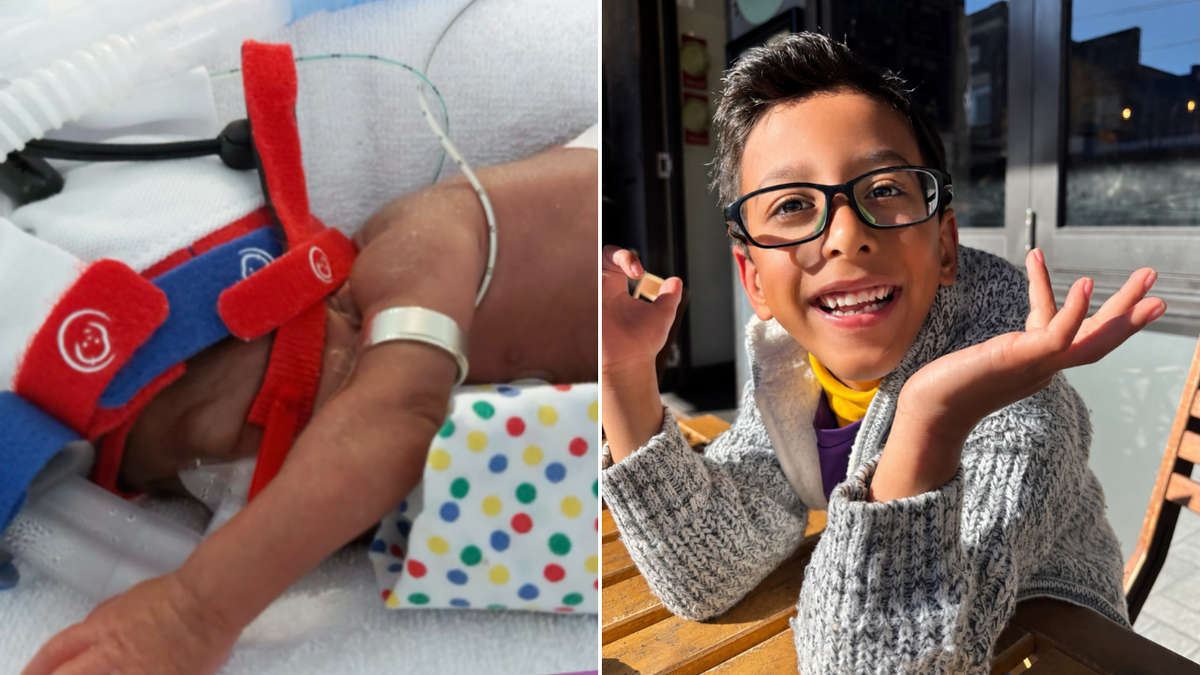
Benji Castelletto was born at just 25 weeks’ gestation, weighing 550g, after a life-threatening pregnancy complication forced his delivery. Six years later, the former micropreemie is thriving, preparing to finish kindergarten and helping his family raise money for other premature babies.
His mother, Hazel Castelletto, had struggled with endometriosis and believed she might never become pregnant. She conceived naturally in 2019, shortly before she and her partner Johnny were due to explore IVF.
“I didn’t actually think I was going to fall pregnant,” said Ms Castelletto, now 43 and from Sydney.
The pregnancy initially felt like an unlikely blessing. But at 20 weeks, she developed an excruciating headache and was diagnosed with pre-eclampsia, a serious condition associated with dangerously high blood pressure and the risk of organ damage.
She was transferred to The Royal Hospital for Women in Randwick, where doctors prepared for the possibility that her baby would need to be delivered extremely prematurely.
“I didn’t understand anything. I was only halfway through my pregnancy,” Ms Castelletto said. “I didn’t even look pregnant yet, I hadn’t even started to feel the kicks. Nothing.”
Doctors gave her medication to manage her blood pressure, including magnesium, and steroids to help accelerate her baby’s lung development. Every extra week of pregnancy was considered important to his chances of survival.
At 23 weeks, Ms Castelletto and Johnny had to confront whether their baby would be resuscitated if he arrived. She was told he could face significant challenges, including disability, blindness or being non-verbal.
“It was the hardest week for me,” she said. “I knew if he was born this early, there was a high chance he would face many challenges later in life: I was told he could be disabled, legally blind, non-verbal. What kind of life would that be like for a child?”
The couple decided not to resuscitate if their son was born at 23 weeks. Ms Castelletto remained on bed rest and reached 24 weeks before aiming for the next crucial milestone.
When irregular blood results indicated that the pregnancy could no longer continue safely, Benji was delivered by emergency caesarean section at 25 weeks — 15 weeks before his due date.
Benji spent six months in neonatal intensive care
He was taken immediately to the neonatal intensive care unit, where he was placed on breathing support inside a humidicrib. At 550g, he was classed as a micropreemie — a baby born before 26 weeks and weighing less than 800g.
Ms Castelletto did not see her son before he was taken away by the medical team. When she woke in recovery, her first question was whether he was alive.
“I did not think I missed out on anything because the priority I think as a NICU mum is the baby,” she said. “The first question I asked the doctor when I came to in recovery was: Is he alive?”
Seeing Benji surrounded by tubes and wires was overwhelming. “I remember saying to Johnny, ‘We made it’,” she said. “I actually couldn’t see much of Benji — there were so many doctors and his body was covered in tubes and wires. But I just wanted to be with him.”
Instead of breastfeeding, Ms Castelletto began expressing milk so it could be delivered through a feeding tube. It was 34 days before she was able to hold her son for the first time, with four nurses needed to lift him safely from his incubator.
“He was small. I remember him being so small and I couldn’t feel him because there was so many wires attached to him,” she said. “I was happy that I could touch him but I was also angry that that’s the way I had to hold my child for the first time.”
Benji remained in intensive care for six months. His mother said one of the most difficult parts was leaving the hospital each day without knowing whether he would still be alive when she returned.
“I would leave and sit in the carpark, not knowing if he’d be alive when I came back the next day,” she said. “I think that was the most saddest part of the entire process.”
Bringing Benji home was a moment of joy, but it also brought fresh anxiety for his parents, who were suddenly without the machines, nurses and constant monitoring of the hospital.
“When Benji finally came home, I thought the hardest part was over,” Ms Castelletto said. “I was so excited, but no one prepares you for the fear of being alone without the machines, nurses and constant monitoring. ‘Is he breathing? Is his feeding tube in the right place? What if something goes wrong?’”
Benji has since continued to defy the fears surrounding his premature birth. Now six, he is at school and preparing to complete his final term of kindergarten.
Family raises money for premature babies
The family later discovered that Benji’s humidicrib and other vital equipment had been funded by Australian charity Running for Premature Babies.
Determined to support other families, they created Food for Thought, an annual event serving authentic Indian food in homes across Sydney. The money raised goes towards hospitals and equipment used to care for premature babies.
“We wanted to help give other families the happy ending we were fortunate to experience. Rather than simply asking for donations, we wanted to give something back,” Ms Castelletto said.
After three events, Food for Thought has raised $65,000. The family is preparing for its fourth event on November 8, continuing a fundraising effort inspired by Benji’s survival and the care he received during his six months in neonatal intensive care.
