


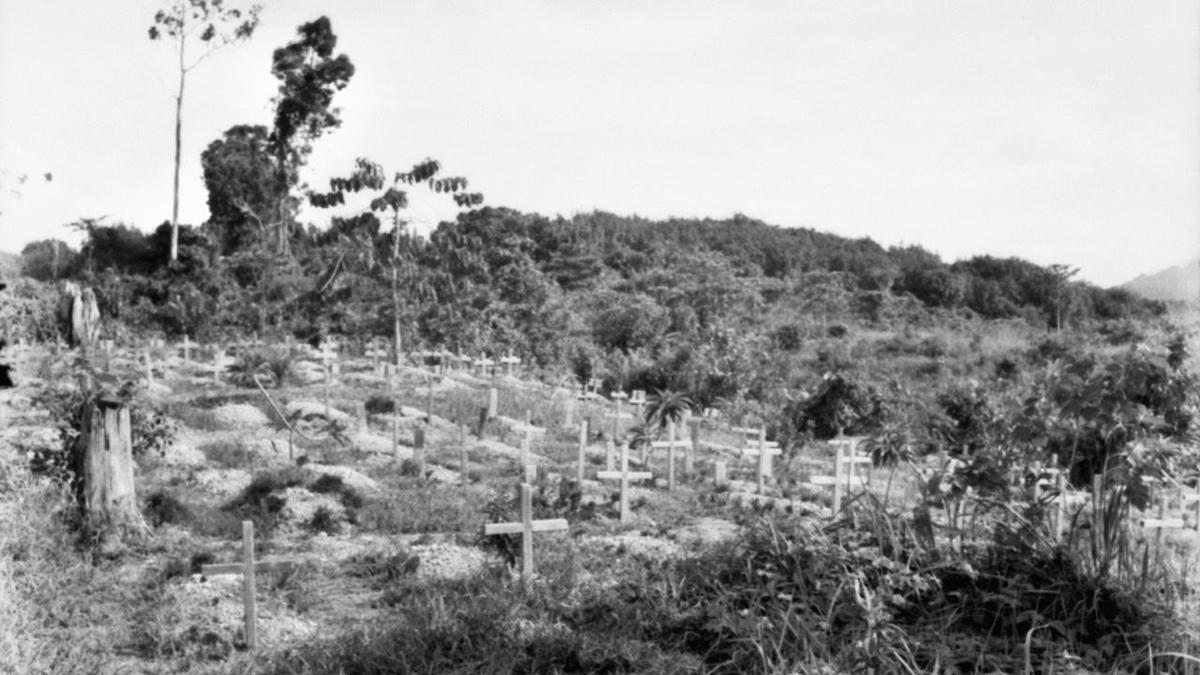
Two planned rescue missions that might have saved hundreds of Australian and British prisoners of war from the Sandakan death marches were abandoned because of intelligence failures, disobeyed orders and incompetence, historian Lynette Silver has claimed.
In her new book, Operation Kingfisher: Unravelling Sandakan’s Darkest Secret, Ms Silver argues that almost 850 Australian prisoners and 193 British prisoners could have been rescued if the first operation had gone ahead by April 30, 1945.
A second mission was later proposed after fresh information suggested the Sandakan camp had not been emptied. It too was cancelled, meaning 37 Australian and 16 British prisoners who remained there were not liberated.
Ms Silver said the same errors were repeated during the second attempt, with field intelligence officers relying on villagers’ reports that the camp had been abandoned rather than confirming the position themselves.
“The same awful mistakes were made that had been made with the first one – poor judgment, not following orders, incompetence,” she said.
“As a result, the ones who were still left alive at Sandakan couldn’t be rescued and we lost everybody in the end.”
Sandakan rescue missions abandoned
More than 1,000 Australian and British prisoners were held at Sandakan in early 1945, where they had been forced to maintain a Japanese airfield. After Allied bombing put the airfield out of commission and an Allied landing was threatened, the Japanese marched most of the prisoners towards Ranau, in Borneo’s interior.
Many prisoners died from starvation, illness and exhaustion along the 260km route. Those unable to continue were killed, while prisoners left behind at Sandakan also died or were killed.
Only six Australians among the more than 1,000 prisoners sent to Ranau survived the war. The Australian War Memorial records that 2,428 Allied prisoners, mostly Australians, died at Sandakan, on the three death marches or at Ranau.
Ms Silver said the second rescue mission was cancelled after the camp was wrongly assumed to be empty. Orders were then issued to bomb and strafe Sandakan, killing prisoners in the process.
She also alleged that senior Australian military officials later sought to conceal what had happened. General Tom Blamey was said to have claimed that US General Douglas MacArthur had refused to provide air transport for the first rescue mission.
Ms Silver described that explanation as a “total fabrication”, saying General MacArthur had approved the operation.
“It was a story invented by General Blamey to cover up the fact we had lost all these people,” she said.
Australian authorities later decided that relatives should be told only that their loved ones had “died while prisoner of war in Borneo”. Ms Silver said information was withheld because officials believed families had already suffered enough, while newspaper editors agreed to report the Japanese atrocities only in broad terms.
“There was a conspiracy to keep as much as possible from the public,” she said.
She said incomplete information helped fuel reports that prisoners had been forced to dig their own graves before being beheaded, when in reality many had died or been killed on the death marches.
“It was done with good intent at the time but the long-term damage is absolutely enormous because you’ve got these families with half-baked stories and unresolved grief,” Ms Silver said.
Craig Tibbitts, a senior historian at the Australian War Memorial, said that whether one or two rescue operations had been planned, the episode amounted to “a botched affair”.
“If the Services Reconnaissance Department had done a better job on gathering intelligence and communicating that back to higher headquarters, then perhaps things could have been different,” he said.
Japanese officers at Sandakan were later tried as war criminals, with those convicted of brutality or murder imprisoned or executed. One prisoner was beheaded at Sandakan just five hours before Japan surrendered.
