


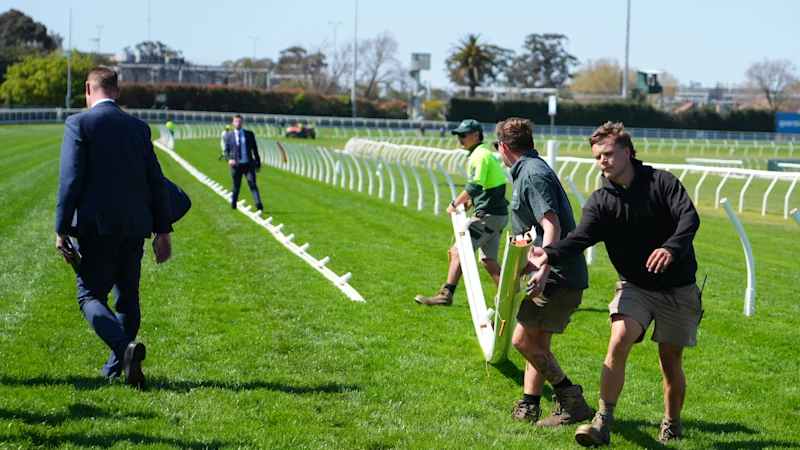
A Caulfield track safety review has been ordered after jockeys raised concerns about loose and uneven patches of ground before Saturday’s Group One meeting, prompting officials to move the inside rail shortly before racing began.
The Melbourne Racing Club instructed ground staff to shift the rail an additional four metres along the home straight, keeping the affected section out of use. The change covered the 350 metres from the turn to the winning post.
The issue was identified during a routine inspection, when several track-repair “plugs” near the inside rail appeared uneven or loose. The plugs are used to fill divots and small holes in the racing surface, and pre-race images showed jockeys able to lift large clumps of turf.
Racing Victoria stewards said they had found several areas of concern and ordered the alteration “out of an abundance of caution”. The Victorian Jockeys Association said a number of riders had reported safety concerns before the first race and were satisfied with the response.
Jockey Patrick Moloney said the surface was satisfactory after the rail had been moved, although the revised layout made the straight difficult to navigate. “You go from a normal position to an obscure position in the straight,” he told Racing.com.
The Melbourne Racing Club said the use of plugs was a routine maintenance practice at racecourses. “With the safety of horses and riders paramount, the decision was made to move the rail out as a precaution,” it said.
The club said it would begin a review immediately after Saturday’s meeting. The incident comes after the MRC faced criticism from punters during the winter over the condition of its Caulfield and Sandown tracks, although the Caulfield surface had performed better in recent weeks.
Caulfield is due to host the $3 million Group One Guineas on October 10, followed by the $6 million Caulfield Cup the following Saturday. Almost 30,000 people attended last year’s Caulfield Cup.
The MRC also faced scrutiny in June after two barrier attendants were caught in starting barriers that had accidentally been reversed into a lake at Sandown. They were later removed with a crane.
