


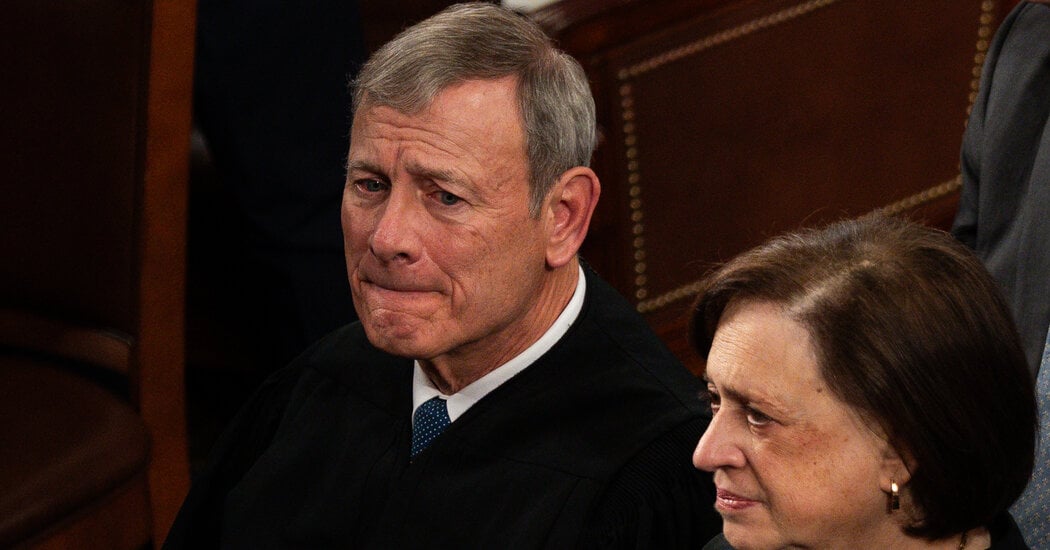
Chief Justice John Roberts has been left isolated at the US Supreme Court after dissenting alongside its three liberal justices against a ruling allowing Donald Trump’s $400 million White House ballroom project to continue.
The court’s five other conservative members said the National Trust for Historic Preservation was unlikely to have the legal standing required to challenge the construction. They did not rule on whether the project itself was lawful, leaving that question to further proceedings in the lower courts.
In a rare and unusually forceful dissent, Mr Roberts said the construction was “likely unlawful” because Congress had not expressly authorised the building of a new structure on federal parkland in Washington DC.
The ruling clears the way for work to resume above ground at the site of the demolished East Wing, despite lower-court findings that the project should be halted. The Supreme Court said the administration was likely to succeed in showing that the preservation group could not bring the case and that other factors favoured allowing construction to proceed.
Roberts warns of limits on presidential power
Mr Roberts, who oversees emergency appeals from the federal courts in the capital, had issued a temporary stay earlier in August to allow the justices time to consider the administration’s application. The final order replaced that temporary measure.
He rejected the majority’s view that the preservationists’ concerns amounted only to offence or distaste at the proposed building’s appearance. The chief justice argued that Alison K Hoagland, an architectural historian and National Trust member who regularly visits the White House, had identified a specific aesthetic injury.
Her concern was that the ballroom would overshadow the existing building and damage what Mr Roberts described as its message of “republican simplicity”. He compared her interest in viewing the White House with earlier cases recognising that environmentalists could suffer a legally valid injury from changes to wildlife or natural landscapes they regularly visited.
Mr Roberts also drew on the words of Theodore Roosevelt and Winston Churchill in arguing for the preservation of historic buildings. He said the White House was an iconic national structure whose symbolism and history were inseparable from its architecture.
The administration has argued that the wider East Wing project includes essential security improvements, including a below-ground military installation and a more secure venue for major official events. Court documents indicate that crews have been working for long hours, with the framework expected to be completed in November and the full project scheduled for August 2028.
Mr Trump welcomed the decision, describing the legal challenge as baseless and saying the completed ballroom and military complex would be a source of national pride.
Brent Leggs, president and chief executive of the National Trust, said the group was disappointed by the ruling but welcomed the chief justice’s dissent. He said the decision was not a final ruling on the merits and maintained that a president did not have unilateral authority to demolish and redesign the White House without congressional approval.
A rare break with the court’s conservatives
The outcome marks an unusual defeat for Mr Roberts, who has generally been able to build majorities across the Supreme Court’s ideological divide. During the term that ended in June, he was in the majority in 96 per cent of argued cases, more than any other justice.
He wrote several important rulings that checked aspects of Mr Trump’s authority, including decisions restricting the use of emergency powers to impose tariffs, blocking an attempt to limit birthright citizenship and preventing the immediate removal of a member of the Federal Reserve board.
In each case, Mr Roberts assembled a coalition comprising the three liberal justices and at least one of Mr Trump’s appointees. In the ballroom case, however, he could not secure a fifth vote.
That result was particularly striking because Mr Roberts has long been associated with a narrow approach to the question of who is entitled to sue the government. As a young lawyer in the Reagan administration, he argued that an environmental group lacked grounds to bring a case, and later wrote in favour of tougher limits on legal standing.
The majority said accepting the preservationists’ argument could create a situation in which almost any citizen could challenge any government action they disliked. Mr Roberts took the opposite view, saying the distinctive nature of the White House and Ms Hoagland’s established interest in viewing it made her injury concrete and particularised.
The Supreme Court’s order allows construction to continue while the legal battle proceeds. But the four-justice dissent has placed the chief justice’s concern over congressional authority and presidential power at the centre of the dispute, even as the court declined to decide the project’s ultimate legality.
