


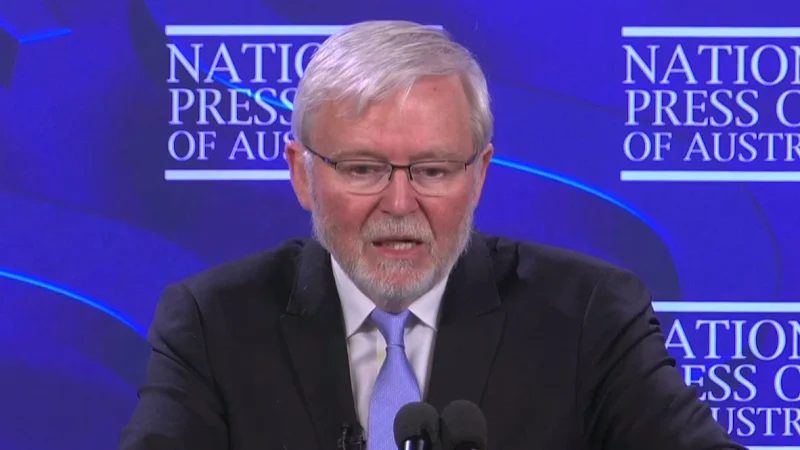
Former Australian prime minister Kevin Rudd has warned that there is roughly a one-in-three chance China could take military action against Taiwan in 2028, a move that could draw in the United States and Australia.
Speaking in Canberra, Mr Rudd stressed that he was describing an “increased possibility”, rather than predicting that conflict was likely. He said the risk had risen as China’s military capabilities strengthened and the strategic balance shifted in Beijing’s favour.
He identified three developments that could shape China’s calculations: Xi Jinping’s expected reappointment as Communist Party general secretary in October 2027, Taiwan’s presidential election in January 2028, and the stance adopted by the US during the final year of President Donald Trump’s term.
Mr Rudd said a victory for Taiwan’s ruling Democratic Progressive Party could be viewed by Beijing as a trigger, given its longstanding association with Taiwanese sovereignty. China’s 2005 anti-secession law allows the use of “non-peaceful means” if Beijing concludes that peaceful reunification is no longer possible.
He said the possibility of a Chinese move against Taiwan should not be treated as a probability, but argued that the changing circumstances warranted greater attention to deterrence. “We just need to be mindful of an increasing level of risk, but still in the possibility stakes, not the probability stakes,” he said.
Mr Rudd also backed continued investment in the AUKUS security partnership, including Australia’s plans to acquire nuclear-powered submarines, as part of efforts by the US and its allies to discourage Chinese military action.
Taiwan’s government has said it has no plans to make a formal declaration of independence, instead seeking to preserve the island’s existing de facto sovereignty. Beijing regards Taiwan as part of China, despite the island’s self-government since 1949.
Mr Rudd, who served as Australia’s ambassador to the United States until 2026, is now president and chief executive of the Asia Society.
