


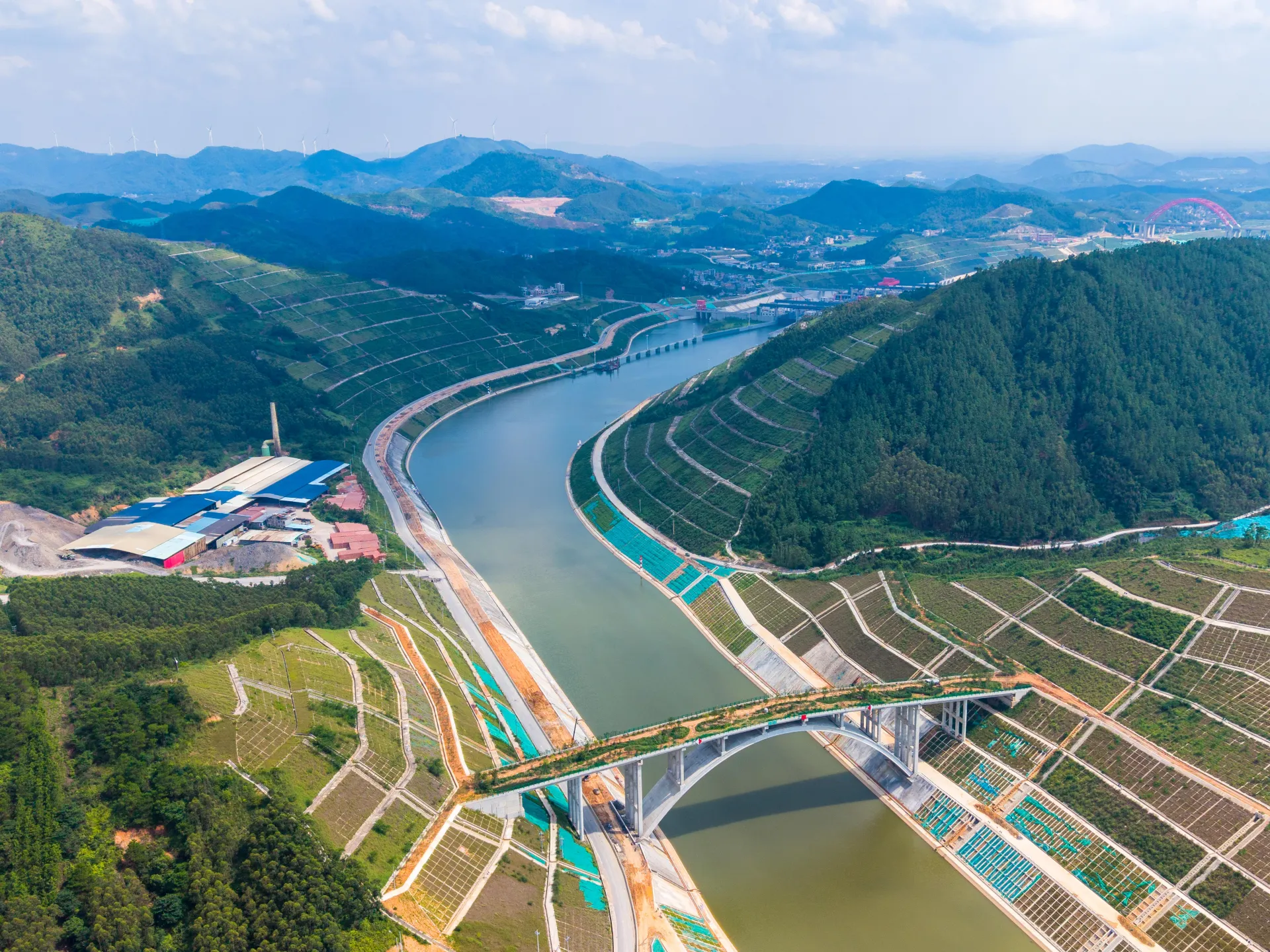
China is opening the Pinglu Canal in Guangxi, creating a new river-to-sea route intended to bring the country’s south-western provinces closer to Southeast Asian markets.
The 134km waterway links the Xijiang River with the Beibu Gulf, the north-western arm of the Gulf of Tonkin between southern China and northern Vietnam. It is the first modern river-to-sea canal built by communist China.
Officials say the canal will cut shipping distances between inland areas and Southeast Asia by about 560km and reduce logistics costs by between 18 and 30 per cent. Transport savings alone are expected to exceed 5 billion yuan, or about 700 million dollars, each year.
The canal, which has cost an estimated 72.7 billion yuan, will accommodate vessels carrying up to 5,000 tonnes. It is designed to allow river ships to reach berths at Qinzhou port without transferring cargo to other vessels.
Pinglu Canal opens a shorter route to Southeast Asia
The project is a central part of China’s New International Land-Sea Trade Corridor, which connects the south and south-west of the country with Southeast Asia and wider international markets.
The network extends inland to major centres including Chongqing and Chengdu, as well as the provinces of Guizhou and Yunnan. Goods can then travel through Guangxi to Beibu Gulf ports before being shipped overseas.
Guangxi officials have described the expected benefits as “tangible gains”, arguing that lower operating costs will support both domestic and international trade.
The canal is opening as commercial ties between China and Southeast Asia continue to expand. China’s customs authorities recorded bilateral trade worth about 4.34 trillion yuan in the first half of 2026, an increase of 18.2 per cent on the same period a year earlier.
Beibu Gulf Port has also expanded rapidly. Its container-handling capacity rose from 2.28 million twenty-foot equivalent units in 2017 to 10.06 million in 2025, while its shipping network now reaches major ports across South-east Asia.
Direct commercial sailings to Can Tho in southern Vietnam are scheduled to begin after the canal opens. A train carrying sodium bisulfate from Chongqing has already arrived at the port of Nanning, Guangxi’s capital, in preparation for the new trading route.
Industrial plans and canal charges
Guangxi is seeking to build an industrial zone along the waterway, known as the Pinglu Canal Economic Belt. The plan is intended to attract manufacturing and link factories more closely with ports, transport infrastructure and supply chains.
Industries being targeted include non-ferrous metals and critical minerals, green chemicals, artificial intelligence and information technology. Industrial areas are also being developed near ports to reduce the distance between production sites and shipping facilities.
Commercial vessels will be allowed to pass through the canal’s three water gates free of charge until December 31 2026. From January 1 2027, operators will pay one yuan, about 14 US cents, for each tonne of a vessel’s capacity on every passage.
The trial charge is due to remain in place until September 2031.
The canal forms part of the wider Belt and Road Initiative, President Xi Jinping’s infrastructure and trade programme linking China with markets in Europe and Africa through roads, railways and ports.
Thousands relocated during construction
The project required the relocation of 2,764 households, comprising 11,228 people across four counties and county-level cities in Guangxi.
In Hengzhou, agreements were signed to clear 368 homes. The buildings were demolished across an area of 84,200 square metres, with 1,221 people temporarily resettled.
Authorities said the relocation programme included 21 different housing designs intended to reflect residents’ customs and needs, including the layout of reception rooms, areas for drying crops, poultry enclosures and storage for agricultural chemicals.
In Shaping, the largest resettlement town, residents were offered four-storey homes covering 420 square metres, with some properties including shop fronts facing the street.
Some families also moved centuries-old trees to their new homes, including a camphor tree said to be 217 years old. The resettlement process was completed in 39 days and was accompanied by promises of construction work and vocational training.
In Xinfu, where Fenghuangping village once stood, one displaced resident said: “There is no longer a village called Fenghuangping, but with the Pinglu Canal, tomorrow will be better.”
The canal is intended to provide China with a shorter route to a major trading region at a time when governments are seeking alternative transport and supply networks. Its opening gives inland south-western China a direct water connection to the Beibu Gulf and overseas markets.
