


The US Supreme Court has blocked the Trump administration’s plan to use the Postal Service to screen mail ballots, placing voting by post at the centre of a fresh dispute over American elections.
The scheme, challenged by two dozen states and several voting rights groups, would have required states to share voter lists with the Postal Service before ballots were processed. Election officials warned that the system could disenfranchise voters and create confusion.
Donald Trump signed the executive order introducing the plan in March, after returning to the White House while continuing to falsely claim that the 2020 election, which he lost, had been rigged. He has repeatedly attacked postal voting, calling it “mail-in-cheating”, despite voting by post himself in a Florida special election in March 2026.
The Postal Service’s long relationship with elections
The ruling is the latest episode in a much longer and often contentious relationship between the US postal system and the country’s elections.
The network was established partly to connect citizens across the new republic and help them share information. The Post Office Act of 1792 reflected the founders’ belief that an extensive postal system would spread knowledge of government laws and proceedings, while low postage rates for newspapers were intended to support an informed electorate.
James Madison warned that high postage costs would restrict the “distribution of knowledge and information throughout the Union”. The legislation also protected the privacy of correspondence and gave Congress control over the creation of new postal routes.
As the country expanded, so did the system. The number of post offices rose from 75 in 1790 to more than 28,000 by 1860, according to Postal Service records.
Early efforts to enable people away from home to vote included measures in Pennsylvania and New Jersey allowing soldiers to cast absentee ballots during and after the War of 1812.
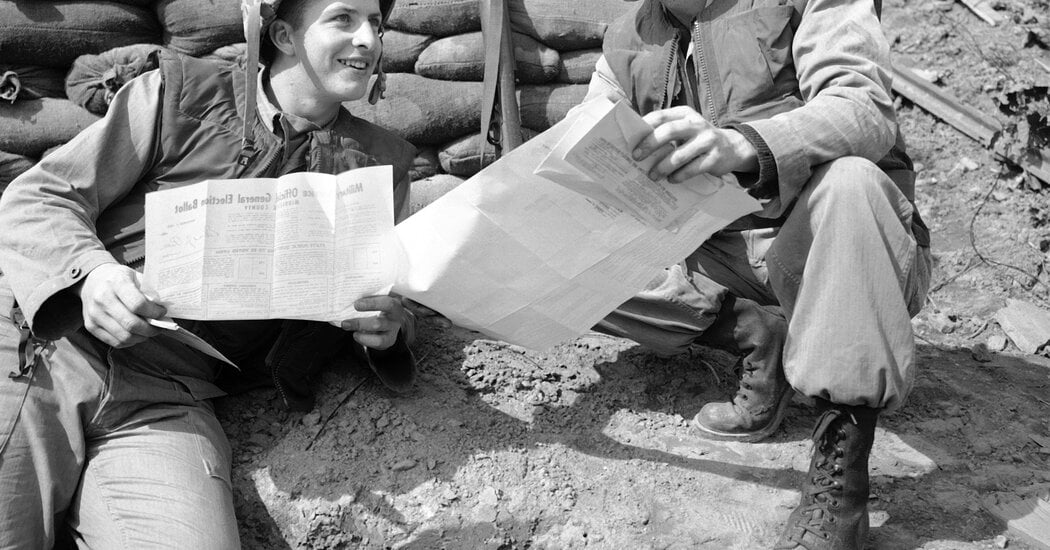
That practice grew significantly during the Civil War, when hundreds of thousands of Union voters were serving far from their usual polling stations. Nineteen Union states permitted troops to vote away from home in the 1864 presidential election, using field polling stations, proxy voting or the post.
The arrangements were disputed. Allegations included ballot-stuffing and pressure on soldiers from officials supporting Abraham Lincoln’s re-election campaign. In Ohio, troops voted in camps and hospitals, with election officials sending the results home in specially printed envelopes.
One soldier, Pvt Isaac Walters, wrote to his sister-in-law before the 1864 election after watching men leave a Union hospital in Virginia on furlough to vote. “They will all get to vote for President I Suppose,” he wrote.
The Civil War established a lasting precedent that Americans unable to reach a polling station should not necessarily lose their right to vote. Absentee voting later extended beyond the military, while subsequent wars prompted further efforts to accommodate voters away from home.
Mail voting becomes a political flashpoint
The Postal Service itself underwent a major change after a federal postal workers’ strike in 1970, when Congress replaced the cabinet-level Post Office Department with the largely self-financing United States Postal Service.
Its traditional business later declined as internet use grew. Total mail volume reached 213 billion items in 2006 before falling sharply; by 2020, first-class mail volume was about half its peak two decades earlier.
During the coronavirus pandemic, states made it easier to vote by post for the 2020 election on public health grounds. Nearly 70 million Americans used mail ballots, even as postmaster general Louis DeJoy introduced operational changes and cost-cutting measures that slowed some deliveries.
Trump amplified unfounded claims of widespread fraud in mail voting, while Democrats accused his administration of attempting to suppress votes. The Postal Service became the subject of congressional hearings, legal challenges and a wider political fight over access to the ballot.
The Supreme Court’s decision to block the latest ballot-screening plan brings that dispute back to the postal network, which was originally designed to connect citizens and circulate information throughout the United States.
