


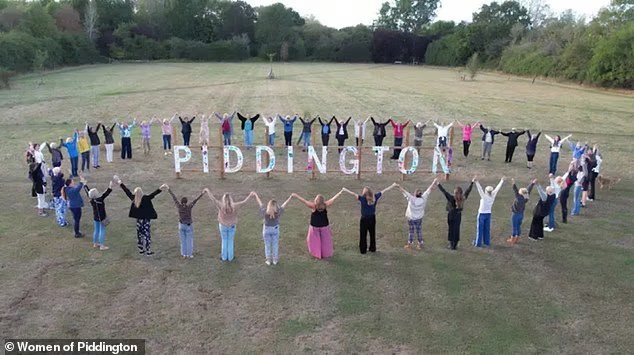
Residents of Piddington in Oxfordshire have voted in a symbolic independence referendum staged in protest against plans to accommodate up to 1,256 asylum seekers at a former military site nearby.
The parish council announced the vote had taken place after villagers went to the polls, although the result has no legal force and the community remains part of the United Kingdom.
Campaigners hope the independence referendum will send a message to Westminster about the proposed use of the former Bicester Garrison, where the Home Office is seeking planning permission for temporary asylum accommodation.
The plans include modular accommodation, health and welfare facilities, roads, security infrastructure and recreational areas. The planning application remains under consideration, with representations due by September 17.
Piddington has a population of about 350, meaning the proposed number of asylum seekers would be more than three times the size of the village.
Residents opposing the scheme say the local infrastructure and roads are not equipped to support a development of that scale. Particular concern has been raised about pedestrian access to the site.
Parish councillor Mike Nixon said there were no pedestrian access areas at the proposed accommodation site and that the nearest path was about a mile and a quarter away along a busy, unlit road.
The Government’s travel plan describes pedestrian access as “limited” and says walking is “not recommended”. It adds that cycling and public transport options may be provided.
The Government has said the former military site would be designed to be largely self-contained to limit its impact on surrounding communities.
A Home Office spokesman said ministers were working to “fairly house asylum seekers” across the country while closing asylum hotels. The department said it engaged with local authorities and police forces to address the safety and security of people living nearby.
The application does not represent a final decision on the site’s future, the spokesman added, as the proposal remains subject to planning, due diligence and other approvals.
Parish council chairman Tim McNally said residents had been driven to hold the vote because they believed the Government had failed to engage with their concerns.
“If we’ve got to do something, it has to be proportionate, and that is not proportionate – that is us having to assimilate into them, not them assimilating into us,” he said.
The referendum followed an earlier vote in July, when 96 per cent of those who took part backed holding an independence referendum. The date of that ballot, July 4, was chosen because of its association with the American Declaration of Independence.
Herbert Owen, a 76-year-old resident known as Herbie, described the latest vote as the “Battle of Britain”.
“It means everything our grandparents, our parents fought for – today is the Battle of Britain,” he said. “This isn’t just about Piddington, this is about our whole country. This Government is destabilising our country.”
Residents have stepped up their campaign in recent weeks. A letter signed by 133 women from the village warned female MPs that “life as we know it will be destroyed” if the plans went ahead.
More than 20 women have also reportedly enrolled in self-defence classes after residents said they had been advised by police to take precautions.
Louise Brooker, 51, said the village would effectively be “on lockdown” if the accommodation was approved, while Melise Witkin, 59, said the issue was one of safety rather than wealth or deprivation.
The proposed development has attracted support from several opposition politicians. Reform UK leader Nigel Farage said he would back other communities seeking to hold similar symbolic votes, while Reform MP Rupert Lowe described the Piddington referendum as something that should be “lauded”.
Former Conservative Home Secretary Suella Braverman also visited the village before the vote and said the plans would “dramatically transform the character of the village”.
Shadow home secretary Chris Philp said residents were concerned about the safety of women and girls, and used the dispute to argue for leaving the European Convention on Human Rights.
The Home Office first announced the Bicester proposal in June as part of efforts to reduce reliance on asylum hotels. No final decision has been made on whether the former garrison will be used for asylum accommodation.
