


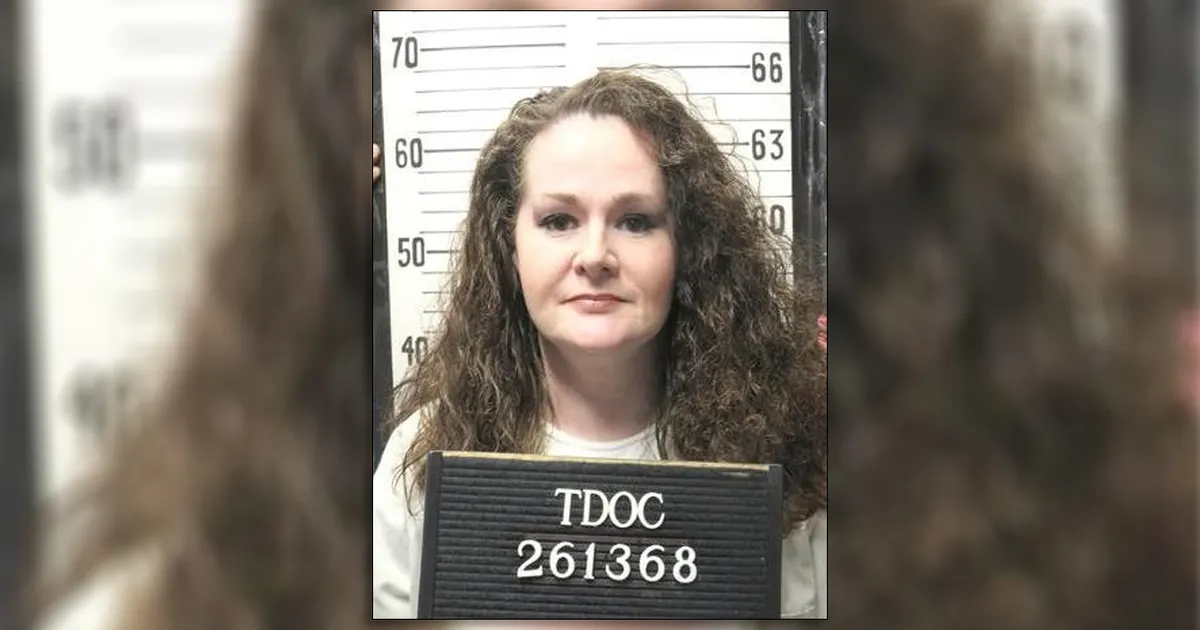
Tennessee officials halted the attempted lethal-injection execution of Christa Gail Pike after the 50-year-old remained alive, breathing and audibly snoring for more than an hour inside a Nashville prison, according to media witnesses.
Pike, the only woman on Tennessee’s death row, had been due to die at Riverbend Maximum Security Institution on Wednesday, 30 September. Her execution was delayed for most of the day by a legal challenge before the US Supreme Court ultimately allowed the state to proceed shortly before 6pm.
Witnesses said prison officials appeared to administer two doses of pentobarbital. Pike continued to move, breathe and make sounds, however, with the execution eventually brought to an end without confirmation from the Tennessee Department of Correction that she had died.
Christa Pike execution halted after witnesses hear snoring
The media witnesses entered the viewing area after 6.40pm and heard faint crying before the curtain to the execution chamber opened at about 7.27pm.
Pike spoke briefly with a spiritual adviser and sang “I Love You So Much” before the injection began. She later complained that a vein in her arm felt as though it was about to burst and said that a particular spot was throbbing.
Witnesses described her taking several deep breaths, lifting her head and moving her legs. She also appeared to raise her body from the gurney and at one point kicked off the sheet covering her.
The curtain was closed at about 7.46pm, then reopened three minutes later. By then, witnesses said Pike was snoring loudly. The curtain was closed again shortly after 8pm, although her breathing and snoring could still be heard from behind it.
Witnesses repeatedly asked prison staff to open the curtain. Instead, they said, the viewing area was left with only the sound of Pike breathing until the microphone was cut off at about 8.53pm and they were ordered to leave.
“We have a lot of questions about what we saw and what we did not see,” said John North, a reporter for WBIR who was among the official witnesses.
Steven Hale of the Nashville Banner said: “I cannot emphasise enough how much of whatever just happened happened behind a closed curtain.”
Victoria Gessner of WKRN, who has witnessed previous executions in Tennessee, said: “Nothing about today was normal. The court delay was just the tip of the iceberg.”
Emergency vehicles were seen arriving at and leaving the prison as witnesses spoke to reporters outside. Pike’s lawyers later said she was receiving treatment at a hospital, but that they had not been told her condition.
The Tennessee Department of Correction did not immediately issue an explanation for the failed execution. Its spokesman, Dorinda Carter, told witnesses she could not provide details about what had happened.
Legal challenge preceded Tennessee execution attempt
The execution had initially been scheduled for 10am, but the Sixth US Circuit Court of Appeals issued a temporary stay roughly an hour beforehand. The court said it needed to consider whether evidence of Pike’s childhood sexual abuse had been fully addressed during sentencing.
The Tennessee attorney general’s office appealed to the US Supreme Court, which overturned the stay in a brief order shortly before 6pm. The state then resumed preparations for the lethal injection.
Pike’s lawyers filed a further emergency application after the procedure began, arguing that leaving her alive and in pain violated her constitutional protection against cruel and unusual punishment.
The case was the second time in 2026 that Tennessee officials have been unable to complete an execution. In May, the lethal injection of Tony Carruthers was abandoned after staff spent more than an hour trying unsuccessfully to establish intravenous access.
Pike was sentenced to death for the 1995 murder of 19-year-old Colleen Slemmer, a fellow job-training student in Knoxville. Prosecutors said Pike lured Slemmer into a wooded area before attacking her with a box cutter and a piece of asphalt.
Pike was 18 at the time of the killing. Her lawyers have argued that her death sentence was an outlier and that jurors did not hear the full extent of her childhood sexual abuse or her mental-health difficulties, including bipolar disorder and post-traumatic stress disorder.
Slemmer’s mother, May Martinez, had travelled from Florida to witness the execution after waiting decades for Pike’s sentence to be carried out. Martinez has said that the failure to complete the procedure compounded the trauma for her family.
