


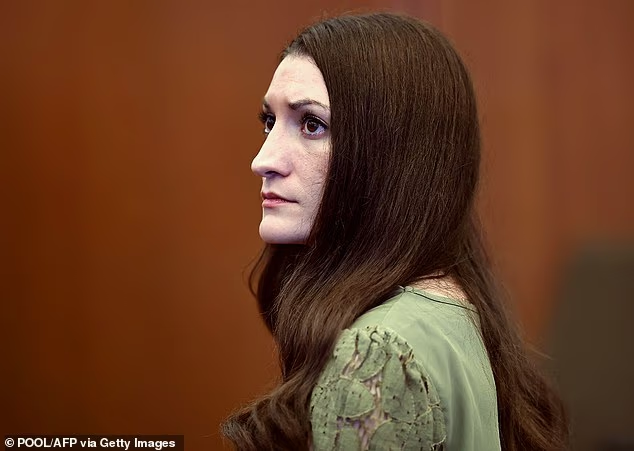
Three jurors who deliberated in the Lindsay Clancy murder trial have revealed that 11 of the 12-member panel were prepared to find the Massachusetts mother not guilty by reason of insanity before a single holdout led to a mistrial.
Clancy, 36, had admitted killing her three children but denied criminal responsibility, arguing that she was suffering from postpartum psychosis after being prescribed a cocktail of medication.
The jury was unable to reach a unanimous verdict at Plymouth Superior Court on Friday, meaning Clancy could face a retrial over the deaths of Cora, five, Dawson, three, and eight-month-old Callan in January 2023.
Lindsay Clancy jurors describe deadlock
Roni Carlson, the jury foreperson, told NBC Boston that the panel was not disputing whether Clancy had killed the children.
“We weren’t trying to figure out if she murdered the children, she did and she’s admitting to that,” Carlson said. “We’re trying to figure out: Did she know right from wrong at that time?”
She said evidence about Clancy’s relationship with her children, including her journals and testimony from her mother-in-law, persuaded her that the defendant had suffered a psychotic episode.
“Everything proved she loved her children,” Carlson said. “So she had to have snapped.”
According to Carlson, the holdout juror acknowledged having reasonable doubt but still refused to support an insanity acquittal.
“I started filling out the forms, I was so excited,” she recalled. “And then he said, ‘But I’m still not going to say she’s not guilty by reason of insanity.’”
Two other female jurors, Paula Devlin and Kellie Farina, also spoke about the deliberations. They said the unidentified juror would not properly engage with the views of the rest of the panel.
Devlin described him as “arrogant”, while Carlson said he “would not interact with us and try to understand”.
The jury spent more than 36 hours deliberating after hearing five-and-a-half weeks of evidence and testimony from dozens of witnesses. Jurors were required to reach a unanimous decision on one of five possible outcomes, including first-degree murder, second-degree murder, manslaughter, not guilty or not guilty by reason of insanity.
Clancy’s defence argued that she had been overmedicated while suffering from severe postnatal mental illness, and that the combination of drugs had triggered a psychosis in which she could not understand the nature or wrongfulness of her actions.
Prosecutors argued that she had planned the killings and knew the difference between right and wrong.
After the jury reported for a third time that it could not agree, Judge William Sullivan declared a mistrial. An emergency attempt by defence lawyers to have the jurors continue deliberating was unsuccessful.
Clancy remains in psychiatric care at Tewksbury Hospital while prosecutors consider whether to bring the case to trial again. Plymouth County District Attorney Timothy Cruz has not yet announced whether the state will seek a retrial, pursue a lesser charge or consider another resolution.
Defence lawyer Kevin Reddington has also appealed directly to President Donald Trump to consider pardoning Clancy. Speaking on Good Morning America, he described her as “intelligent” and “hardworking” and said he hoped the president would consider “the type of person she is” and what she had been through.
Reddington said he remained open to discussions with prosecutors to avoid putting Clancy through another trial, while insisting that her defence had been strong.
