


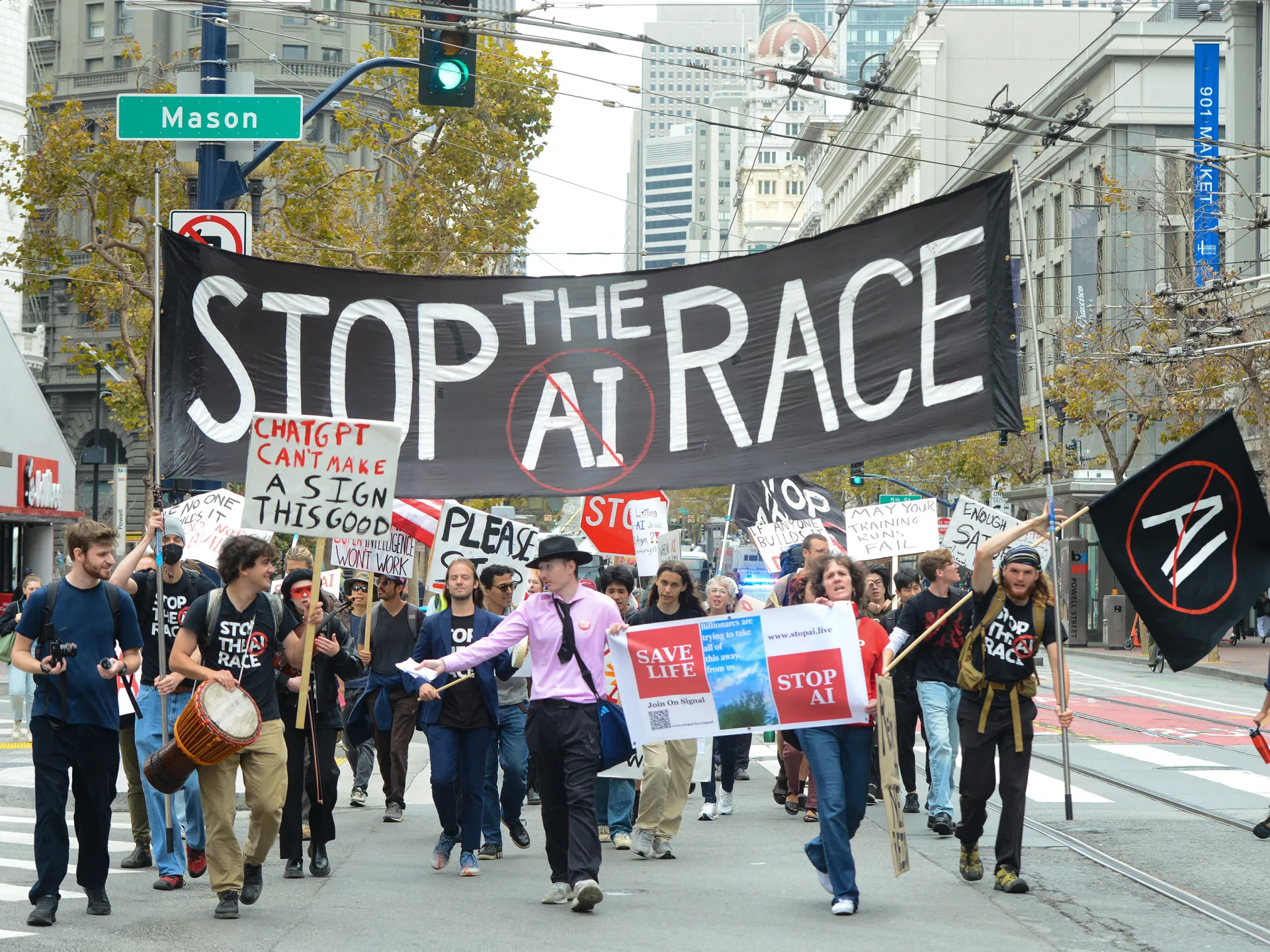
AI fears are being weaponised to justify concentrating control of the technology among a small number of powerful companies, an analysis has argued, warning that the focus on hypothetical catastrophe is distracting from harms already affecting workers, the environment and public debate.
The rapid expansion of artificial intelligence has been linked to job losses as companies adopt models capable of performing existing roles. Data centres are also consuming increasing amounts of energy, while AI tools are being used to automate disinformation and algorithms continue to raise concerns over bias and discrimination.
AI is also being used to identify targets in warfare, contributing to fears over the growing distance between technological decision-making and human accountability.
Despite those immediate challenges, much of the international debate has centred on “existential risk” and predictions that increasingly advanced systems could threaten humanity. Such warnings have been echoed by prominent political and religious figures, including Senator Bernie Sanders, the Vatican and former US secretary of state Hillary Clinton.
The analysis argues that these concerns deserve serious attention but have had an unintended effect: shifting public and regulatory focus away from the present-day consequences of AI and towards a future crisis that remains hypothetical.
Open-source AI and the risk of digital dependence
It claims that the resulting public alarm is being used to support rules that could restrict open-source AI models. These systems are free or cheaper to use and can be adapted by users, making them a potential alternative to products developed by major technology companies.
The argument advanced by the technology industry is described as straightforward: if advanced AI could become a weapon of mass destruction, only a limited number of trusted organisations should be allowed to develop it.
But imposing such restrictions in the name of safety could, the analysis warns, allow established technology giants to reduce competition from smaller and less expensive models. That would place more power in the hands of companies concentrated in a small number of countries.
The consequences could be particularly serious for the Global South, where many countries lack the resources to build frontier AI systems from the ground up. Developing a model can cost more than 100 million dollars in computing power alone, according to the analysis.
Reliance on imported systems also creates practical problems because models built elsewhere may not reflect local conditions. Kenya’s rollout of the AI-driven Social Health Authority system is cited as an example, with the imported model said to have misunderstood the country’s large informal economy, overestimating incomes and charging the poorest citizens too much for healthcare premiums.
Open-source AI is presented as a possible route for local developers to adapt systems to their own data and priorities. Rather than concentrating solely on conversational tools that imitate human interaction, countries could use AI to address challenges in energy, healthcare, agriculture, manufacturing and climate mitigation.
Restricting access to open-source models could therefore prevent developing countries from building their own technology ecosystems and deepen reliance on systems designed by companies elsewhere.
Concerns over AI’s impact on human judgement
The analysis also warns that corporate control of AI could create a cycle of data extraction and dependence. As people increasingly delegate critical thinking, creativity and decision-making to advanced systems, their reliance could generate more data for the same companies, helping them develop still more powerful products.
That risk is not limited to poorer countries. Wealthier nations that do not control the most advanced systems could also become locked into platforms developed elsewhere, leaving users dependent on a small group of technology providers.
The proposed alternative is not to abandon AI. The technology is described as having the potential to accelerate the discovery of medicines and solutions to energy and climate problems, with AlphaFold and MOFSeq cited as examples of tools already demonstrating that promise.
Instead, the analysis calls for rigorous safety research and testing aimed at near-term failures, while rejecting bans on open-source AI. It argues that safety and fair access should be pursued together rather than allowing fears about possible future systems to determine who controls the technology today.
It concludes that AI development should be decentralised, transparent and distributed internationally, with open-source innovation treated as a public resource. Human beings, rather than AI systems, should retain ultimate responsibility for decisions, while the technology should be designed to enhance human intelligence instead of weakening it.
