


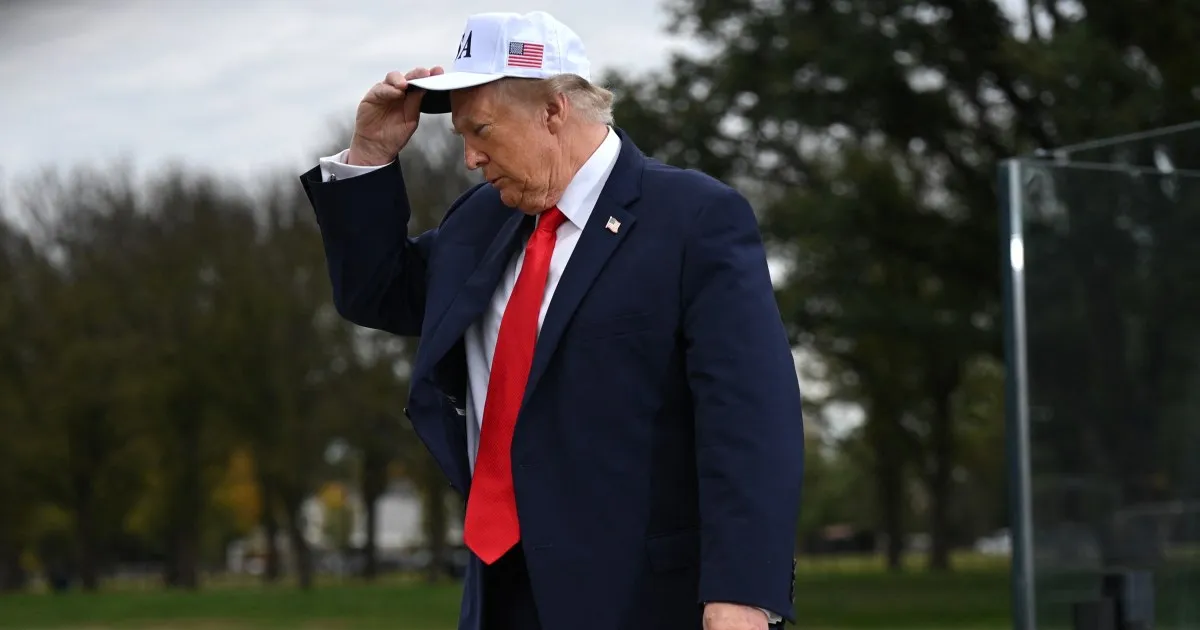
Democrats have taken control of both the US House of Representatives and Senate in the midterm elections, dealing a major blow to Donald Trump’s Republican Party and setting up a radically different Congress for the second half of his presidency.
The new Congress, which will convene in early January, will give Democrats greater power to investigate the administration, block legislation and place pressure on the president’s policies. However, Mr Trump will retain considerable authority to act without congressional approval.
Democrats face a test over the war on Iran
The most immediate confrontation is likely to centre on the US-Israel war on Iran, which Mr Trump began in February without congressional authorisation.
Mr Trump acknowledged that the conflict had contributed to the Republican losses, saying: “I think a part of it was Iran, but at the same time, people understood the importance of what I’ve done with Iran.”
Voters were also angered by inflation and rising fuel and grocery costs. Democrats focused their campaign on affordability and domestic spending, blaming the administration’s policies for worsening household finances.
Mr Trump could still order further attacks, but Democrats may attempt to restrict the money available for military operations when the current government-funding bill expires on December 11.
James Boys, a research fellow at the Centre on US Politics at University College London, said efforts to cut funding would be difficult while American troops remained deployed.
“With troops in theatre, this would prove to be highly problematic and be seen to be placing American lives at risk,” he said.
Congress could also seek to use the War Powers Resolution, which allows a president to respond to an imminent attack but requires military action to end within 60 days unless Congress declares war. Any veto by Mr Trump could only be overturned by a two-thirds majority in both chambers, a threshold Democrats are not expected to reach.
Previous attempts to use the 1973 law have been defeated or rendered ineffective, making it unlikely on its own to bring the conflict to an end.
Scott Lucas, professor of international politics at the UCD Clinton Institute in Dublin, said Democrats could instead work with Republicans who might distance themselves from Mr Trump after the election result.
He pointed to JD Vance, the vice-president, who opposed the war from the outset. Mr Vance sent a letter to Iran’s security chief last week in what was reported to be an effort to revive talks and prevent further attacks.
“[Will] he now push even harder to end the war?” Mr Lucas asked.
Mr Boys said Mr Trump’s inability to seek another term could leave him feeling “he is now unleashed to act with impunity on the world stage”.
“Indeed, given his weakened domestic political circumstances, one can easily imagine Donald Trump escalating policies in the Middle East as he seeks to establish an indisputable presidential legacy,” he added.
Tariffs likely to remain a source of conflict
The result will also intensify the dispute over the president’s tariffs, which range from 10% to 50% on goods from about 90 countries.
The Supreme Court struck down the tariff programme in February, but the administration responded by relying on a different statute and raising some duties from 10% to 15%. Those tariffs are limited to 150 days unless Congress extends them.
Democrats have argued that the tariffs increase the cost of living because US importers ultimately pass the expense on to consumers. They accused Mr Trump of “pickpocketing the American people”.
A Democratic-controlled Congress could seek temporary exemptions to provide relief for exporters. A more fundamental change to US trade policy, however, is likely to depend on the outcome of the 2028 presidential election and the next occupant of the White House.
Mr Boys said the tariff dispute remained before the courts, including questions over whether the administration must return money already collected and how much could be involved.
One area where bipartisan action is expected is tighter restrictions on China’s access to advanced technology. Proposed measures include the Remote Access Security Act, which would extend export controls to remote access of US goods, software and technology, and the Chip Security Act, requiring companies to confirm that advanced artificial intelligence chips remain in authorised locations.
Immigration investigations could widen
Democrats will take over the chairmanships of congressional committees, giving them the authority to launch investigations and subpoena witnesses.
That power could be used to examine the Trump family’s business empire, the president’s ties to the late sex offender Jeffrey Epstein and Defence Secretary Pete Hegseth’s handling of the war with Iran. Democrats could also consider a third attempt to impeach Mr Trump over the conflict.
Immigration policy is expected to be another major target. Democrats have said they want to investigate co-operation between the Internal Revenue Service and the Department of Homeland Security over the administration’s deportation policy affecting refugees and migrants.
Detentions at airports and during immigration hearings have formed part of Mr Trump’s effort to deliver on his campaign promise of mass deportations.
A Fox News poll released before the election found that 53% of registered voters believed the immigration crackdown had “gone too far”. The Department of Homeland Security has said that about 70% of immigration detainees are criminals when pending charges are included, although critics have questioned that figure because suspects are presumed innocent until proven guilty.
Mr Lucas said the election result would allow Democrats and Republicans prepared to work with them to engage state and local communities and promote what he called recovery and responsible policies.
