


Five months after her latest surgery, Katherine Rajasingham was back in her gynaecologist’s office telling him something was wrong.
The Melbourne mum knew the pain. She knew her body, too, but even she had begun to question whether it could really be happening again so soon.
Her surgeon was doubtful, but eventually agreed to operate. Afterwards, he came to her hospital bedside carrying photographs from the procedure.
‘I’ll never forget the day that he came in and showed me what was inside me and what he’d cut out,’ Katie tells Daily Mail. ‘He said, “I’m really sorry. You were right. This is the worst it’s ever been.”‘
She waited until he left the room before she cried.
By then, Katie had spent years being told that the pain she felt wasn’t what she thought it was. Getting answers would take much longer than she ever imagined.
Being proved right should have made trusting herself easier. It didn’t.
‘Just bad periods’
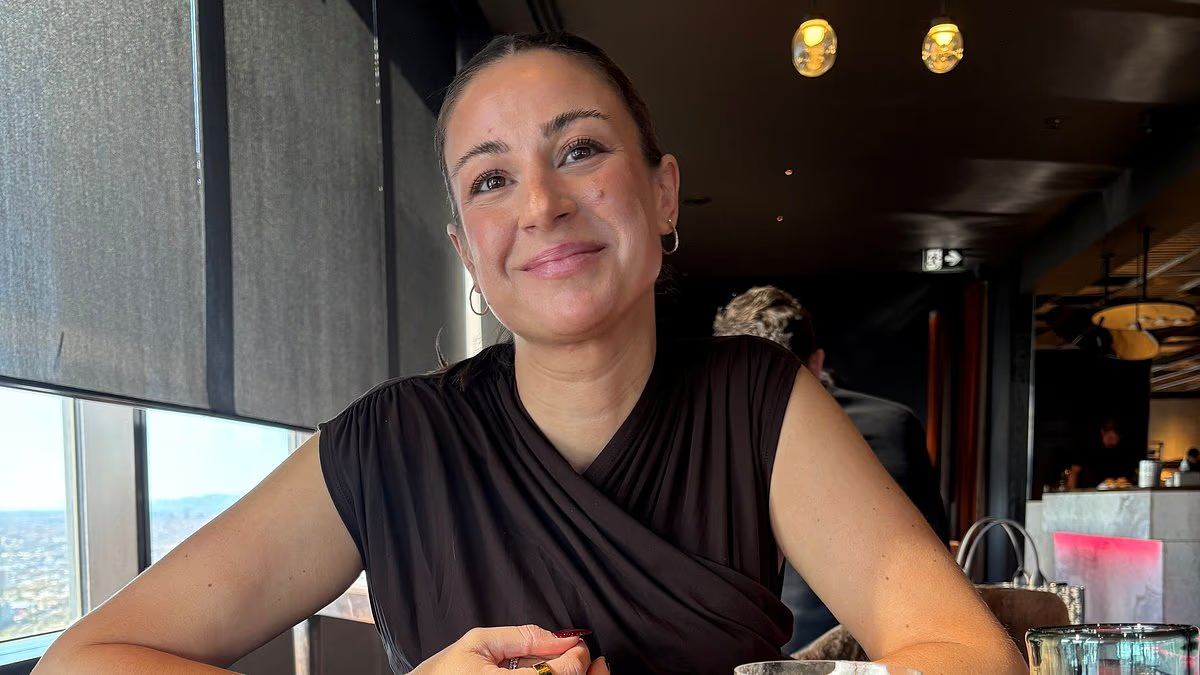
Katie Rajasingham was in pain for 16 years before she finally got a diagnosis

As the years passed, Katie’s pain began dictating what she could and couldn’t do
Now nearly 41 and living in Melbourne’s inner west, Katie is a mum of two who has spent close to two decades working in buying and account management.
Katie’s childhood had rarely felt settled. Her parents separated when she was one, and she moved between three cities and 11 schools, spending the most stable stretch of her childhood living with her grandparents. There was trauma too, although Katie says she learned early to keep moving forward.
She was sporty and competitive, playing soccer, netball and basketball, but also loved literature, history and writing. Then, at 11, she got her first period. By 14, the pain could be so severe she struggled to walk.
Her bleeding was heavy and she lived with the fear of leaking at school. As she got older, there was hormonal acne, bloating and weight fluctuations that left her increasingly self-conscious. Yet the answer from doctors was repeatedly much the same: painful periods.
Doctors prescribed the contraceptive pill and painkillers, and over the years Katie would try different pills, implants and other hormonal treatments. Nothing explained why she was hurting so much. More importantly, nobody suggested endometriosis.
‘I always knew that feeling that amount of pain wasn’t right,’ she says.
It would be another 16 years before she knew why.
‘It took me until I was 30 to get officially diagnosed.’

She went through 11 surgeries
‘I knew something was wrong’
At 19, Katie became pregnant despite being on the contraceptive pill and chose to have a termination at nine weeks.
She returned to hospital twice with heavy bleeding, clotting and pain so severe that, on one occasion, her stepfather had to carry her inside as she screamed. Katie remembers three women trying to hold her still while she was treated. She was told her recovery was not progressing as expected, but still had no explanation for why her body had reacted so badly.
‘That’s when I knew something was wrong with my body,’ she says.
The pain continued through her 20s, but Katie says she was repeatedly told she simply had bad periods and cycled through hormonal treatments and pain medication without getting an answer.
Those years were difficult for other reasons, too. Katie was carrying unresolved trauma and spent time in an abusive relationship with a partner who used drugs. She began using them herself and now sees much of that period as an attempt to escape.
‘My 20s was my way of kind of saying FU to the past,’ she says. ‘But it was also escaping the past and the pain that I felt.’
When pain took over
As the years passed, Katie’s pain began dictating what she could and couldn’t do. She missed her brother’s wedding because she couldn’t manage the four-hour journey to Albury. Sex was painful and, during an abusive relationship, she sometimes took painkillers if she knew her partner would want sex, simply to get through it.
Work brought a different kind of anxiety. In male-dominated industries, Katie became so uncomfortable discussing her symptoms that she would invent another reason when she needed a sick day.
Once, before an operation, she trusted a manager with her diagnosis and asked him to keep it confidential. Katie says he told colleagues anyway, dismissing what she was going through as ‘ladies’ problems’.
The experience stayed with her. For years, she returned to work earlier than she should have after surgery, worried about how taking time to recover might be perceived.
That fear has been difficult to shake. A few months ago, Katie underwent a partial hysterectomy and was advised to take two weeks away from work. She was back after three days.
‘I was really self-conscious,’ she says. ‘I’ve been so scared of the perception.’
Finally, a name for the pain
Around 2015, when Katie was 30, a female GP sent her for an ultrasound. It showed one of her ovaries was stuck out of position, with cysts also visible, and Katie was referred to the Royal Women’s Hospital for a laparoscopy. After some 16 years of pain, she finally had a name for it: endometriosis.
When the pain returned, Katie sought private treatment from Melbourne gynaecologist Simon Gordon. She recalls him telling her he would operate and that afterwards she would never need surgery again. Katie says she subsequently went on to need another eight operations under the care of other doctors.
Gordon retired from practice last year and has since been the subject of a major ABC Four Corners investigation into allegations concerning the treatment of other endometriosis patients. Gordon has said he always acted ethically and responsibly. The Victorian and federal governments have since funded dedicated support services for former patients affected by Gordon’s care.
Under the care of another surgeon, Katie says she was subsequently diagnosed with adenomyosis and pelvic congestion as well. By her count, she has now undergone 10 pelvic surgeries, alongside two Caesarean sections.
Finally having diagnoses brought validation, but it did not bring an end to the pain.
By the time her surgeon admitted Katie had been right, years of having her symptoms questioned had taught her to question them too. Even when the pain returned just five months after surgery, she worried she was overreacting.
‘It took a lot for me to go and say, “Something’s wrong again,” and not be paranoid,’ she says. ‘Even then, after that, you still doubt yourself every time.’
Today, despite years of surgery and a recent partial hysterectomy, Katie says she is still in pain every day. She takes medication to manage it, sees a pain specialist and speaks to her GP weekly. Yet needing that level of care can still bring back the same old feelings.
‘I feel so ashamed that I have to do these things,’ she says.
Trusting herself again
Katie had been warned that her chances of becoming pregnant were low, so when a test turned positive three days before her wedding, she could hardly believe it. The pregnancy began with a threatened miscarriage, but her baby held on.
At full-term, Katie went into labour at home. As her contractions intensified, she repeatedly called the hospital and says she was reassured she likely had plenty of time. Eventually, she stopped waiting.
‘I just said to my husband, “Get in the car.”‘
By the time they reached hospital, her contractions were a minute apart. Katie was eight centimetres dilated and her baby was still breech, prompting an emergency Caesarean. She says she was later told that, had she waited much longer, both she and her son could have been in serious danger.
Her second pregnancy brought another frightening start. Katie woke one morning in a bed soaked with blood and passed a large clot. Unable to get an ultrasound at the hospital overnight, she found a private provider the next day and watched her daughter’s heartbeat on the screen.
The pregnancy continued, and today Katie is the mum of the two children she once feared her endometriosis might prevent her from having, something she describes simply as being ‘very grateful’ for.
‘Everybody thinks they’ve got it’
After the birth of her first child, Katie struggled with severe postnatal mental health difficulties. It took eight months before she reached out for help, eventually spending two weeks receiving treatment at a specialist mental health facility. As she began to understand more about her mental health, she also started wondering whether something else had been missed.
For around two years, she raised the possibility of ADHD with her psychologist. Katie recalls being told: ‘It’s just because it’s a trend at the moment. Everybody thinks they’ve got it. You don’t have it.’
Eventually, her GP referred her for specialist assessment. At around 40, Katie was diagnosed with ADHD, and later complex PTSD.
There was relief in finally understanding herself, but grief too. ‘How different would my life be?’ she remembers wondering.
Learning how her brain works has since changed the way Katie sees herself and what she is capable of. She says the diagnosis ultimately brought something she had spent much of her life without: confidence in herself.

Finally having diagnoses brought validation, but it did not bring an end to the pain. (Katie is pictured with her husband)

Against the odds, Katie now has two children
Building what she needed
For Katie, learning to advocate for herself has also changed what she wants to do for other women. After returning to full-time work following motherhood, she hit burnout while juggling two young children with ADHD, complex PTSD and chronic pain.
Conversations with other mothers made her realise how many were struggling to find the right support. Services existed, but they could be scattered, expensive or difficult to access, while women were often too overwhelmed by the day-to-day load of family life to know where to begin.
Katie is now developing Restore Her Wellness, a business designed to bring health and mental health resources, community connections and practical support for mothers together in one place. She has also been accepted into Tech Ready Women’s investor-ready program as she works towards developing the platform.
For Katie, though, the motivation behind it is simple.
‘I just want to help mums,’ she says. ‘I come from the lived experience. I’ve lived the experience, I’m going through the experience and I’m building something that I need as well.’
Now nearly 41, Katie suspects her body may be changing again. She believes she could be experiencing symptoms of perimenopause, but when she raised the possibility with her GP, she says she was told she was too young.
This time, Katie didn’t allow the doubt to settle in. She has made an appointment to seek another opinion.
‘Whilst it’s taken 40 years and so much rejection and disbelief, I now back myself,’ she says. ‘If I think something’s wrong, I just take the steps to find out.’
