


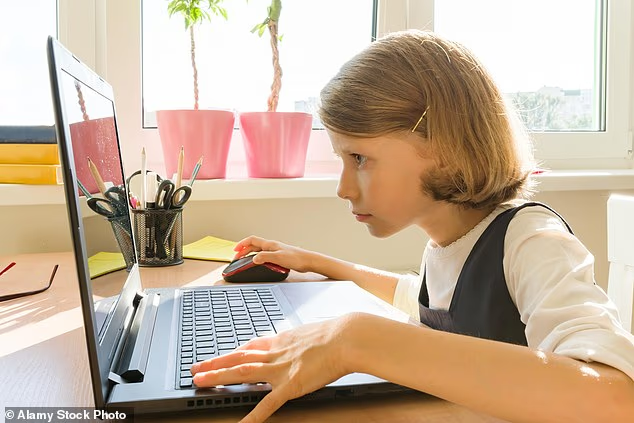
More than 150 clinicians have urged ministers to reduce screen time in classrooms, warning that the increased use of digital learning is contributing to a crisis in children’s speech and language development.
The signatories include GPs, paediatricians, audiologists and speech therapists, who say pupils are developing communication difficulties “earlier and more severely than in previous years”. They also raised concerns about a rise in poor eyesight linked to exposure to screens.
In a letter to Education Secretary Lucy Powell and Health Secretary Yvette Cooper, the professionals called for the Government to examine the effect of sustained screen-based learning on children’s physical and developmental health.
They said the use of tablets, laptops and interactive whiteboards had expanded rapidly during the pandemic and had not subsequently been reduced. Almost one million children are now understood to use device-based learning in every lesson at school.
The clinicians said about £900 million a year is spent on education technology in English schools, but claimed there are no official checks examining how such products affect children’s physical health.
“A generation is being taught on devices and platforms that have never been subject to systematic, child-focused testing for their cumulative impact on children’s eyes, ears or speech,” the letter states. “We are the clinicians who will spend the rest of our careers treating the consequences.”
Clinicians call for health checks on education technology
The professionals said they were particularly concerned about one-to-one devices being used in early years education, where they argued that language development depends on face-to-face interaction.
“Language acquisition depends on rich, responsive, face-to-face interaction that screens, however well designed, cannot replicate,” they wrote.
The letter claims that a three-year-old spending three hours a day on a screen misses an estimated 194 conversational turns and 1,139 adult words each day, with the impact accumulating over time.
The clinicians are calling for health checks on products used in schools, along with guidance on safe daily levels of screen exposure. They also warned that education technology used by millions of pupils at school and for homework faces no equivalent child-focused scrutiny to products such as medicines, food or toys.
Dr Louise Milne, a consultant paediatrician at Portsmouth Hospitals University Trust, and Dr Sanjiv Nichani, a senior consultant paediatrician and co-founder of the Children’s Intensive Care Unit at Leicester Children’s Hospital, are among those who signed the letter.
Laura Trott, the shadow education secretary, said the Government was repeating mistakes over the use of screens in schools and for homework. She said there was “little evidence to support the use of them” and argued that Britain should learn from countries which had begun changing course after adopting widespread classroom screen use.
Ministers introduced a mobile phone ban for schools in the summer, although devices used for learning are not covered by the policy.
Jane Rowland, of the campaign group SafeScreens, said screens now dominated the school day and continued to be used at home. Dr Becky Foljambe, a GP and founder of Health Professionals for Safer Screens, said: “We can’t keep prescribing glasses and speech therapy for a problem that schools are making worse.”
A Government spokesman said technology, when used well, could support pupils who needed it and help teachers deliver education. The spokesman added that gathering evidence was vital and that ministers were working with teachers, school leaders and parents as understanding of the most effective use of technology developed.
