


Leaders of Germany, Italy and Belgium have urged Brussels to halt the expansion of EU regulation, calling for an “emergency brake” to allow national governments to block rules they believe are damaging their economies.
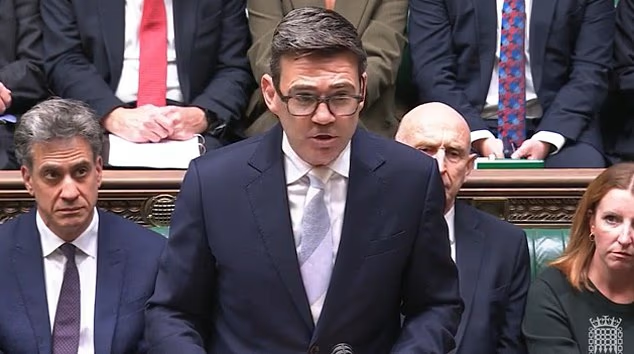
The intervention comes as Prime Minister Andy Burnham argues that Britain should move closer to the European Union and has opened the possibility of rejoining the bloc. His position has prompted renewed criticism from Brexit supporters, who say the appeal from three major EU states underlines the costs of closer integration.
German Chancellor Friedrich Merz, Italian premier Giorgia Meloni and Belgian Prime Minister Bart De Wever made their demands in a letter to European Council president António Costa ahead of an EU leaders’ summit.
They said new powers were needed primarily to protect small and medium-sized businesses, which they warned were being hit by a growing volume of rules agreed in Brussels.
“We call for further ambitious simplification packages to decisively advance the cutting of red tape in the European Union,” the leaders wrote.
They also called for an “emergency brake” on onerous legislation, arguing that unnecessary regulatory costs risked causing “permanent losses of European industrial capacity” and weakening investment and competitiveness.
Experts cited in the source material say the volume of EU regulations has increased fourfold since 2010, with industry particularly affected. Mr Burnham has said he wants to revive Britain’s industrial sector.
The appeal comes against a backdrop of weak growth in some of the bloc’s largest economies. The UK economy grew by 1.4 per cent last year, compared with 0.8 per cent in France, 0.5 per cent in Italy and 0.2 per cent in Germany.
There are also concerns over France’s public finances, with its debt-to-GDP ratio approaching 120 per cent. Greece’s ratio was around 127 per cent when it helped trigger the eurozone crisis in 2009.
Reform UK deputy leader Richard Tice said the letter was “a truly damning verdict” on an organisation Labour wanted to tie Britain back to.
“Why handcuff ourselves to a failing bloc? Reform UK will tear up all remaining EU red tape, back British business and make this country the best place in the world to invest,” he said.
Conservative leader Kemi Badenoch said the 2016 referendum result should be respected and that governments had failed to make sufficient use of the freedoms created by leaving the EU.
“One of the things that governments have failed to do, and I’m afraid that includes previous Conservative governments, is be bold enough to use the freedoms,” she said during a visit to east London.
Mike Wood, the Conservative shadow Cabinet Office minister, said Mr Burnham should concentrate on domestic priorities rather than seeking closer ties with Brussels. He said it was “bizarre” that the Prime Minister would want to take Britain back into a bloc whose leaders were warning about bureaucracy and red tape.
John Longworth, chairman of the Independent Business Network, said it was “insanity” to seek membership of an organisation whose major states recognised the effect of regulation on their economic performance.
Mr Burnham has said it would be a “dereliction of duty” to ignore the possibility of a closer relationship with Brussels. He has argued that the public mood has changed since 2016 and that the British people would decide what happened next.
He is due to use a summit with the EU on November 20 to discuss closer ties. Possible agreements could cover food standards and greater freedom of movement for young adults, while he has previously said the options could extend to full membership.
Shanker Singham, a former adviser to international trade secretary Sir Liam Fox, said rejoining the EU would be particularly damaging to the City of London because of the cost of complying with EU financial regulation.
