


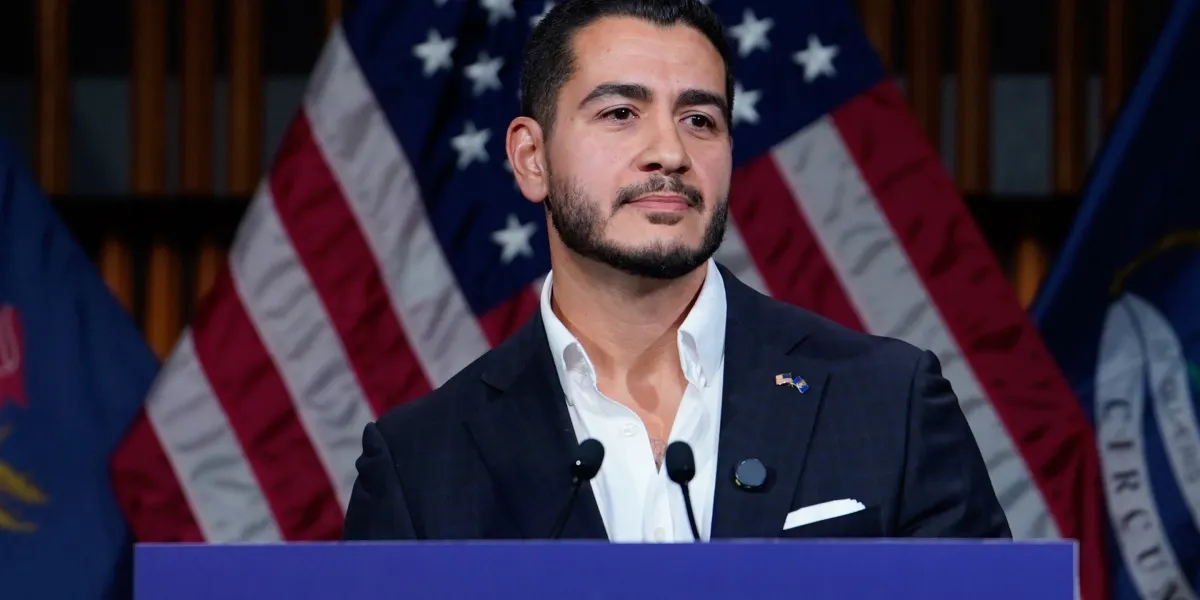
Abdul El-Sayed has won Michigan’s open Senate race, bringing one of the most prominent Medicare for All advocates in the US Congress as Democrats take control of both chambers.
The 42-year-old Democrat defeated Republican Mike Rogers after campaigning for a universal, publicly funded single-payer healthcare system. He has also co-written a detailed plan setting out how such a system could operate.
“It shouldn’t be this hard to see a doctor in the richest, most powerful country in the world,” El-Sayed told supporters during his victory speech in Detroit.
Healthcare costs were a major concern for voters during the election. An NBC News exit poll of more than 79,000 people found that 85 per cent were very or somewhat concerned about the cost of care, while 61 per cent said the federal government should play a bigger role in helping Americans obtain it.
Democrats remain divided over how to respond. Many moderates favour strengthening the Affordable Care Act, which expanded coverage through Medicaid and subsidised private insurance marketplaces. Progressives including El-Sayed continue to back Medicare for All, which would replace much of the private insurance system with a single public payer.
What Medicare for All would cover
In his 2021 book, Medicare for All: A Citizen’s Guide, co-written with Micah Johnson, El-Sayed describes the proposal as an enhanced version of the traditional Medicare programme used by millions of older Americans.
The plan would provide lifelong insurance to every American and cover doctors’ appointments, prescription medicines and emergency treatment. It could also include long-term care, dental treatment and vision services, while allowing patients to see any participating provider without out-of-network charges.
El-Sayed has argued that universal coverage would also end the link between employment and insurance. “Turn 26, get a job, lose a job, get married, get divorced: none of these would cost you your health insurance under Medicare for All,” he wrote in Senate testimony.
His position on private insurance has evolved. In 2020, he said Medicare for All “does away with the private insurance market”. During the campaign, however, he said his version would not prohibit private plans offered through employers or unions, although his campaign website said the public system should make those plans “redundant and unnecessary”.
El-Sayed has proposed placing the programme under, but separate from, the executive branch, in a structure similar to the Federal Reserve. At a campaign roundtable, he said that would prevent Medicare from changing “on a dime” whenever a new president took office.
He has also said the programme would negotiate prescription drug prices on behalf of the entire country.
How El-Sayed says the plan could be funded
El-Sayed and Johnson argue that Americans already pay for healthcare through taxes, insurance premiums, deductibles and co-payments. Under their proposal, that money would be channelled through the public sector rather than private insurers.
The plan would combine existing federal spending on Medicare, Medicaid and subsidies for private insurance into a single funding stream. The authors have also suggested administering the programme at state level, allowing states to redirect money currently spent on Medicaid and private insurance.
Further funding would come from progressive taxation, including a wealth tax on the richest Americans, changes to corporate taxation and higher taxes on investment income. The proposal also relies on savings from reduced administrative costs and lower prices for medicines and healthcare services.
The question of how the plan would affect middle-class families remains unsettled. El-Sayed has said he would “hope” to avoid raising taxes on most Michigan families, including those earning about 100,000 dollars a year, while experts have argued that tax increases on the middle class would probably be necessary. Some households could nevertheless pay less overall.
Medicare for All faces opposition in Congress
El-Sayed has acknowledged that the main difficulty is political rather than technical. “The biggest challenge is not making the math work. The biggest challenge is not architecting the system. The biggest challenge is creating the political will to get there,” he said during the campaign.
Support for Medicare for All has grown, but the proposal remains contested. An Axios-Ipsos poll released in October found that 43 per cent of Americans supported it, compared with 24 per cent who opposed it and 32 per cent who were unsure.
Pharmaceutical companies and the American Hospital Association are among its critics. They argue that abolishing private insurance would cost healthcare administration jobs and leave middle-class families facing higher taxes.
A 2018 analysis by Charles Blahous, a former public trustee for Medicare and Social Security, estimated that Bernie Sanders’ version of the proposal would add 32.6 trillion dollars to federal spending over 10 years. Blahous described that estimate as a lower bound based on the assumption that the plan’s cost controls achieved their full projected savings.
Democrats will control both chambers of Congress from January, but Republicans and many moderate Democrats oppose a single-payer system. Any legislation would probably need 60 votes to overcome a Senate filibuster, as well as the signature of President Trump.
El-Sayed will have at least one fellow advocate in the Senate. In Maine, Democrat Troy Jackson defeated Republican Senator Susan Collins after campaigning on Medicare for All and said he would be a “dog with a bone” on the issue.
El-Sayed told supporters that winning a Senate seat was only the beginning of his campaign. “The goal is to use that seat to transform our politics,” he said.
