


The brother and boyfriend of a Cornell University student who alleges she was gang-raped by seven fraternity members were held at gunpoint by police after a hoax emergency call sent officers to her family home.
The anonymous caller falsely claimed that a man inside the house had shot his mother, was threatening his sister and intended to kill her. The incident was one of several alleged swatting attacks against the family since Jane Doe filed a civil lawsuit against the seven Chi Phi fraternity brothers.
Swatting involves making a false emergency call designed to provoke an armed police response at an innocent person’s address.
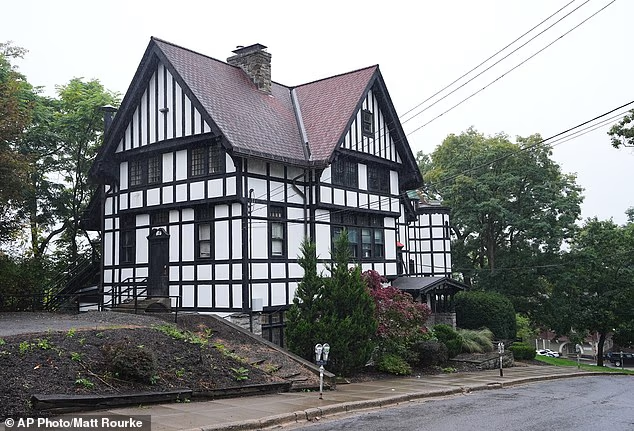
According to a police report, officers were dispatched to Doe’s family home on October 6 after a male caller claimed he was inside the property and had killed or was about to kill members of his family.
As police arrived, a car containing two young men was seen leaving the driveway. The men, later identified as Doe’s brother and boyfriend, were ordered out of the vehicle and told to lie on the ground while an officer drew his gun and searched them for weapons.
Doe’s father then told officers: “I’m the DAD. WHAT’S GOING ON?” He identified his daughter as the alleged victim in the Cornell case and said the family was being threatened by “numerous unknown people”.
Police searched the house and found that nobody had been harmed. While officers remained at the scene, the caller allegedly rang 911 again, claiming to be armed with an AR-15 and threatening to kill everyone inside before taking his own life.
Other calls in recent weeks allegedly claimed that the family home was on fire or threatened to bomb the residence, according to the report.
Doe’s lawyer, Thomas Giuffra, said she had also received hundreds of threatening phone calls, text messages and social media direct messages. He said she had covered the windows of the family home with pieces of paper because of the threats.
The Cornell sexual assault allegations
In her civil lawsuit, Doe alleges that seven Chi Phi members sexually assaulted her during a party at the fraternity house near Cornell’s campus in Ithaca on October 19, 2024.
She claims she was incapacitated after being given ketamine and alcohol, and that sexual acts took place without her consent until she lost consciousness. She also alleges that messages portraying her as sexually available were circulated among fraternity members without her knowledge.
The seven men named in the lawsuit — Matthew Ingalls, Jonathan Newell, Winston Lee, Gillio Lopes, Diego Sarabia, Scott Norris and Scott Kretzschmar — have denied wrongdoing. They have said their interactions with Doe were consensual or that they were not involved.
No criminal charges have been filed. Doe reported the alleged assault to Cornell police in November 2024, and campus investigators sent a summary of their findings to the district attorney’s office, which decided not to prosecute.
Cornell later shut down the Chi Phi chapter and said some students had been expelled while others were suspended. Doe left the university several months after reporting the alleged assault and later returned to live with her family.
The case has since prompted further action. New York Governor Kathy Hochul removed the district attorney from the case this month after public criticism over the lack of charges, and the investigation is now being led by New York Attorney General Letitia James.
Cornell has also hired former deputy US attorney general Sally Yates to review the university’s response. The university has suspended fraternity parties and social events until the end of the 2026-27 academic year and introduced a policy providing for the immediate suspension of chapters that breach its rules.
