


Federal emergency assistance has been approved for 76 Georgia counties as communities across North Georgia clear fallen trees and repair damaged power lines after Isaias left about 20,000 customers without electricity.
President Donald Trump approved the declaration on Saturday, allowing the Federal Emergency Management Agency to coordinate equipment and relief operations in areas affected by the storm.
The decision came as utility crews made progress across the state, restoring power to more than 80,000 homes and businesses. Georgia Power said roughly 20,000 customers remained without electricity by Saturday afternoon, although no firm timetable had been given for completing the remaining repairs.
Crews tackle widespread power damage
Outage numbers in the Atlanta metropolitan area fell sharply during the day. Fulton County recorded 754 outages, while Cobb County had fewer than 500 and DeKalb County more than 400. Gwinnett County had 44 outages.
The worst disruption was reported in parts of the north Georgia mountains. Amicalola EMC said more than 7,000 customers were still without power, mainly in Pickens, Gilmer and Lumpkin counties.
Georgia Power said teams had been deployed throughout the state and were using remote switches and smart-grid technology to restore supplies while limiting risks to workers and the public.
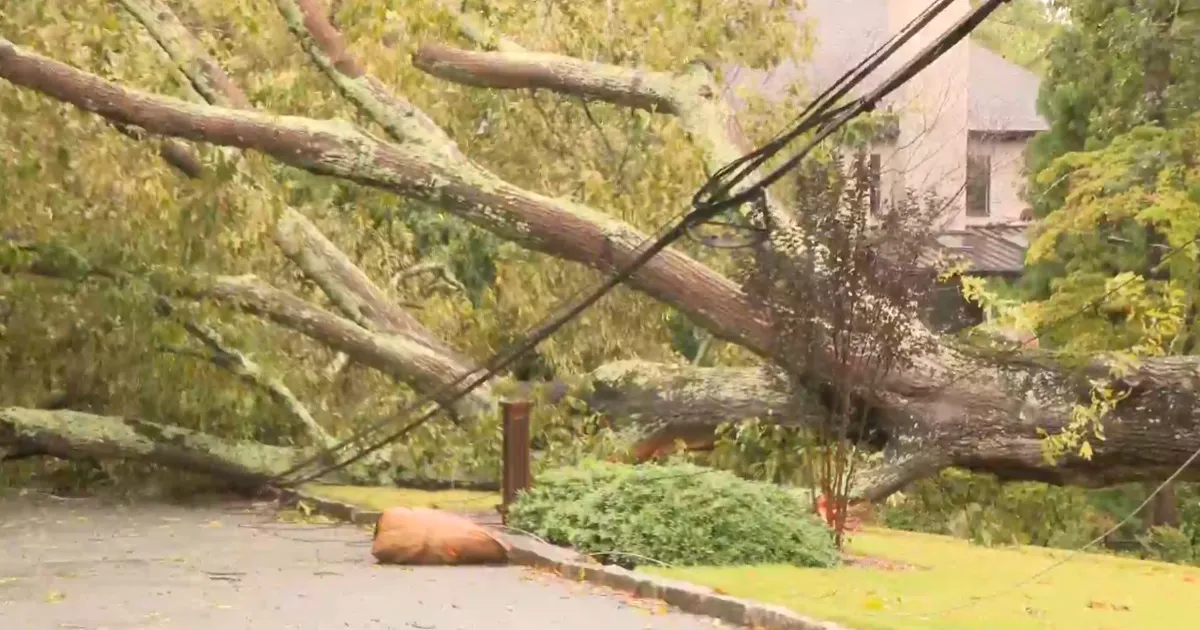
Repair work was continuing in neighbourhoods where saturated ground and strong winds brought down mature trees. In Stone Mountain, contractors worked along Valley Creek Drive to remove a tree that had fallen across power lines and damaged utility cables.
In Rockdale County, a tree crushed a parked car outside a house, narrowly missing the building. Other damage was reported from Brookhaven to communities east of Atlanta, with trees blocking roads and striking vehicles, homes and overhead lines.
Federal declaration covers 76 counties
The federal declaration covers counties including Fulton, DeKalb, Cobb, Gwinnett, Cherokee, Clayton, Coweta, Douglas, Fayette, Forsyth, Hall, Henry, Pickens, Gilmer, Lumpkin and Rockdale.
It follows a state of emergency declared by Governor Brian Kemp ahead of the storm. Georgia officials had warned that heavy rain, strong winds and the risk of tornadoes could cause fallen trees, flooding and extended power cuts across the state.
Isaias came ashore near Destin, Florida, late on Friday as a Category Two hurricane before weakening into a post-tropical cyclone as it moved inland across Alabama. At least four deaths have been reported in Florida and Alabama, with fallen trees striking homes blamed in the cases described by authorities.
The storm’s impact in North Georgia was intensified by heavy rainfall, which loosened the soil around tree roots. Even moderate gusts were then sufficient to bring down fully leafed trees onto roads, buildings and power infrastructure.
Storm threat eases but tornado risk remains
Severe weather warnings were issued in eastern Georgia after storm cells associated with Isaias passed through Screven and Burke counties. A tornado watch remained in effect for areas extending from Augusta towards Savannah during Saturday evening.
Further light showers were possible in Rockdale, Gwinnett, DeKalb and Henry counties before conditions cleared overnight. Eastern areas between Macon, Athens and Toccoa also remained vulnerable to brief rotating storms and localised warnings as the system moved away.
Emergency officials have yet to establish the full cost of the damage, with assessments continuing across homes, farms and public roads. It also remains possible that further Georgia counties could be added to the federal assistance programme as inspections are completed.
Residents were urged to stay away from downed power lines and to treat all fallen cables as live. Utility companies have not yet said when every remaining customer will be reconnected.
