


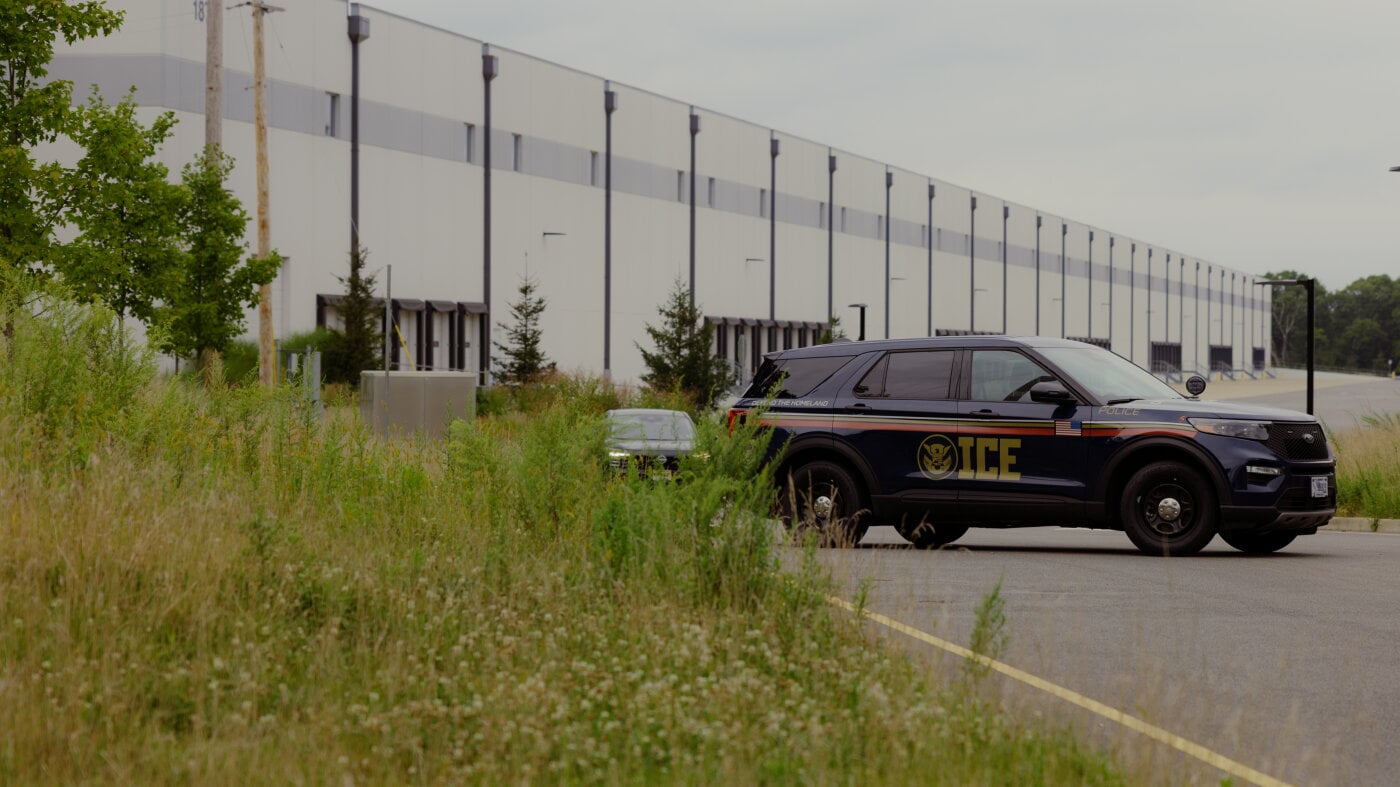
An ICE detention warehouse in Roxbury, New Jersey, appears to have been used to hold migrants despite a court order blocking its conversion into a detention centre, according to accounts from detainees, relatives and witnesses.
The facility was among 11 warehouses acquired by the US Department of Homeland Security in early 2026 as part of a plan costing about $1 billion. The proposals provoked protests and legal challenges, and courts in several states halted conversion work while environmental assessments were carried out.
However, evidence gathered in New Jersey suggests detainees were taken to the Roxbury site following immigration raids in the nearby town of Dover on September 4.
The New Jersey attorney general’s office is examining reports about the warehouse, while local campaigners are demanding access to the site and an investigation into whether the government breached the court order.
Accounts of detainees taken to Roxbury
The rumours began circulating during the summer, as Immigration and Customs Enforcement (ICE) carried out a sharp increase in arrests. Residents near the warehouse, located in a wooded area off Route 46, reported seeing vehicles travelling to the site, sometimes in convoy.
On the morning of September 4, masked immigration agents carried out raids in Dover. A woman who witnessed one of the arrests said she followed the vehicle transporting detainees towards Roxbury.
She said the car turned on to the road leading to the warehouse. Shortly afterwards, two other vehicles appeared to circle her and film her, an experience she described as intimidating. She asked for her name to be withheld because she feared possible government retaliation.
Dover council member Sandra Wittner said the timing appeared significant. The raids took place between 7am and 8am, she said, while the vehicle followed by the witness reached the warehouse road at about 8.25am.
Another woman in Dover said she recognised her father in footage of the arrests circulating on social media. The 59-year-old later telephoned her and said he had been handcuffed and was being held in what appeared to be a jail.
She said she had been unable to speak to him since. A friend who was arrested during the same operation was later located in Honduras after being deported.
The man, who asked to remain anonymous because he feared for relatives still in the United States, said the agents took him to Roxbury in a van. He said he and nine other men were handcuffed and held in the car park for several hours before being transferred to another facility.
“I just went into a state of shock,” he said. “I signed my deportation papers. The next morning I regretted it. But I was scared.”
Homeland Security did not answer questions about whether people had been held at the Roxbury warehouse. In a statement, it repeated that ICE detention facilities were subject to strict standards and said immigrants could choose to leave detention by being deported.
Legal dispute over the ICE warehouse
The court order covering the Roxbury property allows ICE to carry out certain forms of upkeep, according to campaigners, but does not permit the warehouse to be used for detention while an environmental assessment is pending.
Andrew Mergen, a Harvard professor and former lawyer with the US Justice Department’s Environment and Natural Resources Division, said the government might argue that its actions did not technically breach the order because the site had not formally been converted into a detention centre.
But he said such an approach could undermine the purpose of the legal challenge. “The community is acting here to prevent people from being detained,” he said. “And the administration seems to have cleverly elided that intention, by sort of saying ‘well we’re not going to build this facility, but we’re going to use this space in furtherance of detention.’”
Project NINJA, a New Jersey coalition opposed to ICE detention expansion, said using the premises to hold people would violate the order. The group has called for an oversight visit by members of Congress.
Ms Wittner said: “We need our Congress members to conduct an oversight visit yesterday, quite honestly. We need our state to aggressively pursue this investigation and demand to get inside.”
She said officials had had time to remove evidence if the warehouse had been used improperly, adding that the authorities could have “clean[ed] up their mess” if they believed they had been caught doing something they should not have done.
Claims over conditions at planned detention sites
The Roxbury warehouse formed part of a wider plan to expand immigration detention capacity during President Donald Trump’s mass deportation drive. Several of the sites faced opposition from residents and immigrant rights groups, in conservative as well as liberal communities.
A contractor involved in discussions about converting the warehouses said officials at Homeland Security had privately raised serious concerns about the proposal. The contractor spoke anonymously because of fears of retaliation from the government.
He said his company had proposed building camps in Texas modelled on Federal Emergency Management Agency facilities, which he considered more humane. The suggestion was rejected, he said.
“We were told point blank that that was not what the administration wanted,” he said, claiming that officials had indicated the facilities should not be comfortable or humane.
The contractor also alleged that the White House adviser Stephen Miller had wanted the detention sites to be “cruel” and “painful”. He said Miller was not present at the meeting but that officials told him the proposal for more humane facilities was not what Mr Miller wanted.
White House spokesperson Lauren Bis rejected the allegation, describing it as “false hearsay allegation(s) from someone who has never even met or talked with Stephen Miller”. She said Mr Miller “has never made any remarks to anyone about wanting illegal aliens to have worse detention facility conditions” and called the claim defamatory.
The White House did not respond to repeated requests for Mr Miller to comment directly.
Warehouses retained for immigration enforcement
Homeland Security has begun selling some of the warehouses bought under the original plan. It has retained several others, including sites in Maryland, Arizona and New Jersey, because of their strategic locations.
Michael Wriston, a former military intelligence analyst who co-founded a group monitoring ICE’s expansion, said such properties could fill gaps in the agency’s detention network, particularly in places without enough local jail capacity or agreements with police departments.
In Maryland, Arizona and New Jersey, legal action by state attorneys general has either forced or persuaded Homeland Security to halt the planned conversions pending environmental reviews.
The continuing uncertainty has fuelled concern in Dover, where residents say the September arrests have left people afraid to speak publicly. At a local diner, a waitress who declined to be named said one of the detained workers had regularly eaten there.
She asked whether it was known where the men had been taken.
