


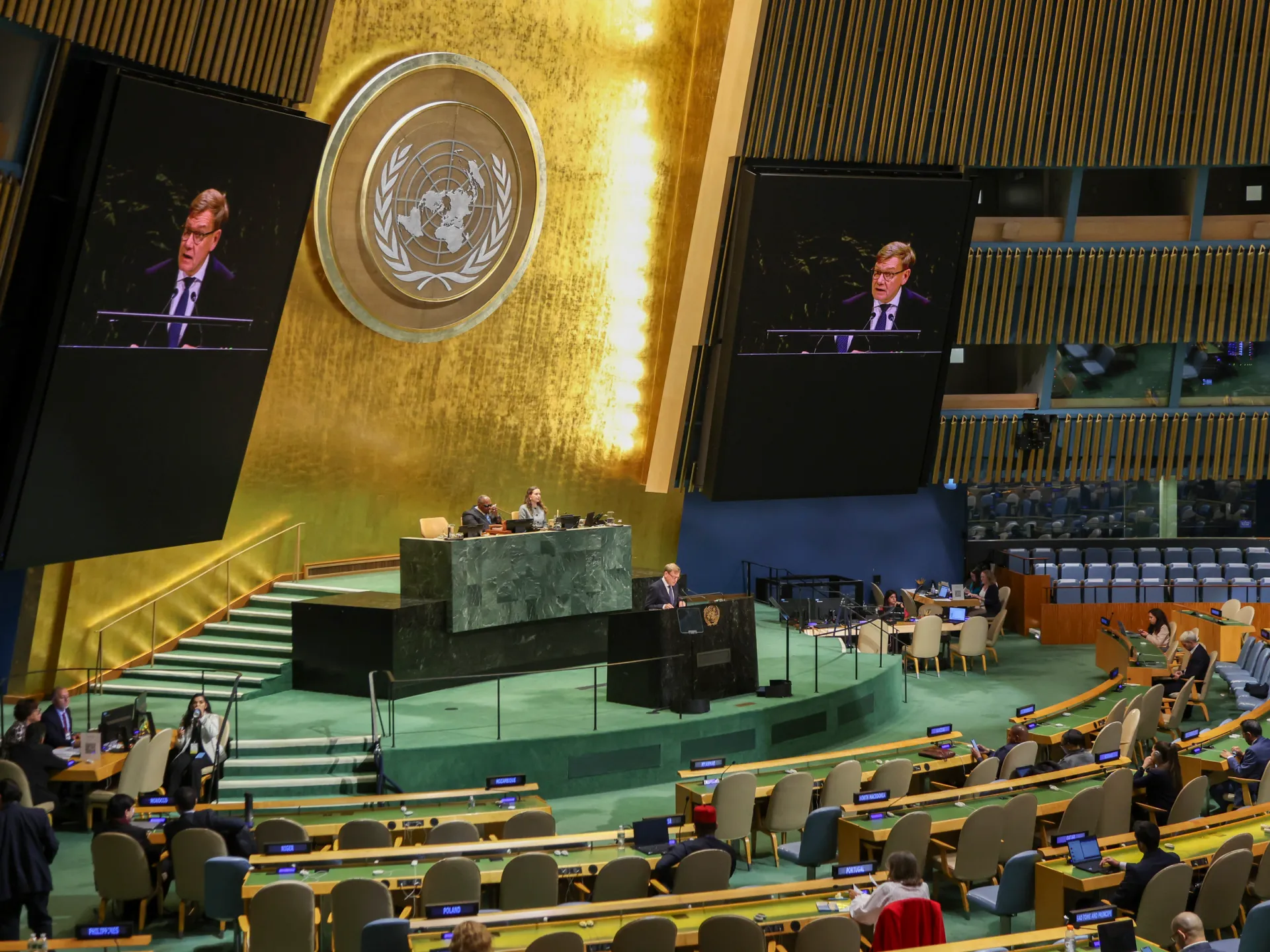
The 81st United Nations General Assembly ended with world leaders divided over the wars in Gaza and Iran, the future of artificial intelligence and the limits of international law. UN secretary-general António Guterres warned that the world faced four defining tests: conflict, climate change, inequality and AI.
In his final address before leaving office, Mr Guterres said the central issue across all four challenges was power – over force, money, energy, technology, rules and the future.
“That is why the UN Charter – and the work of the United Nations – matter more than ever,” he told delegates.
Gaza and Palestinian statehood dominate debate
The conflict in Gaza and the worsening situation in the occupied West Bank were among the most prominent issues at the summit, with France, Canada, Iraq and the UK among those calling for Palestinian sovereignty.
French President Emmanuel Macron questioned the international response to the crisis, asking: “What credibility do we have if we continue to remain inactive in the face of Gaza?”
Mr Macron, UK Prime Minister Andy Burnham, Canadian Prime Minister Mark Carney and Saudi Foreign Minister Prince Faisal bin Farhan Al Saud chaired a meeting on Palestinian statehood during the assembly.
The gathering took place as Israel’s government continued settlement construction in the occupied West Bank. Dozens of delegates walked out of the chamber during Israeli Prime Minister Benjamin Netanyahu’s address, in which he said Israeli forces would continue fighting Hamas and Iran.
A US-led Board of Peace also announced a proposed 66-project reconstruction plan for Gaza, backed by $2.4 billion in suggested funding. The plan excludes the UN agency for Palestinian refugees, UNRWA, which the board said should have no role in Gaza’s future.
That decision was criticised by Palestinian political analyst and playwright Ahmed Najar, who said it aligned with efforts to marginalise and ultimately dismantle the agency.
Trump defends military action
US President Donald Trump used his speech to defend military action in Venezuela and Iran, presenting himself as a leader who had delivered peace rather than merely called for it.
Mr Trump said the abduction of former Venezuelan president Nicolas Maduro in January had been followed by the release of hundreds of political prisoners. He also claimed Caracas had signed a $65 billion oil agreement with the US.
“To the victor belong the spoils – you’ve all heard that,” he said.
On Iran, Mr Trump repeated that Tehran must not be allowed to obtain nuclear weapons. He said a 12-day war in July 2025 had destroyed the country’s nuclear programme and claimed that the ongoing US-Israel conflict had sunk 159 Iranian naval vessels.
“I have a big decision to make – will a deal be made with Iran that lets them rebuild and create a far greater country than it ever was before … or do I annihilate the Islamic Republic and do it quickly,” he said.
Iranian officials hold talks
Iranian officials drew significant interest in meetings away from the main chamber. President Masoud Pezeshkian said Iran had been defending itself following attacks on the country and the deaths of its supreme leader, scientists and children.
“We are not terrorists, our innocent people have been the targets of cowardly attacks and aggressions imposed upon our country,” he said.
Mr Pezeshkian also rejected the idea that peaceful nuclear technology should be controlled by only a small group of countries, saying Iran would not surrender what it regarded as its right.
Foreign minister Abbas Araghchi met counterparts from India, Qatar, Turkey, Pakistan and Ukraine. He also held a four-hour meeting with US special envoy Steve Witkoff and Donald Trump’s son-in-law Jared Kushner, mediated by Qatar.
Calls for global rules on artificial intelligence
Artificial intelligence was another dominant theme, with leaders urging international co-operation as governments grapple with its potential impact on economies, politics, security and society.
Finnish President Alexander Stubb called AI “the most consequential technology in the history of mankind” and said people should remain in control of its development.
“We can compete, cooperate or slow down. For me, cooperation is the best way forward,” he said.
Mr Guterres and the European Union backed safety standards and international rules. Mr Trump, however, argued that innovation should not be restricted by international regulation and said the US should control its own AI sector.
China sends vice-president in Xi’s absence
Chinese President Xi Jinping did not attend the general debate despite being in the US for a summit with Mr Trump. Vice-president Han Zheng represented China instead.
Mr Han said the sovereignty and security of Middle Eastern countries, including those in the Gulf, should be respected, without referring directly to Iran.
He also called for the West Bank to be governed and Gaza rebuilt according to the principle of Palestinians governing Palestine, while urging a return to the two-state solution.
On AI, Mr Han called for a people-centred approach aimed at narrowing the digital divide and ensuring that technological development benefited people broadly.
