


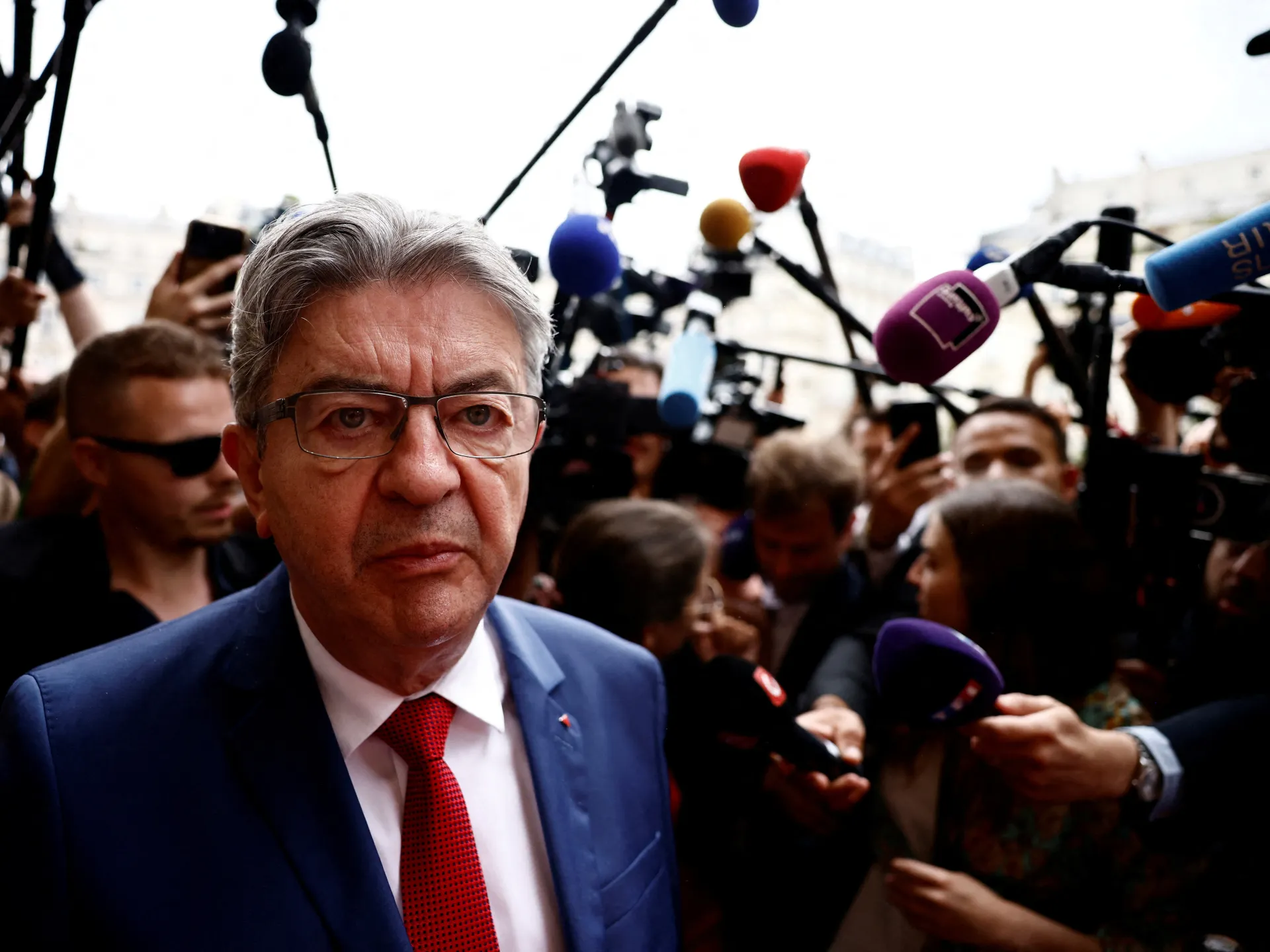
Jean-Luc Mélenchon has emerged as the strongest left-wing challenger to Marine Le Pen ahead of next year’s French presidential election, as he presents a programme shaped by nationwide protests over living costs and failing public services.
The leader of France Unbowed (LFI) will set out his proposals at a rally in Le Bourget, north of Paris, after publishing the programme online. Supporters among the student-led demonstrations have hailed him as a hero, while opponents on the right call him radical and former allies have accused him of authoritarian leadership.
Mélenchon is proposing to cut the retirement age to 60, raise the minimum wage to €1,700 a month and renationalise parts of the economy. He also wants France to leave Nato.
His plans for France’s debt would require the European Central Bank to stop demanding repayment of debt it holds, effectively converting it into a permanent interest-free loan. He argues this would give the government greater freedom to spend.
On Europe, he says France should remain in the European Union but refuse to follow rules that conflict with its social, environmental or economic programmes, setting up the prospect of confrontation with Brussels.
Jean-Luc Mélenchon’s support among protesters
LFI has gained momentum since student protests that began in mid-September expanded to include groups angry about public services, rising prices and uncertain prospects. Some of the demonstrations have involved vandalism and looting.
“His strength is that he is in tune with the demands of the demonstrations: better wages, money in education, a lot of welfare measures, no austerity cuts which appease people who are fed up with the cost of living,” said Jacques Reland, a senior research fellow at the Global Policy Institute.
“He is the vote of the protesters,” Mr Reland said.
Critics argue that Mélenchon’s spending plans are unrealistic at a time when France’s debt and budget deficit are under scrutiny. Economists have warned that investors could sell French government bonds, increasing the cost of borrowing and potentially causing losses.
“Borrowing money and deciding not to give it back – that’s called theft,” Prime Minister Sebastien Lecornu said in September in response to the debt proposals.
LFI says its plans would be funded by higher taxes on wealthy individuals and companies. The party is proposing a minimum 2 per cent tax on billionaires’ wealth, the restoration of France’s wealth tax and higher taxes on large inheritances.
“Financial capital has benefitted, and it is the one that should pay,” Mélenchon said in October.
Beligh Nabli, a professor of public law at UPEC-Paris XII, said the programme was rooted in a tradition of state intervention associated partly with Keynesian economics. He said it appeared radical largely because most other parties had moved away from such policies.
“Yet, this radicalism is only relative – it appears radical when compared to other contemporary political offerings, but from the perspective of the history of social democracy, it is not radical at all,” Mr Nabli said.
Mélenchon, 75, was born in Morocco to French parents and moved to France as a child. After studying philosophy and modern literature, he joined the Socialist Party in the 1980s but later broke with it over its shift towards more liberal economics.
He left the party in 2008 and founded the Left Party, which later developed into LFI. The movement has attracted working-class voters, marginalised communities and younger supporters.
Divisions on the French left
Recent polling has placed Mélenchon on between 17.5 and 18 per cent, giving him a clear lead over his rivals on the left. Raphael Glucksmann, leader of the centre-left Place Publique, is behind him after securing Socialist Party backing through a joint primary in October.
Fabien Roussel of the Communist Party, Green leader Marine Tondelier and independent candidate Francois Ruffin are also running separately. The wider left remains divided over whether to support LFI, with smaller parties considering an alliance while Mr Glucksmann has ruled one out.
“This will be one of the key debates throughout the presidential campaign,” Mr Nabli said.
Mélenchon’s support for Palestine is another source of tension. He has repeatedly refused to describe Hamas as a terrorist organisation and has accused Israel of genocide in Gaza, a term Mr Glucksmann and other left-wing politicians have been reluctant to use.
Political opponents on the left have accused Mélenchon’s rhetoric of fuelling anti-Semitism, a claim he rejects.
Despite his lead among left-wing candidates, Mélenchon remains well behind Marine Le Pen nationally. An October Toluna Harris Interactive poll indicated that Ms Le Pen would defeat him by 70 per cent to 30 per cent in a run-off.
Analysts say his confrontational style, as well as his economic programme, could make it difficult for him to attract support beyond his core base. Former allies have also criticised the way LFI is run.
Former LFI candidate Thomas Guenole has described the movement as a “dictatorship” led by “an autocrat”. Former lawmaker Raquel Garrido said some on the left supported LFI’s policies but not its leader’s “methods”, while former ally Clementine Autain accused the party of becoming “authoritarian”.
“He is the ‘supreme leader’,” Mr Reland said. “The party is very organised, but it’s not a democratic party at all.”
