


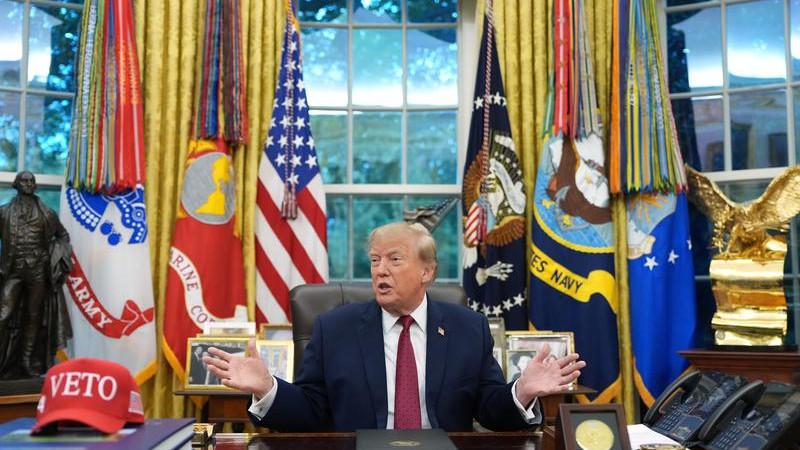
Donald Trump’s third-term ambitions have been dealt a major blow by a sweeping Democratic midterm victory, according to campaign expert Cory Alpert, who said the result amounted to a near-complete rejection of the President’s agenda.
Mr Alpert, a PhD researcher at the University of Melbourne and former Biden-Harris White House staffer, said the scale of the losses would force the Republican Party to reassess its relationship with Trump ahead of the 2028 presidential election.
Voters, he said, had punished candidates closely associated with the President, including in seats that had not been expected to become competitive.
Republicans face a reckoning over Trump
The result has left the Make America Great Again movement in a precarious position. Mr Alpert said it was not necessarily finished, but warned it marked “the beginning of the end of Trump’s time as the sole feature of Republican politics if the party wants to survive extinction”.
Republicans seeking the presidency in 2028 would need to find a way to distance themselves from Mr Trump, whom voters appeared to regard as politically toxic, he said.
That task will be complicated by Mr Trump remaining in the White House and retaining significant influence over Republican primary voters.
Mr Alpert said the midterms had also weakened the President’s repeated suggestions that he could seek a third term. The US Constitution prevents another period as president, although Mr Trump’s claims continued through the election campaign.
All seven states that were regarded as swing states in the 2024 campaign will have Democratic governors in 2028, Mr Alpert said, undermining any hopes of Republican state officials overseeing elections in those battlegrounds.
He said he did not expect Mr Trump to be impeached, arguing Democrats would be “foolish to make a martyr of him”. He added that the President could eventually resign, although he did not believe that point had been reached.
Why the Democrats made gains
Mr Alpert said the Democratic surge was primarily a rejection of Mr Trump and the Republican Party, despite voter frustration over the cost of living and the ongoing Iran war.
Support among Latino voters, Black men and younger people appeared to move back towards the Democrats after those groups had shifted towards Mr Trump in 2024.
Some Republicans were also believed to have stayed at home rather than vote for a Democratic candidate or support a MAGA-aligned contender. Independents performed strongly in some races, while traditional Democratic constituencies recorded a sharp rise in turnout.
Mr Alpert said Mr Trump might privately respect the scale of the Democratic victory, but warned that he could begin assigning blame more directly in the weeks ahead.
His ability to remove senior officials as scapegoats could be restricted, however, because a substantial Democratic majority in the Senate would make it difficult to replace Cabinet secretaries requiring Senate confirmation.
Vance and Rubio among possible successors
Vice President JD Vance and Secretary of State Marco Rubio were identified by Mr Alpert as early contenders to succeed Mr Trump, although he said virtually no Republican had emerged from the midterms with clear momentum.
The party is expected to spend the coming months examining how to retain Trump’s supporters while creating distance from a President whose political ties have now become a liability.
Mr Alpert described that as a “billion-dollar question”, saying Republicans had received a clear warning that associations with Mr Trump would be punished unless the national mood changed substantially.
The Democrats, meanwhile, face the challenge of converting their electoral gains into a durable political advantage. They secured statewide victories in Arizona, Texas and Georgia, among other states, giving the party influence in areas it had not previously expected to compete in successfully.
Mr Alpert said their priority should be affordability, warning against becoming distracted by cultural issues that voters were not currently focused on.
Maintaining that discipline in government, he said, would give Democratic candidates the strongest possible platform for the 2028 presidential election.
