


Google has unveiled WeatherNext 3, an artificial intelligence weather model it says can deliver more accurate, detailed and frequent forecasts than both rival AI systems and established government forecasting tools.
Developed by scientists at Google DeepMind and Google Research, the model is expected to feed weather information shown through Google Search, Google Maps and Gemini. It will also be made available to users and researchers through Google’s cloud platforms.
WeatherNext 3 was ranked the most accurate model in tests carried out using Operational WeatherBench, a comparison platform developed by the weather technology company Brightband. The assessment examined measures including temperature, wind speed and humidity.
Google said the system outperformed AI models from Microsoft, Nvidia, Google and the European Centre for Medium-Range Weather Forecasts, as well as traditional forecasts produced by the US National Weather Service and the ECMWF.
WeatherNext 3 delivers more detailed forecasts
Conventional forecasting relies on government supercomputers running complex mathematical simulations of the atmosphere. Although highly capable, those systems are costly and can take considerable time to produce results.
Machine-learning researchers began developing alternative approaches after the ECMWF released more than 50 years of weather data in 2018. These models learn patterns from historical observations and can generate forecasts much more quickly than physics-based systems.
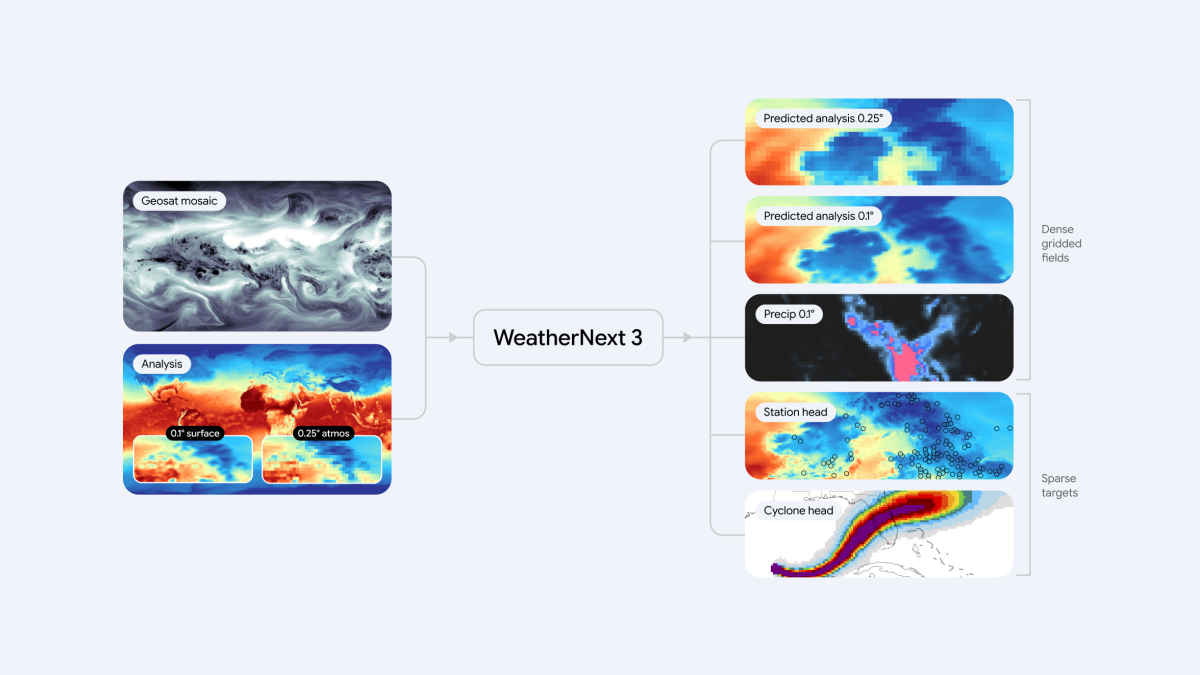
WeatherNext 3 is designed to address several persistent weaknesses in AI forecasting. Google researchers said it can provide predictions at a resolution of 5km for key variables, compared with the broader areas covered by many existing systems.
Its performance in rainfall forecasting has improved by 60 per cent compared with WeatherNext 2, while forecasts can now be generated hourly rather than at six-hour intervals. The model is also trained to predict conditions recorded at individual weather stations, allowing its results to be checked against specific, real-world measurements.
“The idea, with a lot of AI applications, is to try to run tasks as end-to-end as possible,” Daniel Rothenberg, an atmospheric scientist at Brightband, said. He described the ability to predict what a particular station, such as one at Denver airport, would record each hour as a way of bringing the forecasting process closer to the point of measurement.
The model is 2.4 times larger than its predecessor and can process weather satellite observations collected in real time each hour. Google said it was the first high-resolution global AI forecasting model to incorporate raw observations directly, although the weather company WindBorne has said its WeatherMesh 6 system has been using observations from weather balloons and other sources since late 2025.
Both systems continue to rely on national weather datasets, meaning fully direct data assimilation remains a longer-term challenge. Google said its forecasts operate at a higher resolution across the globe.
Ferran Alet, a staff research scientist manager at DeepMind, said machine learning was suited to the difficulty of modelling a chaotic atmosphere from incomplete information and limited computing resources.
The technology could have applications beyond everyday forecasts. More precise predictions of wind, rainfall and cloud cover may help renewable energy projects operate more reliably, while improved weather information could support farming and other climate-sensitive work in regions without access to expensive supercomputers and sensor networks.
